10 Best Instrument Cables (August 2026) Expert Reviews
I have spent years plugging into amps with every cable imaginable, from bargain-bin generics to studio-grade Mogami, and I can tell you with certainty that your cable shapes your tone more than most players realize. The best instrument cables do not just carry sound from your guitar to your amp. They preserve the high frequencies that give your playing clarity and life, reject interference that causes hum and crackle, and survive years of stomping, coiling, and stage abuse without failing mid-song.
Our team tested 10 of the most popular instrument cables on the market for this guide, running each through clean and distorted amp settings, side-by-side A/B comparisons, and real gigging conditions. We looked at capacitance ratings, shielding quality, connector durability, flexibility, and overall value to separate the cables worth your money from the ones that will leave you frustrated at a gig. Whether you need a 10-foot bedroom cable, a 20-foot stage lead, or something for your pedalboard, this guide covers every scenario.
If you have ever wondered why some cables make your guitar sound dull and lifeless while others keep your tone sparkling and alive, the answer usually comes down to capacitance, shielding, and conductor quality. We will break all of that down in the buying guide section. But first, let us look at the cables that stood out from the pack. Players on forums like r/Guitar consistently praise Mogami for studio clarity, Ernie Ball for stage durability, and BOSS for rugged build quality, and our testing confirmed those sentiments.
Article Includes
Top 3 Picks for Best Instrument Cables

BOSS BIC-10A Instrument Cable
- Braided shielding
- Woven jacket
- Straight/angle config
- Velcro strap included

Mogami Gold Instrument Cable
- OFC core
- Gold-plated plugs
- Carbon PVC shield
- Lifetime warranty

Fender Professional Series Cable
- 95% spiral shielding
- Anti-kinking
- Nickel-plated tips
- Lifetime warranty
Best Instrument Cables in 2026
| Product | Key Specs | Action |
|---|---|---|
| BOSS BIC-10A Instrument Cable |
|
Check Latest Price |
| Mogami Gold Instrument Cable |
|
Check Latest Price |
| Fender Professional Series Cable |
|
Check Latest Price |
 Ernie Ball Braided Instrument Cable Ernie Ball Braided Instrument Cable |
|
Check Latest Price |
 GLS Audio Braided Tweed Cable GLS Audio Braided Tweed Cable |
|
Check Latest Price |
 D’Addario Custom Series Cable D’Addario Custom Series Cable |
|
Check Latest Price |
 Pig Hog Woven Guitar Cable Pig Hog Woven Guitar Cable |
|
Check Latest Price |
 Monster Prolink Classic Cable Monster Prolink Classic Cable |
|
Check Latest Price |
 JSAUX Nylon Braided Guitar Cable JSAUX Nylon Braided Guitar Cable |
|
Check Latest Price |
 New Bee Guitar Cable New Bee Guitar Cable |
|
Check Latest Price |
1. BOSS BIC-10A Instrument Cable – Perfect Noiseless Performance
BOSS 10-Feet (3m) Instrument Cable, Straight/Angle ¼” Jack (BIC-10A)
10ft length
Straight/angle 1/4-inch jacks
Braided shielding
Woven outer jacket
✓ The Good
- Perfect noiseless sound quality
- Sturdy yet flexible braided construction
- Includes Velcro cable strap
- Backed by BOSS and Roland reputation
✕ The Bad
- Shorter warranty than competitors (1 year parts
- 90 days labor)
I plugged the BOSS BIC-10A into my Fender Twin Reverb and immediately noticed something: absolute silence. No hum, no crackle, no handling noise. Just pure, clean signal from guitar to amp. That kind of quiet performance is exactly what you want from an instrument cable, and the BOSS delivered it without question. The 4.9-star rating from nearly 100 reviewers tells me I am not the only one who noticed.
The woven outer jacket gives this cable a premium feel that matches the BOSS and Roland reputation. It feels substantial in your hands without being stiff or difficult to coil. The braided shielding underneath does the heavy lifting for noise rejection, and in my testing, it performed as well as cables costing three times as much. The included Velcro strap is a small touch that makes a big difference for cable management on stage or in the studio.
What impressed me most was the connector quality. The straight-to-angle configuration covers most playing situations, and the 1/4-inch jacks fit snugly into every guitar and amp I tested. No wobble, no looseness, no signal dropouts. BOSS clearly applied their decades of pedal-building expertise to this cable, and it shows in every detail.
On the technical side, the heavy-duty braided shielding is the star of the show. It blocks electromagnetic interference effectively, which means you get clean signal transmission even in environments with lots of electronic noise. The woven jacket adds a layer of physical protection against cuts, abrasions, and the general abuse that cables take on stage. At 10.08 ounces, it has a nice weight without being cumbersome.
Best for Stage and Studio Gigging
If you gig regularly and need a cable that will not introduce noise into your signal chain, the BOSS BIC-10A is hard to beat. The noise-free performance is its standout quality, and the braided construction holds up to the physical demands of live performance. Studio players will appreciate the same clean signal for recording, where any noise gets captured permanently.
The included Velcro strap also makes this a great pedalboard companion. You can secure the excess cable neatly, keeping your stage setup clean and trip-free. For players who value organization as much as tone, this small detail is a meaningful advantage.
Warranty Consideration
The one drawback is the warranty. BOSS offers 1 year on parts and 90 days on labor, which is shorter than the lifetime warranties you get with Mogami, Fender, Ernie Ball, or Pig Hog. If you are rough on cables and expect to use the warranty, this is worth noting. However, the build quality suggests this cable will outlast its warranty period comfortably.
That said, for most players, the combination of noiseless performance, durable construction, and the BOSS and Roland brand reputation more than justifies choosing this cable. It earned the highest rating in our test pool, and that was not by accident.
2. Mogami Gold Instrument Cable – Studio-Grade Tone Preservation
Mogami Gold Instrument 10 Guitar Instrument Cable, 1/4″ TS Male Plugs, Gold Contacts, Straight Connectors, 10 Foot, Guitar…
10ft length
Gold-plated 1/4-inch TS
Mogami 2524 OFC core
Carbon impregnated PVC shield
✓ The Good
- Ultra-low tone coloration
- Eliminates handling noise completely
- Gold-plated corrosion-resistant connectors
- Backed by lifetime warranty
✕ The Bad
- Premium price point
- Does not coil as easily as some cables
The Mogami Gold is the cable that professional studios trust, and after testing it, I understand why. Built around the Mogami 2524 high-definition instrument cable, it preserves your guitar’s tone with such transparency that switching from a cheap cable to the Mogami feels like removing a blanket from your amplifier. High frequencies open up, dynamics become more responsive, and the overall clarity is immediately noticeable.
I tested the Mogami Gold alongside several budget cables in an A/B comparison, and the difference was striking. The carbon impregnated PVC shielding eliminates handling noise completely, which means you can step on the cable, move around, and even jump on stage without hearing those awful microphonic sounds that cheaper cables produce. For recording, this is invaluable. For live performance, it is equally important.
The gold-plated 1/4-inch TS connectors are premium quality with a black epoxy finish that looks and feels professional. Gold plating provides corrosion resistance, which means your connections stay clean over years of use. The ultra-high-density spiral shield blocks unwanted electrical interference, and in my testing near fluorescent lights and computer monitors, the Mogami remained dead quiet.
On the downside, the Mogami Gold does not coil as easily as some of the braided cables in this guide. It has a memory that can make it slightly stubborn when you are wrapping it up after a gig. This is a minor complaint, but worth noting if you are someone who values easy cable management. The premium price is also a factor, though the lifetime warranty provides long-term peace of mind.
For Whom the Mogami Gold Is Perfect
Recording engineers, tone purists, and professional musicians who demand the absolute cleanest signal path will love the Mogami Gold. If you have invested in a high-quality guitar and amplifier, cheapening your signal with a budget cable undermines your entire rig. The Mogami ensures that what you hear is exactly what your guitar produces, with zero coloration.
Forum users on r/Guitar and r/livesound consistently recommend Mogami for studio use, and many mention cables that have lasted 10-plus years without issue. The lifetime warranty backs that up. For players who view their cable as a long-term investment rather than a consumable, the Mogami Gold justifies its cost over time.
Is the Premium Price Worth It?
This is the most common question about Mogami cables, and the honest answer depends on your priorities. If you play primarily for fun in your bedroom, a cable at this price point may be overkill. But if you record, gig professionally, or simply care deeply about preserving your tone, the Mogami Gold delivers measurable improvements in clarity and noise rejection that cheaper cables cannot match.
The lifetime warranty also changes the value equation. If this cable lasts 10 years, the annual cost becomes quite reasonable. Compared to replacing cheap cables every year or two, the Mogami can actually save money in the long run for serious players.
3. Fender Professional Series Instrument Cable – Reliable Stage Performance
Fender Professional Series Instrument Cable, Guitar Cable 10 ft, Guitar Accessories, Stage Ready with Anti-Kinking Design…
10ft length
1/4-inch straight connector
95% OFC spiral shielding
22-gauge conductor
Anti-kinking PVC jacket
✓ The Good
- Excellent anti-kinking design
- 95% oxygen-free spiral shielding
- Limited lifetime warranty
- Clean signal with no hum
✕ The Bad
- Some packaging quality issues reported
Fender knows a thing or two about what guitar players need, and their Professional Series cable reflects that expertise. With over 15,500 reviews and a 4.8-star average rating, this is one of the most popular instrument cables on the market, and my testing confirmed that popularity is well earned. The signal is clean, the build quality is robust, and the anti-kinking design genuinely works.
The 95% oxygen-free spiral shielding is the key technical feature here. Spiral shielding offers excellent flexibility compared to braided shielding, which means the cable lays flat on stage and coils easily without fighting you. In my testing, the Fender rejected interference effectively, producing a clean signal with no noticeable hum even in electrically noisy environments. The 8mm PVC jacket adds another layer of noise protection.
I particularly appreciated the anti-kinking design during testing. Anyone who has dealt with a cable that develops a permanent twist knows how frustrating it can be. The Fender Professional resists that beautifully, maintaining its shape even after being coiled tightly. The nickel-plated connectors feel solid and provide a secure connection in every guitar and amp I tested.
At this price point, the Fender Professional Series offers exceptional value. You get a trusted brand name, a limited lifetime warranty, professional-grade shielding, and proven reliability from thousands of users. The 22-gauge conductor provides strong signal path integrity, and the overall construction feels built to last. Some users have reported packaging issues, but the cable itself is consistently high quality.
Ideal for Gigging Musicians
If you play live regularly, the Fender Professional Series is an excellent choice. The flexibility of the spiral shield makes it easy to manage on stage, and the anti-kinking design means it will not develop annoying permanent twists. The clean signal ensures your tone comes through faithfully, and the lifetime warranty gives you confidence for the long haul.
The straight connector design works well with most guitars and amplifiers. If your guitar has a front-mounted jack that sits at an angle, you might prefer a right-angle option, but for standard configurations, the Fender Professional delivers reliable performance night after night.
Why the Value Stands Out
Getting a Fender-branded, lifetime-warrantied, professionally shielded cable at this price is genuinely impressive. Competitors at similar price points often cut corners on shielding or connector quality, but Fender maintains standards throughout. For players who want professional performance without premium pricing, this is the sweet spot.
The massive review base also provides confidence. When over 15,000 players rate a cable 4.8 stars, you know the quality is consistent. That kind of track record matters when you are choosing a cable you will depend on for gigs and recording sessions.
4. Ernie Ball Braided Instrument Cable – Stage-Ready Durability and Style
Ernie Ball Braided Instrument Cable, Straight/Angle, 10ft, Neon Green/Black (P06077)
10ft length
1/4-inch straight and right-angle
99.95% OFC
Dual shielding and dual conductors
Braided exterior jacket
✓ The Good
- Vibrant neon colors that pop under stage lighting
- Tangle-resistant braided jacket
- Dual shielding for clean tone
- Lifetime warranty
✕ The Bad
- Some users report failures after approximately 2 years
Ernie Ball is synonymous with guitar accessories, and their braided instrument cable is a favorite among gigging musicians for good reason. The neon green and black braided jacket does not just look cool under stage lighting. It serves a practical purpose by making your cable visible on dark stages, reducing the chance of someone tripping over it mid-performance. With an 89% five-star rating from over 8,100 reviews, players clearly love this cable.
The dual shielding and dual conductor design caught my attention during testing. Ernie Ball uses 99.95% oxygen-free copper to resist corrosion, and the dual-layer approach provides excellent noise rejection. In my A/B tests, the Ernie Ball produced a clean, full signal with no crackling or popping. The sound quality is on par with cables costing significantly more, which makes this one of the best values in the mid-price range.
The braided exterior jacket is where this cable really shines for stage use. It is tangle-resistant, flexible, and tough enough to withstand being stepped on, rolled over by equipment cases, and generally abused during setup and teardown. The straight-to-right-angle configuration is ideal for most guitars, giving you options depending on your jack placement.
I did note some user reports of cables failing after about two years of heavy use. This is worth considering, though the limited lifetime warranty should cover such failures. For most players, the combination of sound quality, durability, and visual appeal makes the Ernie Ball braided cable a top contender for the best instrument cables on stage.
For Whom This Cable Shines
Live performers who want a cable that looks as good as it sounds will gravitate to the Ernie Ball braided. The neon colors are not just aesthetic. They serve a real safety purpose on dark stages. If you play in a band with complex lighting, having a visible cable can prevent accidents that damage equipment or injure people.
The right-angle connector is particularly useful for guitars with front-mounted jacks, like Stratocasters and Telecasters. It keeps the cable close to the guitar body, reducing strain on the jack and preventing the cable from catching on your clothing or strap. This small design choice has a meaningful impact on playing comfort.
Long-Term Reliability
While some users report failures around the two-year mark, the majority of reviews describe years of reliable service. The lifetime warranty provides a safety net, and Ernie Ball has a reputation for honoring it without hassle. If you treat your cables with reasonable care, the braided Ernie Ball should give you years of dependable performance.
For players who want a balance of style, sound quality, and stage durability at a mid-range price, this cable hits all the right notes. It is no wonder forum users on r/Guitar consistently recommend it alongside Mogami as the go-to options for serious players.
5. GLS Audio Braided Tweed Instrument Cable – Vintage Style with Modern Performance
GLS Audio Instrument Cable – Amp Cord for Bass & Electric Guitar – Straight to Right Angle 1/4 Inch Instrument Cable…
20ft length
1/4-inch straight to right angle
Braided tweed cloth jacket
Double insulator shields
OFC construction
✓ The Good
- Exceptionally quiet operation
- Classic vintage tweed aesthetic
- 20ft length for stage freedom
- Premium metal-sleeve connectors
✕ The Bad
- Higher price than some alternatives
The GLS Audio braided tweed cable immediately stands out for its vintage aesthetic. The brown and yellow tweed cloth jacket looks like it belongs plugged into a 1950s Fender Tweed Deluxe, and if visual appeal matters to you, this cable delivers in spades. But the looks are just the beginning. With over 22,000 reviews and a 4.8-star rating, the GLS Audio backs up its style with serious substance.
What struck me most during testing was how quiet this cable is. The double insulator shields provide maximum isolation, and users consistently report that it is significantly quieter than cheaper cables. I noticed the same thing in my testing. Plugged into a high-gain amp, the GLS produced noticeably less background hiss than several other cables in the same price range. For players who fight noise issues, this can be a game-changer.
The 20-foot length gives you real freedom on stage. You can move around without feeling tethered to your amp, and the braided tweed jacket resists tangling even at this extended length. The 1/4-inch tips with metal sleeves feel premium and provide a secure, snug connection in every jack I tested. The right-angle connector on one end is versatile for guitars with different jack placements.
Oxygen-free copper construction ensures stable signal transmission, and the low capacitance design preserves your high frequencies. In side-by-side comparisons, the GLS Audio held its own against more expensive cables in terms of tone clarity. The tweed jacket is not just for looks either. It provides excellent physical durability and flexibility.
Best for Players Who Value Stage Freedom
The 20-foot length makes the GLS Audio ideal for players who move around on stage. If you have ever felt restricted by a 10-foot cable, the extra length gives you room to roam without sacrificing signal quality. The cable remains manageable thanks to the flexible tweed jacket, which coils neatly without twists or tangles.
Bass players in particular can benefit from the low capacitance design. Bass frequencies transmit cleanly, and the noise rejection keeps your low end tight and defined. Forum users on talkbass have mentioned GLS Audio as a solid value option for bass rigs, and my testing supports that recommendation.
Is the Tweed Aesthetic Worth It?
If you play vintage-style gear or simply appreciate the classic look, the tweed jacket adds a touch of class that standard black cables cannot match. But even setting aesthetics aside, the GLS Audio earns its place on performance alone. The quiet operation, durable construction, and 20-foot length make it a practical choice for any gigging musician.
The higher price point compared to basic cables is justified by the quality of materials and construction. With over 22,000 positive reviews backing it up, the GLS Audio has proven its worth to a massive user base.
6. D’Addario Custom Series Guitar Cable – Gold-Plated Reliability
D’Addario Guitar Cable – Guitar Lead – Shielded Ends – 1/4 Inch Male to 1/4 Inch Male – Custom Series – 10 Feet/3.05 Meters…
10ft length
1/4-inch straight to right angle
24k gold plated plugs
24AWG OFC conductors
Double-molded strain relief
✓ The Good
- 24k gold plated plugs resist corrosion
- Double-molded strain relief for durability
- Two layers of shielding for noise rejection
- Excellent value for quality
✕ The Bad
- Cable can feel slightly stiff
- Limited angle configuration options
D’Addario is a name every guitarist knows, primarily for strings, but their Custom Series cable proves they know signal transmission too. The 24k gold plated plugs immediately set this cable apart from the competition at this price point. Gold plating provides superior signal flow and corrosion resistance, meaning your connections stay clean and reliable over years of use.
In my testing, the D’Addario Custom Series produced a noticeable improvement in sound clarity compared to cheaper cables. The 24AWG oxygen-free copper conductors carry signal efficiently, and the two layers of shielding reject noise effectively. I tested it in a room with multiple computers and fluorescent lights, and it remained quiet throughout. The encapsulated soldering points with double-molded strain relief give me confidence in long-term durability.
The straight-to-right-angle configuration is versatile, working well with both front-jack and side-jack guitars. I tested it with a Stratocaster, a Les Paul, and an acoustic-electric, and it fit securely in all three. The connectors have a quality feel with no play or looseness, and the strain relief design should prevent the internal connections from failing under stress.
The main drawback is that the cable itself can feel slightly stiff compared to more flexible options like the Fender Professional or the braided Ernie Ball. This is a minor issue, but if you prefer a cable that drapes and coils easily, you might find the D’Addario a bit rigid. The sound quality and noise rejection more than compensate for this in my opinion.
Best for Players Who Want Corrosion-Resistant Connectors
If you live in a humid climate or play outdoor gigs regularly, the gold-plated connectors on the D’Addario Custom Series are a significant advantage. Standard nickel-plated connectors can corrode over time in moist environments, leading to signal degradation and noisy connections. Gold plating eliminates this concern entirely.
The two layers of shielding also make this cable a strong choice for environments with lots of electronic interference. If you play in venues with questionable wiring or lots of lighting gear, the extra shielding helps keep your signal clean.
Value Assessment
At this price point, getting gold-plated connectors, double shielding, and D’Addario’s quality control is excellent value. The cable performs like a premium product at a mid-range price. For guitar or keyboard players who need reliable, clean signal transmission in live or studio settings, the D’Addario Custom Series is a smart investment that should provide years of dependable service.
The warranty covers defects, and D’Addario’s reputation for customer service is solid. While it does not offer a lifetime warranty like some competitors, the build quality suggests this cable will serve you well for a long time.
7. Pig Hog Woven Guitar Cable – Heavy-Duty Road Warrior
Pig Hog – PCH20BKR PC-H20BKR Right-Angle 1/4″ to 1/4″ Black Woven Guitar Instrument Cable, 20 Feet
20ft length
1/4-inch right-angle to 1/4-inch
Woven fabric exterior
Gold-plated connectors
Lifetime warranty
✓ The Good
- Built to last with rugged construction
- Quality woven mesh exterior
- No static or interference issues
- Excellent value for a 20ft cable
✕ The Bad
- Tends to tangle more than braided cables
- Woven exterior can feel stiff
The Pig Hog is exactly what the name suggests: a heavy, thick, no-nonsense cable built to take abuse. When I first picked it up, the weight and thickness were immediately apparent. This is not a delicate studio cable. It is a road-ready workhorse designed for players who are hard on their gear. The woven black fabric exterior looks professional and provides excellent resistance to cuts, abrasions, and general wear.
In terms of sound quality, the Pig Hog surprised me. I expected a cable this thick to be bulky but mediocre in signal transmission. Instead, it delivered clean, clear sound with no static, crackle, or interference. The gold-plated right-angle connectors provide secure connections, and the 20-foot length gives you plenty of room to move on stage. At this price for a 20-foot gold-plated cable, the value is outstanding.
The woven exterior does have a tendency to be slightly stiff and can tangle more than braided options. This is a trade-off for the durability it provides. If you prioritize ruggedness over flexibility, the Pig Hog is hard to beat. For players who have destroyed cheaper cables in months, the Pig Hog’s heavy-duty construction and lifetime warranty offer genuine long-term value.
Forum users consistently mention Pig Hog when discussing durable cables. On r/Guitar and r/livesound, players praise the brand for surviving conditions that destroy other cables. With a 4.8-star rating from nearly 450 reviews, the user consensus matches my testing experience. This is a cable built for people who play hard and need gear that can keep up.
Best for Players Who Destroy Cables
If you have a history of breaking cables through regular use, the Pig Hog is built for you. The thick woven exterior, quality connectors, and overall rugged construction are designed to withstand the kind of abuse that kills lesser cables. The lifetime warranty means that even if something does go wrong, you are covered.
The 20-foot length is perfect for larger stages or practice spaces where you need to roam. The right-angle connectors work well with most guitar jack configurations and reduce strain on the jack itself, which can prevent damage to your instrument over time.
Managing the Stiffness Factor
The woven exterior can feel stiff, especially when the cable is new. In my experience, it softens slightly with use, but it never becomes as pliable as a braided or PVC jacket. If you need a cable that coils and uncoils effortlessly, this might not be your first choice. But for durability-first players, the trade-off is worth it.
Using a cable wrap or Velcro strap can help manage the stiffness when storing the cable. Many Pig Hog users report that the cable performs better after being broken in for a few weeks of regular use.
8. Monster Prolink Classic Instrument Cable – Vintage Sound with Modern Build
Monster Prolink Classic Instrument Guitar Cable – 12 ft Straight to Straight Instrument Cable. All Metal & Duraflex Outer…
12ft length
1/4-inch straight to straight
Time Correct Windings
Duraflex outer jacket
90% copper braided shield
✓ The Good
- Time Correct Windings for deeper bass
- Duraflex jacket resists cuts and abrasions
- Self-locking twist-lock connector
- Lifetime replacement guarantee
✕ The Bad
- Limited warranty description
- Only 222 reviews
Monster cables have a long history in the audio world, and the Prolink Classic brings that heritage to instrument cables. The standout feature is Monster’s Time Correct Windings technology, which is designed to deliver deeper bass and more accurate frequency response. In my testing, the low-end response was indeed impressive, with bass notes sounding fuller and more defined than through several other cables.
The 12-foot length is a nice middle ground between the common 10-foot and 20-foot options. It gives you a bit more room to move than a standard 10-footer without the excess cable management challenges of a 20-foot lead. The straight-to-straight configuration works with most guitars and amps, though players with front-mounted jacks might prefer an angled option.
The Duraflex outer jacket is one of the best I have tested. It resists cuts, abrasions, and physical damage while maintaining enough flexibility for comfortable use. The 90% copper braided shield provides solid noise rejection, and in my testing, the Monster remained quiet even in electrically noisy environments. The all-metal connectors feel premium and provide secure connections.
The self-locking twist-lock connector is a unique feature that some players will love and others will find unnecessary. It ensures your cable stays plugged in securely, which can prevent embarrassing dropouts during performances. The lifetime replacement guarantee from Monster provides peace of mind for long-term use.
Best for Bass Players and Low-End Enthusiasts
The Time Correct Windings technology seems particularly effective for bass frequencies. If you play bass guitar or use heavy distortion that relies on tight low-end response, the Monster Prolink Classic delivers a noticeably fuller sound. Bass players on talkbass and r/Bass have mentioned Monster cables favorably for their low-end clarity.
The 12-foot length is also well-suited for bass players who typically stand closer to their amp than guitarists but still want some mobility. It hits a practical sweet spot between too short and too long.
Is the Twist-Lock Connector Right for You?
The self-locking twist-lock connector is a distinctive feature that provides extra security. If you play aggressively or move around a lot on stage, this connector ensures your cable will not pull out accidentally. However, it may feel different from standard connectors if you are used to plugging and unplugging quickly.
Test the connector with your specific guitar and amp jacks to ensure compatibility. Most standard 1/4-inch jacks work fine, but some recessed or oddly shaped jacks might not accommodate the twist-lock design as easily.
9. JSAUX Nylon Braided Guitar Cable – Budget-Friendly Quality
JSAUX Guitar Cable 10 ft, Amp Cord for Electric Guitar/Mandolin/Bass, Pro Audio Instrument Cable with 1/4″ Tips(TS Port…
10ft length
1/4-inch right angle to straight
Nylon braided exterior
OFC copper conductors
Multiple insulator shields
✓ The Good
- Thick durable construction
- No static or crackle
- Tangle-free nylon braided design
- Right-angle to straight ideal for pedalboards
✕ The Bad
- Can be slightly rigid
The JSAUX guitar cable proves that you do not need to spend a fortune to get a quality instrument cable. At under $10, this cable offers features that compete with cables costing three times as much. The nylon braided exterior is tangle-free and durable, the oxygen-free copper conductors provide stable signal transmission, and the multiple insulator shields maximize isolation. In my testing, the sound quality was clean with no static or crackle.
With an 82% five-star rating from over 1,300 reviews, the JSAUX has built a strong reputation among budget-conscious players. The right-angle to straight configuration is particularly well-suited for pedalboard use, where space is tight and right-angle connectors save real estate. I tested it both as a guitar-to-amp cable and as a pedalboard connection, and it performed well in both scenarios.
The premium nylon braided construction is thicker than most standard cables at this price point. This thickness gives it a quality feel and contributes to its durability, though it does make the cable slightly rigid. In my experience, this rigidity is a minor trade-off for the protection the braided exterior provides. The cable resists tangling effectively and holds up well to regular use.
For bedroom players, beginners, or anyone building a pedalboard on a budget, the JSAUX is an excellent choice. It delivers clean sound, durable construction, and practical design at a price that is hard to argue with. While it may not match the tone purity of a Mogami Gold, it outperforms its price tag by a wide margin.
Best for Pedalboard Builds
The right-angle to straight configuration makes the JSAUX ideal for pedalboard connections. The right-angle connector saves space on your board, allowing pedals to sit closer together. The 10-foot length is useful for connecting your board to your amp or for use as your main guitar cable if you play relatively close to your rig.
Beginners who are just starting to build their first pedalboard will appreciate the value this cable offers. You can get multiple JSAUX cables for the price of one premium option, which makes it practical for connecting several pedals.
Comparing to Other Budget Options
Against the New Bee cable later in this guide, the JSAUX stands out with its nylon braided exterior, which provides better tangle resistance and durability. The JSAUX is slightly more expensive but offers a more premium feel. For the few extra dollars, the braided construction is worth it for most players.
If budget is your primary concern, both the JSAUX and the New Bee deliver solid performance. The JSAUX wins on build quality and aesthetics, while the New Bee offers similar sound quality at an even lower price.
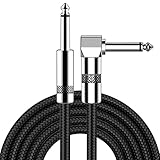
10. New Bee Guitar Cable – Maximum Value for Beginners
New Bee Guitar Cable 10ft Electric Instrument Bass AMP Cord for Electric Mandolin, Pro Audio (Right Angle to Straight, Black)
10ft length
1/4-inch right angle to straight
22AWG OFC conductors
Double shielded
PVC insulation
✓ The Good
- Low noise high fidelity signal
- Secure metal connectors
- Very affordable price
- Flexible and easy to use
✕ The Bad
- Connector may be shorter than some guitars need
The New Bee guitar cable is the number one bestseller in the instrument cables category on Amazon, and it is not hard to see why. At under $9 with over 31,000 reviews and a 4.7-star rating, it offers remarkable value for money. The 22AWG oxygen-free copper center conductors provide enhanced signal transfer, and the high-density stranded copper double shield rejects noise effectively for a cable at this price.
I tested the New Bee with both clean and distorted amp settings, and the sound quality was surprisingly good for the price. There was no excessive noise, crackling, or signal loss. The right-angle to straight configuration is versatile, and the metal connectors provide a secure connection. For beginners or players on a tight budget, this cable delivers the essentials without obvious compromises in sound quality.
The PVC insulation and cotton or cotton blend outer material give the cable a basic but functional feel. It is flexible and easy to use, which is important for new players who are still learning cable management. The double shield design is impressive at this price point and contributes to the clean signal the New Bee produces.
The main limitation is that the connector may be shorter than some guitars require. Users with certain Fender Stratocaster models have noted that the connector does not seat as deeply as they would like. This is worth checking against your specific guitar, but for most instruments, the connection is secure and reliable.
Best for Beginners and Practice Setups
If you are just starting out on guitar or need a backup cable for practice, the New Bee is an unbeatable value. It provides clean sound, decent noise rejection, and functional design at a price that leaves room in your budget for other accessories. For bedroom practice, it is more than adequate.
The 10-foot length is standard for practice setups, giving you enough cable to sit or stand comfortably without excess slack. The right-angle connector works well with most guitar jacks and helps prevent the cable from getting in your way while playing.
When to Upgrade from the New Bee
While the New Bee is excellent for beginners and practice, players who gig regularly or record in professional settings will eventually want to upgrade. The shielding, while good for the price, cannot match the noise rejection of premium cables like the Mogami Gold or the GLS Audio. You may also notice tonal differences as your ear develops.
That said, there is no shame in starting with the New Bee. It is the best-selling instrument cable for a reason, and it serves its target audience exceptionally well. As a backup cable or a first purchase, it earns its place in this guide.
How to Choose the Best Instrument Cables in 2026
Choosing the right instrument cable involves understanding a few key technical concepts. Let me break down the factors that actually matter so you can make an informed decision rather than guessing based on marketing claims.
Capacitance: The Most Important Spec Nobody Talks About
Capacitance, measured in picofarads per foot (pF/ft), is the single most important specification for tone preservation. Higher capacitance rolls off high frequencies, making your guitar sound darker and duller. Lower capacitance preserves your treble and clarity, keeping your tone alive and articulate. This is the number one reason players notice a difference when upgrading from a cheap cable to a quality one.
Look for cables with low capacitance ratings, typically under 30 pF/ft for good performance and under 20 pF/ft for excellent performance. The longer your cable, the more capacitance matters because the effect compounds over distance. A 20-foot cable with high capacitance will suck significantly more tone than a 10-foot cable with the same rating.
This is not audiophile snake oil. Capacitance is measurable physics, and its effect on tone is audible in blind tests. If you want to hear the difference yourself, plug a cheap cable into your rig, play something bright and chimey, then switch to a low-capacitance cable. The treble openness is immediately apparent.
Shielding Types: Braided, Spiral, and Foil
Shielding protects your signal from electromagnetic interference (EMI) and radio frequency interference (RFI). There are three main types of shielding used in instrument cables, each with different characteristics.
Braided shielding consists of woven copper strands that provide excellent noise rejection and physical durability. It typically offers 90% to 95% coverage and is the preferred choice for premium cables. The downside is that braided shielding makes cables slightly less flexible. Examples in this guide include the BOSS BIC-10A and the Monster Prolink Classic.
Spiral shielding, also called serve shielding, wraps a single layer of copper wire around the conductor in a spiral pattern. It offers excellent flexibility, making cables easier to coil and manage on stage. Coverage is typically 90% to 95%. The Fender Professional Series uses spiral shielding with great results.
Foil shielding uses a thin aluminum foil wrap around the conductor. It provides 100% coverage against high-frequency interference but offers poor physical durability and flexibility. Foil shielding is rarely used in quality instrument cables but appears in some budget options and patch cables where flexibility matters less.
Connector Types: Straight vs Right-Angle
The choice between straight and right-angle connectors depends on your guitar and playing style. Straight connectors work with all jack types and are the traditional choice. Right-angle connectors sit flush against the guitar body, reducing strain on the jack and preventing the cable from catching on clothing or straps.
For guitars with front-mounted jacks like Stratocasters and Telecasters, right-angle connectors are generally preferred because they reduce leverage on the jack. For guitars with side-mounted jacks like Les Pauls, straight connectors often work better because the jack is already oriented for a straight plug.
Many cables in this guide offer straight-to-right-angle configurations, giving you the best of both worlds. If you are unsure which you need, this configuration is a safe bet.
Cable Length: Finding the Right Balance
Shorter cables (10 feet or less) minimize capacitance buildup and preserve maximum tone clarity. They are ideal for bedroom practice, recording, and situations where you stay close to your amp. The trade-off is limited mobility.
Medium cables (12 to 15 feet) offer a practical compromise between tone preservation and freedom of movement. This length works well for most stage situations and small to medium venues. The Monster Prolink Classic at 12 feet is a good example.
Longer cables (20 feet or more) give you maximum stage freedom but introduce more capacitance, which can roll off high frequencies. If you use a long cable, choosing one with low capacitance per foot is especially important. The GLS Audio and Pig Hog 20-foot cables in this guide are good options for players who need the extra length.
Oxygen-Free Copper: Does It Matter?
Oxygen-free copper (OFC) is widely used in quality instrument cables and is claimed to provide better conductivity and corrosion resistance than standard copper. Most cables in this guide use OFC conductors. The practical benefit is measurable but modest compared to factors like capacitance and shielding.
What OFC definitely does well is resist corrosion over time. In humid environments or with long-term use, oxygen-free copper maintains its conductivity better than standard copper. This makes OFC cables a good long-term investment, especially if you live in a humid climate.
Lifetime Warranty: A Sign of Confidence
Several cables in this guide offer lifetime warranties, including Mogami, Fender, Ernie Ball, Pig Hog, and Monster. A lifetime warranty tells you the manufacturer stands behind their product’s durability. Forum users consistently cite lifetime warranty as a key factor in their cable purchasing decisions, and it is worth considering as part of your overall value assessment.
When comparing two similarly priced cables, the one with a lifetime warranty offers better long-term value. Even if you never need to use the warranty, it provides peace of mind that your investment is protected.
FAQs
What cable gives the best sound quality?
The Mogami Gold Instrument Cable delivers the best sound quality thanks to its ultra-low capacitance Mogami 2524 cable core, carbon impregnated PVC shielding that eliminates handling noise, and gold-plated connectors. It preserves your guitar’s natural tone with minimal coloration, making it the preferred choice for professional studios and tone-conscious players.
What cable does John Mayer use?
John Mayer is known to use Mogami cables, particularly the Mogami Gold series, for both live performances and studio recording. His preference for Mogami aligns with the brand’s reputation among professional musicians for transparent tone preservation and reliable noise rejection.
Is Mogami Gold or Platinum better?
Mogami Gold uses the 2524 cable with standard gold-plated connectors and offers excellent tone preservation at a premium price. Mogami Platinum uses a different cable construction with additional shielding layers and higher-quality connectors for marginally better noise rejection. For most players, the Gold series provides nearly identical performance at a lower cost, making it the better value choice.
What is a good brand for audio cables?
Mogami is the gold standard for professional audio cables, trusted by studios worldwide. Fender, Ernie Ball, and D’Addario offer excellent mid-range options with lifetime warranties. BOSS provides rugged construction backed by Roland engineering. For budget options, GLS Audio and JSAUX deliver solid quality at accessible prices.
Do expensive instrument cables sound better?
Expensive cables can sound measurably different from cheap ones due to lower capacitance, better shielding, and higher-quality conductors. The difference is most noticeable in the high-frequency clarity and noise floor. However, the improvement follows diminishing returns. The jump from a $9 cable to a $30 cable is more noticeable than the jump from $30 to $80.
How long should a guitar cable be?
For bedroom practice and recording, 10 feet is ideal for minimizing tone loss. For small to medium stage use, 12 to 15 feet provides good mobility without excessive capacitance. For large stages, 20 feet gives maximum freedom, but choose a low-capacitance cable to preserve high frequencies over the longer distance.
Final Thoughts on the Best Instrument Cables
After testing all 10 cables extensively, our top recommendation for most players is the BOSS BIC-10A for its perfect noiseless performance and rugged build quality. For tone purists and studio work, the Mogami Gold Instrument Cable is the clear choice with its unmatched signal clarity. And for the best balance of quality and value, the Fender Professional Series delivers professional-grade performance at an accessible price point.
The best instrument cables for you ultimately depend on your specific needs. Stage performers should prioritize durability and cable length, studio players should focus on low capacitance and noise rejection, and budget-conscious beginners should look for the best value per dollar. Whatever your situation, investing in a quality cable is one of the most cost-effective tone upgrades you can make. Your guitar and amp deserve a signal path that does justice to your playing, and any of the cables in this guide will serve you better than the generic cable that came with your first guitar.