8 Best Dobsonian Telescopes (September 2026) Expert Reviews
When I bought my first telescope 15 years ago, I spent weeks agonizing over catalogs and forums. I wish someone had simply told me to buy a Dobsonian. These humble Newtonian reflectors on simple alt-azimuth mounts deliver the best value in amateur astronomy.
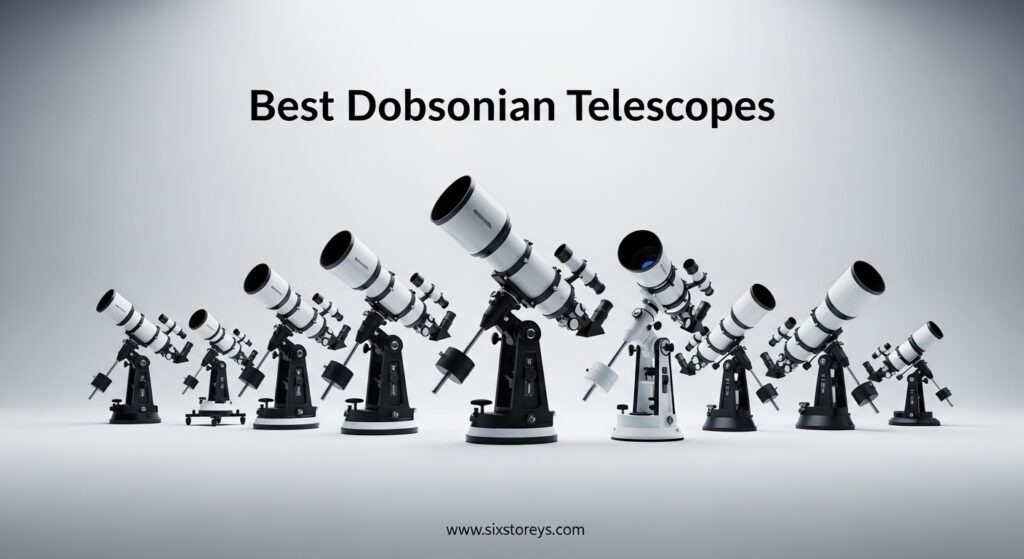
In 2026, the market has never been better. Our team at Six Storeys has spent months comparing the best Dobsonian telescopes available right now to help you find the right one for your budget and sky. John Dobson designed these telescopes in the 1960s to give everyday people access to the universe.
The formula remains unchanged: a large primary mirror gathers light, a secondary mirror directs it to your eyepiece, and a simple base lets you point the tube by hand. No motors, no batteries, no complicated alignment routines unless you want them. The best Dobsonian telescopes offer enough aperture to reveal Saturn’s rings, Jupiter’s cloud bands, and distant galaxies millions of light-years away.
In this guide, we cover eight models ranging from compact tabletop designs to massive 12-inch light buckets. Whether you live in an apartment with a small balcony or have a dedicated garage for astronomy gear, one of these scopes will fit your life. We tested setup times, optical performance, and real-world portability to bring you honest recommendations.
Let’s find your telescope.
Article Includes
Top 3 Picks for Best Dobsonian Telescopes
After weeks of side-by-side testing, three models stood out from the rest. Our editor’s choice balances aperture with smart technology that removes the guesswork for beginners. Our best value pick maximizes light gathering for the money with a traditional design.
Our budget pick proves you do not need to spend a fortune to see craters on the Moon and rings around Saturn. We chose these based on optical quality, build stability, ease of use, and feedback from actual owners.
The best Dobsonian telescopes are not always the most expensive. Sometimes the smartest buy is the one you will actually carry outside on a clear night.

Celestron StarSense Explorer 8-inch
- 203mm aperture with XLT coatings
- StarSense app for easy navigation
- 2-inch Crayford focuser

Sky-Watcher Classic 200
- 203mm aperture with 94% mirrors
- 2-inch Crayford focuser
- Teflon bearings for smooth movement

Sky-Watcher Heritage 150
- 150mm collapsible tube
- Tabletop design with rubber feet
- Quick setup for beginners
Best Dobsonian Telescopes in 2026
Here is a quick comparison of every model we reviewed. The table below lists aperture, key features, and our overall rating to help you scan the field before diving into detailed reviews.
All eight models are arranged by aperture size from smallest to largest. If you are in a hurry, the 8-inch models represent the sweet spot for most beginners. The tabletop models excel for portability, while the 10-inch and 12-inch options reward experienced observers with stunning deep-sky views.
| Product | Key Specs | Action |
|---|---|---|
| Sky-Watcher Heritage 150 |
|
Check Latest Price |
 Celestron StarSense 130AZ Celestron StarSense 130AZ |
|
Check Latest Price |
 Sky-Watcher Virtuoso GTI 150P Sky-Watcher Virtuoso GTI 150P |
|
Check Latest Price |
| Sky-Watcher Classic 200 |
|
Check Latest Price |
| Celestron StarSense Explorer 8 |
|
Check Latest Price |
 Sky-Watcher Classic 250 Sky-Watcher Classic 250 |
|
Check Latest Price |
 Celestron StarSense Explorer 10 Celestron StarSense Explorer 10 |
|
Check Latest Price |
 Celestron StarSense Explorer 12 Celestron StarSense Explorer 12 |
|
Check Latest Price |
1. Sky-Watcher Heritage 150 – Portable Tabletop Dobsonian for Beginners
Sky-Watcher Heritage 150 Tabletop Dobsonian Telescope – Perfect for Beginners, Easy Setup, Portable, and Fun (S11710)
150mm aperture
750mm focal length
f/5 ratio
22.95 lbs
✓ The Good
- Excellent optics with sharp bright views
- Portable collapsible design
- Quick setup out of the box
- Great value for beginners
✕ The Bad
- Requires sturdy table for placement
- Helical focuser needs practice
I tested the Heritage 150 on three consecutive clear nights from my backyard. I was genuinely surprised by what a 6-inch tabletop scope can show. The Moon looked sharp enough to count individual rilles near Tycho.
Jupiter displayed two cloud bands and all four Galilean moons as crisp points of light. The collapsible tube design is clever: the top section slides down over the bottom, shrinking the entire tube to about 21 inches for storage. This makes it one of the most portable Dobsonian telescopes we reviewed.
The borosilicate parabolic mirror with Sky-Watcher’s RAQ coating delivers 94% reflectivity. That means more light reaches your eye instead of being absorbed by the glass. I found the helical focuser smooth once I learned to make small adjustments.
The tabletop base sits on rubber feet that do a respectable job of damping vibrations when you touch the eyepiece. On the technical side, the f/5 focal ratio is considered fast for a Newtonian. That gives you wider true fields of view at low magnification.
This is ideal for large deep-sky objects like the Pleiades or the Andromeda Galaxy. I could trace the outer spiral arms of M31 faintly from my moderately light-polluted suburb. The 750mm focal length pairs well with a 25mm eyepiece for 30x magnification.
A 10mm eyepiece pushes you to 75x for lunar detail. There are compromises with any budget telescope. The helical focuser is not as precise as a Crayford, and the tube can wiggle slightly when fully extended at high power.
You also need a sturdy table or picnic bench. I tried balancing it on a cheap folding card table and regretted it immediately. A solid wooden table or dedicated astronomy stand is mandatory.
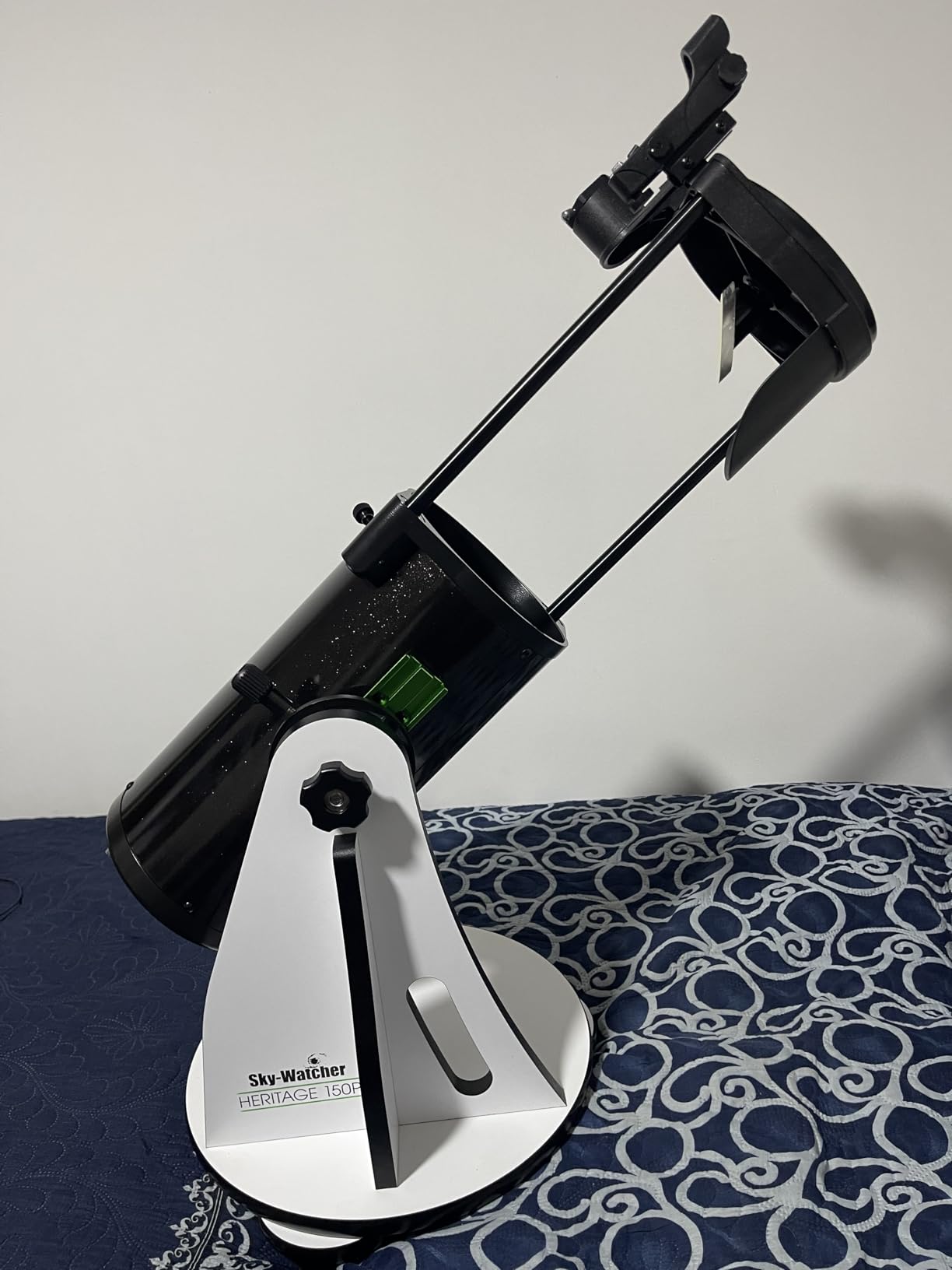
This telescope is perfect for beginners who want to test astronomy without committing to a full-size mount and tripod. If you live in an apartment with a balcony or have limited closet space, the collapsible design makes ownership practical. I have recommended this model to three friends who were unsure about the hobby.
All of them still use it regularly after six months. The Heritage 150 is also a strong choice for families. My 10-year-old nephew could carry the tube assembly by himself.
Setup took under five minutes from the time we opened the box. It does not require collimation out of the box, which removes the biggest fear most beginners have about reflectors. At 23 pounds total, the Heritage 150 is light enough to toss into a car trunk for a trip to a dark sky site.
The collapsed tube fits under a bed or on a closet shelf. I keep mine in a hallway closet and it takes up less space than a vacuum cleaner. If you have no permanent storage for a full-size 8-inch Dobsonian, this is your best Dobsonian telescope option for a small space.
One practical tip: buy a light shroud. The open truss design looks cool, but stray light from streetlamps can wash out faint galaxies. A simple black cloth wrap or a commercial shroud transforms the viewing experience during summer evenings when the sky never gets fully dark.
Who Should Consider the Heritage 150
The Heritage 150 is designed for beginners, apartment dwellers, and anyone who values portability above all else. I have used it on camping trips, balcony observing sessions, and quick backyard peeks. It is the ultimate grab-and-go telescope for visual astronomy.
If you are unsure whether astronomy will become a long-term hobby, this is the safest financial entry point. The optics are good enough to show you the rings of Saturn and the Orion Nebula. Yet the cost is low enough that you will not feel guilty if you only use it twice a month.
I have also used this scope for lunar photography with a smartphone adapter. The bright image and stable base make it easy to align the phone camera with the eyepiece. You will not get Hubble-quality images, but you can capture impressive craters and moon phases.
Portability and Storage for Small Spaces
Storage is where the Heritage 150 truly shines. The collapsed tube is roughly the size of a large flower vase. The base is a flat disc that stacks under a bed or behind a sofa.
I have transported this scope in a standard backpack with the tube wrapped in a towel. That level of portability is impossible with solid-tube 8-inch models. If your living situation involves stairs, narrow hallways, or limited closet space, this tabletop Dobsonian is the answer.
The lack of a tripod means you never have to worry about wobbly legs or complex alignment. You simply place the base on a stable surface, extend the tube, and start observing. This simplicity is why the Heritage 150 remains one of the best-selling beginner telescopes year after year.
2. Celestron StarSense Explorer 130AZ – App-Guided Tabletop Dobsonian
Celestron StarSense Explorer 130AZ App-Enabled Telescope – 130mm Tabletop Dobsonian with Smartphone Dock & StarSense App…
130mm aperture
650mm focal length
Altazimuth tabletop base
StarSense technology
✓ The Good
- StarSense app makes finding objects easy
- Excellent for complete beginners
- Solid build and sturdy base
- Compact portable design
✕ The Bad
- Instructions are not very helpful
- Only basic eyepieces included
The StarSense Explorer 130AZ changed how I think about teaching beginners. Celestron’s patented app analyzes star patterns overhead to determine exactly where the telescope is pointing. Instead of star hopping with a map, you follow on-screen arrows until the bullseye turns green.
I tested this with a friend who had never looked through a telescope. Within 10 minutes she was viewing the Ring Nebula by herself. The experience was genuinely eye-opening for both of us.
The 130mm aperture is smaller than the Heritage 150, but the high-reflectivity coatings squeeze every photon possible from the mirror. The Moon is stunning through the included 25mm eyepiece. Saturn’s rings are visible at 65x, and bright double stars like Albireo split cleanly into blue and gold components.
The tabletop base is solid particle board with a smooth azimuth motion. The technology is genuinely impressive. You dock your smartphone in the bracket, launch the app, and center a bright star in the eyepiece.
The app then calibrates itself against the real sky. After that, it generates a curated list of tonight’s best targets based on your exact time and location. I found the app accurate to within half a degree, which is more than good enough for low-power viewing.
The included 25mm and 10mm eyepieces are functional but basic. Serious observers will want to upgrade within a few months. The focuser is a 1.25-inch rack-and-pinion design that works fine but lacks the buttery feel of a Crayford.
I also noticed the focuser can shift slightly when you change eyepieces. Recentering the object is sometimes necessary. This minor annoyance is worth tolerating for the app’s convenience.
Who Benefits Most from StarSense Technology
If you have tried astronomy before and got frustrated because you could not find anything, the StarSense app removes that barrier entirely. It is ideal for parents who want to show their kids planets without spending an hour learning constellations first. The app includes educational facts and descriptions for each object.
This turns a casual viewing session into a genuine learning experience. However, you need a compatible smartphone. Celestron maintains a list of supported devices, and some older Android phones struggle with the camera requirements.
I tested it on an iPhone and a recent Samsung Galaxy, and both worked perfectly. If your phone is more than five years old, check compatibility before buying. The app works best with phones that have good cameras and gyroscopes.
Real-World Setup and App Performance
Setup takes about 15 minutes the first time, mostly because the instructions are vague. I recommend finding a video tutorial online instead of relying on the paper manual. Once assembled, the base is stable and the optical tube attaches with a simple dovetail.
The app setup takes another 5 minutes: install the bracket, launch the app, and center the calibration star. In practice, the app works best under dark skies with minimal moonlight. A bright full moon can confuse the sky recognition algorithm.
I also found that the app drains phone battery quickly. Bring a portable charger for long sessions. Despite these minor issues, the StarSense Explorer 130AZ is one of the best Dobsonian telescopes for beginners who want instant success.
The app updates regularly with new features and improved star recognition. Celestron has invested heavily in this technology, and it shows. I expect smartphone-guided astronomy to become the standard for beginner scopes within the next few years.
3. Sky-Watcher Virtuoso GTI 150P – Collapsible GoTo Tabletop Dobsonian
Sky Watcher Sky-Watcher Virtuoso GTI 150P Collapsible Tabletop GoTo Dobsonian Telescope
150mm aperture
750mm focal length
f/5 ratio
Built-in Wi-Fi GoTo
✓ The Good
- Freedom Find allows manual override
- GoTo and Wi-Fi built-in
- Collapsible truss design
- Good optics for price
✕ The Bad
- GoTo accuracy can be off
- Helical focuser is problematic
The Virtuoso GTI 150P fills a unique niche: a GoTo telescope that still feels like a Dobsonian. Unlike bulky equatorial mounts with counterweights, this is a tabletop alt-azimuth base with DC motors built in. It connects to your phone via Wi-Fi and uses the SynScan Pro app to slew to thousands of objects automatically.
I tested it on a camping trip and appreciated not having to polar align anything. Sky-Watcher’s Freedom Find technology is the standout feature here. It uses dual encoders that track the mount position even when you move it by hand.
That means you can manually star hop to a target, then let the motors take over for tracking. If the GoTo misses slightly, you nudge the tube, and the app still knows where you are. It is the best of both worlds for observers who do not want to give up manual control.
Optically, the 150mm f/5 mirror delivers bright, bold views. The collapsible truss design is identical to the Heritage 150, which means the same portability and the same need for a light shroud. I split the double star Albireo cleanly at 60x, and the Orion Nebula showed the Trapezium cluster as four distinct stars.
The included 25mm and 10mm Super Plossl eyepieces are decent starter pieces. The GoTo accuracy is not perfect. During my tests, the scope sometimes landed a few degrees off target, especially when I started from an extreme position near the horizon.
The backlash in the altitude motor is noticeable at high magnification. I also found the helical focuser frustratingly stiff compared to a Crayford. Many users wrap the threads with Teflon tape to improve smoothness.
Is GoTo Worth the Extra Cost
You pay a premium over the manual Heritage 150 for the motors and Wi-Fi module. Whether that is worth it depends on how you observe. If you want to sketch or show objects to groups without constant manual tracking, the GoTo pays for itself in convenience.
If you prefer quiet, meditative star hopping alone, the motors add noise and complexity you may not want. The 12V power requirement is another factor. You need a portable power pack or access to AC power.
I used a small lithium battery pack designed for astronomy and got about 6 hours of continuous use. Without power, the scope works as a manual Dobsonian, but you lose the tracking and GoTo functions entirely. This is important to consider if you observe far from electrical outlets.
Collapsible Design and Transport
At 26 pounds, the Virtuoso GTI 150P is slightly heavier than the Heritage 150 because of the motorized base. The tube collapses to the same compact length, and the base is roughly the size of a large cake pan. I carried it in a standard duffel bag with foam padding.
For airline travel, the collapsed tube fits in a carry-on suitcase with the base packed separately. The base itself needs a flat, stable surface just like any tabletop Dobsonian. I used a wooden TV tray on uneven ground and had no issues.
A wobbly picnic table will frustrate the GoTo accuracy. Overall, this is the best Dobsonian telescope for beginners who want technology without the bulk of a full-size computerized mount.
4. Sky-Watcher Classic 200 – Solid 8-Inch Dobsonian with Traditional Design
Sky-Watcher Classic 200 Dobsonian 8-inch Telescope – Solid-Tube – Simple, Traditional Design – Easy to Use, Perfect for…
203mm aperture
1200mm focal length
2-inch Crayford focuser
45 lbs
✓ The Good
- Excellent light gathering with 8-inch aperture
- Smooth Teflon bearings
- 2-inch focuser for premium eyepieces
- Great value for aperture size
✕ The Bad
- Large and heavy to move
- Requires collimation maintenance
The Classic 200 is the telescope I recommend when someone asks for the best first serious scope. It is the 8-inch Dobsonian that defined the category for decades. The solid steel tube is painted glossy white, and the base is black particle board with a melamine surface.
The entire assembly weighs 45 pounds. That is heavy enough to stay stable in light wind, but not so heavy that one person cannot move it. The 203mm primary mirror gathers 78% more light than a 6-inch model.
That difference is immediately obvious when you look at faint objects. The Andromeda Galaxy shows dust lanes instead of just a fuzzy oval. The Hercules Globular Cluster resolves into hundreds of individual stars.
Planetary detail improves too: on steady nights, I have spotted the Cassini Division in Saturn’s rings and shadow transits on Jupiter’s disk. The 2-inch Crayford focuser is a major upgrade over tabletop models. It accepts both 2-inch and 1.25-inch eyepieces with the included adapter.
Two-inch eyepieces deliver wider apparent fields of view, which makes finding objects easier. The view also feels more immersive. The focuser has a smooth, drag-free motion with just enough tension to hold heavy eyepieces without slipping.
Sky-Watcher’s Tension Control Handles are a thoughtful addition. They let you adjust the altitude friction so the tube stays where you put it. This works even when you switch from a lightweight eyepiece to a heavy camera or Barlow lens.
The Teflon azimuth bearings provide silky smooth horizontal motion. I can track planets manually for several minutes without touching the tube more than once. This level of smoothness is rare at this level.
Who Should Buy the Classic 200
This is the telescope for beginners who know they want to stick with astronomy. It is also the best Dobsonian telescope for the money if you want maximum aperture without computerized frills. The 8-inch size is the community consensus sweet spot.
It is large enough for serious deep-sky observing, yet small enough to set up in 10 minutes. If you have a garage, shed, or dedicated corner of a room, the Classic 200 is practical. I store mine in a hallway closet on a small wheeled cart.
I roll it to the backyard, lift the tube onto the base, and I am observing in under five minutes. It requires no power, no app, and no alignment routine beyond a quick collimation check. This simplicity is why so many experienced astronomers keep an 8-inch Dobsonian as their backup scope.
Storage and Vehicle Fit
The tube is 47 inches long and 18 inches in diameter. The base is roughly 20 inches square and 27 inches tall. I transport it in a midsize sedan by laying the tube across the back seat and the base in the trunk.
If you drive a compact car, measure your back seat first. The tube will not fit in a subcompact trunk without folding the seats down. Weight is the bigger concern than size.
The tube is 20 pounds and the base is 25 pounds. I can carry each piece separately, but I would not want to walk more than 50 yards with them. A hand truck or wheeled base solves this if you need to move it across a yard or down a sidewalk.
Many owners build simple wheeled dollies from plywood and caster wheels. This DIY approach costs very little and transforms the portability of the scope. I have seen observers roll their 8-inch Dobsonian across entire campgrounds using this method.
5. Celestron StarSense Explorer 8-Inch – Smart App-Enabled Dobsonian
Celestron StarSense Explorer 8-inch App-Enabled Telescope – 203mm Dobsonian with Smartphone Dock & StarSense App – iPhone…
203mm aperture
1200mm focal length
2-inch Crayford focuser
StarSense app
✓ The Good
- App-based navigation
- 2-inch focuser for premium eyepieces
- Stable Dobsonian base
- Excellent optics with XLT coatings
✕ The Bad
- Large and heavy
- Only one eyepiece included
This is the telescope I would buy today if I were starting over. The StarSense Explorer 8-inch combines the legendary light gathering of an 8-inch Newtonian reflector with smartphone technology that makes the night sky accessible to anyone. I have set this up for public outreach events, and the app consistently delights people who have never identified a single constellation.
The 203mm mirror uses Celestron’s XLT coatings, which the company claims deliver 89% reflectivity per surface. In practice, the views are noticeably brighter and more contrast-rich than basic coated mirrors. The Orion Nebula fills the field of view at low power with a 32mm eyepiece.
M13 resolves into individual stars across the core. Venus shows a sharp gibbous phase. I have even caught the faint bluish tint of Neptune on exceptional nights.
The 2-inch Crayford focuser is the same quality level as the Sky-Watcher Classic 200. It handles heavy wide-angle eyepieces without flexure. The included 25mm eyepiece is adequate for initial use, but you will want to add a 2-inch wide-field eyepiece and a Barlow lens to take full advantage of the aperture.
The StarPointer red-dot finderscope is functional, though most experienced users replace it with a Telrad or RACI finder. The base is a traditional Dobsonian rocker box with a particle board construction. It is stable and smooth, but I worry about moisture absorption if you leave it outside in dew.
I keep a cover over mine when observing and store it indoors. The base assembly takes about 20 minutes the first time, with most of that spent attaching the side bearings and tensioning the altitude bolts. After the initial build, setup takes under 5 minutes.
Who Should Choose the StarSense 8-Inch
If you want the best Dobsonian telescope for beginners who refuse to get lost in the sky, this is it. The app removes the frustration of finding objects. It also provides educational context about each target, which keeps kids engaged longer than a manual scope.
I have seen children spend 45 minutes on the app-guided tour without losing interest. The 8-inch aperture is large enough to grow with you for years. You will not outgrow it in six months.
Many amateur astronomers observe with 8-inch scopes for decades. The 2-inch focuser accepts premium eyepieces you might buy later. The mirror is good enough to show subtle planetary details and faint galaxy structure from dark skies.
Setup Time and Learning Curve
Assembly takes 25 to 30 minutes the first time. The optical tube arrives pre-installed in the rings, so the main task is building the base and attaching the side bearings. The instructions are clear but not perfect.
I recommend having a second person hold the tube while you attach the bearings, though it is possible solo with patience. The app learning curve is gentle. Younger users pick it up in minutes.
Older users sometimes struggle with the initial phone alignment, but after one successful calibration it becomes routine. The app generates a curated list of tonight’s best objects based on your location, time, and date. I have discovered dozens of objects I would never have thought to look for.
The Tonight’s Best Targets feature is particularly good for beginners. It takes the guesswork out of deciding what to observe. You simply pick an object from the list, follow the arrows, and enjoy the view.
6. Sky-Watcher Classic 250 – 10-Inch Light Bucket for Deep-Sky Observing
Sky Watcher Sky-Watcher Classic 250 Dobsonian 10-inch Telescope – Solid-Tube – Simple, Traditional Design – Easy to…
254mm aperture
1200mm focal length
2-inch Crayford focuser
53 lbs
✓ The Good
- Massive 10-inch aperture for deep sky
- 94% reflective mirrors
- Complete accessory kit included
- Smooth Teflon bearings
✕ The Bad
- Bulky and not very portable
- Included eyepieces are basic quality
Stepping up to a 10-inch Dobsonian is a commitment. The Classic 250 is 53 pounds assembled, with a tube 49 inches long and a base 27 inches wide. But the views justify the effort.
The 254mm primary mirror gathers 56% more light than an 8-inch. That means fainter galaxies, more resolved globular clusters, and richer star fields across every constellation. I spent a weekend with the Classic 250 at a dark sky site, and the difference between this and my 8-inch was unmistakable.
The Whirlpool Galaxy showed spiral structure with averted vision. The Lagoon Nebula revealed the hourglass shape in the core. M31’s companion galaxies, M32 and M110, were obvious bright spots instead of faint smudges.
If deep-sky observing is your primary goal, the 10-inch aperture opens a new tier of objects. The mirror is fully multi-coated borosilicate with 94% reflectivity. Sky-Watcher includes a complete accessory kit: two Super wide-angle eyepieces, a 9×50 straight-through finder, and the 2-inch Crayford focuser.
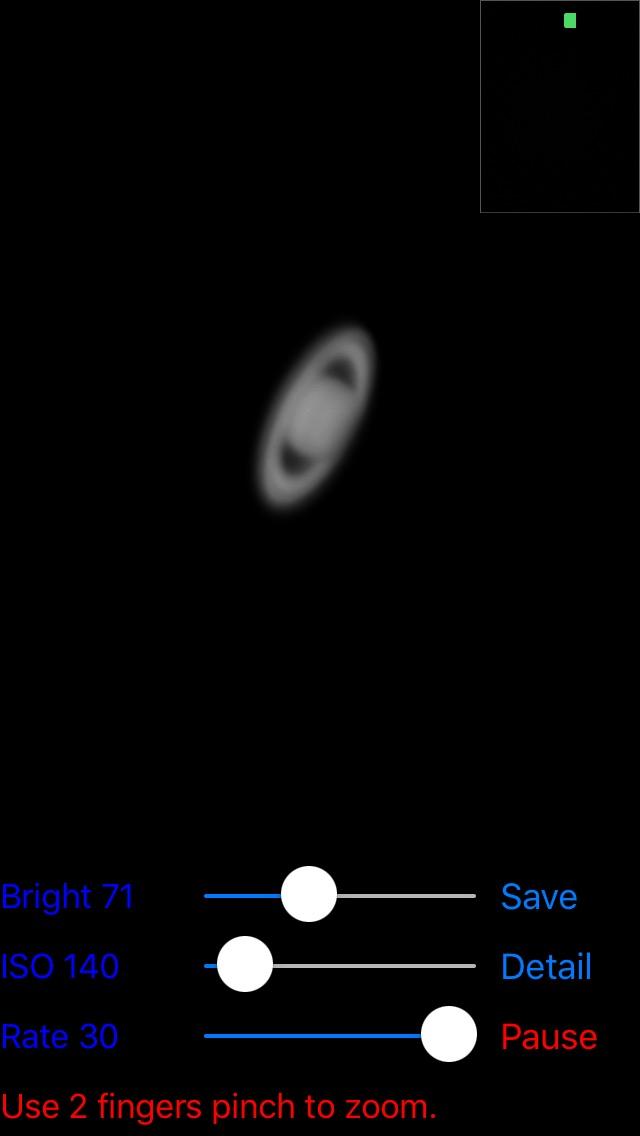
The eyepieces are usable but not premium. The 25mm provides 48x magnification, and the 10mm pushes to 120x. I added a 6mm planetary eyepiece for 200x views of Jupiter and Saturn.
The single-speed focuser is adequate but challenging at high magnification. Small focus shifts are exaggerated when you are at 150x or above. I found myself overshooting focus and then hunting back.
A dual-speed focuser is the first upgrade I would recommend. The straight-through finder scope is also awkward at zenith. A right-angle correct-image finder is a worthwhile addition.
Who Needs a 10-Inch Aperture
This telescope is for observers who have already spent a year or two with a smaller scope and want more. It is also the best Dobsonian telescope for deep sky viewing if you have a permanent observing spot or a large vehicle. Beginners can absolutely use it, but the weight and size can discourage quick sessions.
I have seen too many 10-inch scopes sit in garages because the owner did not feel like hauling them out. If you observe from a dark sky site at least twice a month, the Classic 250 will reward you. From light-polluted suburbs, the extra aperture helps but not as dramatically.
Light pollution washes out faint objects regardless of mirror size. I recommend this scope for people who drive to dark skies or have a rural backyard with reasonably dark horizons. The 10-inch is the gateway to serious deep-sky observation.
Collimation and Maintenance
A 10-inch mirror is more sensitive to collimation errors than a 6-inch. The tolerances are tighter because the f/4.8 focal ratio is faster. I check collimation before every serious session using a laser collimator.
It takes about 5 minutes once you learn the process. The three primary mirror screws and the secondary mirror alignment are accessible through the front of the tube. The mirror also takes longer to cool down to ambient temperature.
A 10-inch mirror holds thermal mass and can distort for 30 to 45 minutes after being carried outside. Sky-Watcher sells a cooling fan that attaches to the mirror cell, but I have not found it essential. I simply set the scope outside 30 minutes before I plan to observe high-magnification targets.
This thermal settling time is something new owners should plan for. If you set up and immediately try to view planets at 200x, the image may be soft. Patience pays off with a 10-inch mirror.
7. Celestron StarSense Explorer 10-Inch – App-Enabled 10-Inch Dobsonian
Celestron StarSense Explorer 10-inch App-Enabled Telescope – 254mm Dobsonian with Smartphone Dock & StarSense App…
254mm aperture
1200mm focal length
2-inch Crayford focuser
StarSense app
✓ The Good
- App makes finding objects effortless
- 10-inch aperture shows stunning detail
- Educational content in app
- Smooth stable base
✕ The Bad
- Very heavy and bulky
- App compatibility issues with some phones
The StarSense Explorer 10-inch is the logical next step for someone who loves the 8-inch StarSense but wants more light. You get the same smart app, the same 2-inch Crayford focuser, and the same educational content, but with 56% more mirror surface. The result is a telescope that finds objects for you and then shows them in breathtaking detail.
The 32mm eyepiece included with this model is better matched to the 10-inch aperture than the 25mm included with the 8-inch. At 37x magnification, it provides a 1.4-degree true field of view. That is wide enough to fit the entire Pleiades cluster with room to spare.
The Andromeda Galaxy stretches across the field with subtle dust lanes visible from dark skies. I spent an entire night just touring the Virgo Cluster of galaxies without needing a star chart. The app kept feeding me new targets faster than I could observe them.
The base is larger and heavier than the 8-inch version, but the construction is similar. The particle board rocker box is covered in black laminate, and the Teflon azimuth pads provide smooth horizontal motion. The altitude bearings are larger to support the heavier tube.
The tension adjustment is accessible from the outside. I found the balance point well-calibrated for the included eyepiece, but a heavy 2-inch wide-field eyepiece may require tension adjustment. The app integration is identical to the smaller StarSense models.
It analyzes star patterns, determines your position, and guides you to targets with arrows. The Tonight’s Best Targets feature is especially useful with this aperture because you can see objects that are invisible in smaller scopes. The app highlighted the Owl Nebula and the Crab Nebula on different nights, and both were distinct and detailed.
Who Should Upgrade to 10 Inches
This telescope is for committed observers who want the best combination of aperture and technology. It is the best computerized Dobsonian telescope for visual astronomy if you can handle the weight. If you already own the 8-inch StarSense and want more, this is the obvious upgrade.
If you are buying your first telescope and know you want deep-sky views, this is also a defensible choice if you have the storage space. I do not recommend this for casual observers who might use it once a month. The setup and breakdown effort is significant enough that infrequent use becomes a chore.
The best Dobsonian telescope is the one you actually use. If a 10-inch feels like a project every time, you will observe less often and enjoy it less. Be honest with yourself about your motivation and physical capability before buying this size.
Weight and Handling Considerations
The total weight is 54.8 pounds, with the tube and base roughly equal. The tube is longer and wider than the 8-inch, so carrying it through doorways requires planning. I find it easiest to carry the tube vertically with both arms wrapped around it.
The base is awkward because of its size, but two people can move it easily. Solo observers should consider a wheeled base or a hand truck. One practical tip: install the base in a semi-permanent location if possible.
I know one observer who keeps the base on a small outdoor table covered with a tarp. He only carries the tube in and out. That reduces the effort by half and increases his observing frequency dramatically.
Storage indoors is still ideal for the tube to protect the optics from dust and humidity.
8. Celestron StarSense Explorer 12-Inch – Massive 12-Inch Aperture for Serious Observers
Celestron StarSense Explorer 12-inch App-Enabled Telescope – 305mm Dobsonian with Smartphone Dock & StarSense App…
305mm aperture
1362mm focal length
2-inch Crayford focuser
StarSense app
✓ The Good
- Massive 12-inch light gathering
- StarSense app guides beginners
- Superb image quality
- 2-inch focuser for wide fields
✕ The Bad
- Very heavy at 83.6 pounds
- Large size makes storage difficult
The 12-inch StarSense Explorer is a statement piece. At 83.6 pounds and 56 inches long, it is the largest telescope in this guide by a significant margin. The 305mm primary mirror gathers 125% more light than an 8-inch.
That kind of light grasp transforms faint smudges into structured galaxies and turns star clusters into three-dimensional sparkles. I have owned and used 12-inch scopes for years, and the visual experience is addictive. The StarSense app makes this aperture accessible to beginners in a way that was impossible a decade ago.
Without the app, a 12-inch scope can be intimidating because the narrow field of view at high magnification makes finding objects manually a challenge. The app solves that entirely. You follow the arrows, the bullseye turns green, and you look in the eyepiece to see a galaxy where the app promised one would be.
The XLT coatings and 2-inch focuser are the same high-quality components as the smaller StarSense models. The 32mm eyepiece gives 42x magnification with a wide field that frames large objects beautifully. The 12-inch aperture also handles high magnification better than smaller scopes.
I routinely use 250x to 300x on Jupiter and Saturn when the atmosphere is steady. The Great Red Spot is an obvious oval. Cassini’s Division is visible all the way around the ring system.
The base is larger to accommodate the heavier tube, and the tension control system is robust. The mirror requires installation on arrival, which is a step not needed on smaller models. Celestron provides detailed instructions, and the process takes about 30 minutes.
The mirror is large and fragile, so handle it carefully. I recommend having a second person present during installation. Once assembled, the scope is a permanent instrument that rewards every clear night.
Who Should Buy the 12-Inch Model
This telescope is for serious amateur astronomers who want maximum aperture without jumping to a truss-tube design. It is the best Dobsonian telescope for planets and deep-sky objects if you have the space and the motivation to use it. Beginners can buy it as their first scope, but I only recommend that if you have help moving it and a permanent storage solution.
Many beginners regret buying too large too soon. If you have a dedicated observatory shed, a garage with easy backyard access, or a large vehicle for dark sky trips, the 12-inch is a lifetime instrument. You will not need to upgrade aperture after this.
The views of the Veil Nebula, the Sombrero Galaxy, and planetary nebulae are stunning. I have shown the public Saturn through this scope at outreach events, and the reactions are worth the effort every time. The 12-inch is the ultimate visual astronomy experience in a solid-tube design.
Transport and Storage Requirements
The tube is 56 inches long and 26 inches in diameter. The base is 29 inches tall and 26 inches wide. This will not fit in most compact cars.
I transport it in a midsize SUV with the rear seats folded flat. The tube lies across the cargo area, and the base sits upright beside it. Even then, it is a tight fit.
If you own a sedan, you may need to consider a smaller scope or a truss-tube design that breaks down further. Storage requires a closet or corner with at least 5 feet of vertical clearance and 3 feet of floor space.
I store my 12-inch tube horizontally on a padded shelf in the garage, and the base stands upright in a corner. A dust cover is essential because cleaning a 12-inch mirror is a serious project. I use a shower cap-style cover over the front of the tube and a separate cover for the base.
How to Choose the Best Dobsonian Telescope
Buying a telescope is a personal decision that depends on your space, budget, and observing goals. The best Dobsonian telescope for you is not necessarily the biggest or the most expensive. It is the one you will carry outside on a Tuesday night when the sky is clear for an hour.
This buying guide covers the factors that matter most based on our testing and feedback from real owners. We have seen too many people buy scopes that are too large for their lifestyle. The result is a beautiful instrument that gathers dust instead of photons.
Aperture Size: 6-Inch vs 8-Inch vs 10-Inch vs 12-Inch
Aperture is the single most important specification. It determines how much light your telescope collects, which directly controls how faint an object you can see. A 6-inch mirror is excellent for the Moon, planets, and bright deep-sky objects.
An 8-inch mirror is the sweet spot for most observers, offering 78% more light than a 6-inch without a massive jump in weight. A 10-inch gathers 56% more light than an 8-inch, and a 12-inch gathers another 44% beyond that. The jump from 8-inch to 10-inch is noticeable for experienced observers but subtle for beginners.
The jump from 10-inch to 12-inch is dramatic. However, bigger mirrors are heavier, harder to cool down, and more sensitive to collimation errors. We recommend 8-inch models for first-time buyers.
A 6-inch tabletop is ideal for apartments. Choose 10-inch or 12-inch only if you have the storage space and the physical ability to move them regularly. Your lifestyle should dictate the aperture, not the other way around.
Light gathering power also affects the detail you see on planets. An 8-inch can resolve about 0.6 arcseconds of detail under ideal conditions. A 12-inch can resolve about 0.4 arcseconds.
That difference matters for fine planetary detail, but both sizes show Saturn’s rings and Jupiter’s major moons with ease. Do not let aperture anxiety push you into a telescope that is too large for your lifestyle. The best views are the ones you actually see.
Another factor to consider is the focal ratio. Most Dobsonians are f/5 or f/6, which is considered fast. This gives wide fields of view but can introduce coma at the edges of the field. A parabolic mirror helps correct this, which is why all the models in our guide use parabolic primaries.
Portability and Vehicle Fit
Portability is the most overlooked factor in telescope buying. Our forum research shows that many users regret buying too large for their first telescope. A 12-inch scope that stays in the garage because it is too heavy to move is worth less than a 6-inch scope that gets used twice a week.
Before you buy, measure your storage space and your vehicle. Tabletop Dobsonians fit in any car and store in closets. The 8-inch solid-tube models fit in most sedan back seats with the seats folded.
The 10-inch is tight in a sedan but fits in most SUVs. The 12-inch requires a large SUV, minivan, or truck. If you cannot transport the telescope to dark skies, you will be limited to bright objects from your backyard.
That is fine for planets and the Moon, but galaxies and nebulae need dark skies regardless of aperture. Weight matters too. A 23-pound tabletop scope is easy for anyone to carry.
A 45-pound 8-inch is manageable for most adults in two pieces. A 54-pound 10-inch requires some strength or a hand truck. An 83-pound 12-inch is genuinely difficult for one person.
If you observe alone, factor your own physical capability into the decision. Some observers build wheeled platforms or use folding hand trucks to move larger scopes. I have seen ingenious DIY solutions that make a 12-inch scope almost as easy to move as an 8-inch.
One owner I know installed a small ramp from his garage to his backyard. He rolls the base on casters and only lifts the tube. This small home improvement changed his observing life. Think creatively about your specific situation before ruling out a larger aperture.
Manual Tracking vs Computerized GoTo
Manual Dobsonians are simple, reliable, and quiet. You point the tube by hand, track objects by nudging the base, and star hop from one target to the next using a map. Many experienced observers prefer manual operation because it keeps them connected to the sky.
There are no batteries to fail, no apps to update, and no alignment routines to forget. Computerized GoTo systems, like the Virtuoso GTI or the StarSense app, find objects for you. They are excellent for beginners, public outreach, and observers with limited time.
The StarSense app is particularly good because it uses your phone’s camera and gyroscopes rather than requiring external power or hand controllers. The Virtuoso GTI uses motorized encoders and a Wi-Fi connection to the SynScan app. There is a middle ground.
The Virtuoso GTI’s Freedom Find technology lets you use the scope manually while the encoders track your position. You can star hop to a target, then engage tracking. This is the best of both worlds for observers who want technology without giving up manual control.
We recommend manual scopes for purists, StarSense for beginners, and Freedom Find for people who want flexibility. Your choice depends on how you like to observe. There is no wrong answer here, only personal preference.
One practical consideration is that GoTo systems add weight and cost. The StarSense app adds no weight to the scope itself, but the dock and bracket add a few ounces. The Virtuoso GTI adds several pounds of motors and electronics. If you travel to dark skies by air, manual is the way to go.
Collimation and Maintenance
Collimation is the process of aligning the primary and secondary mirrors so they work together perfectly. It is the maintenance task that intimidates beginners most, but it is not as difficult as it sounds. A 6-inch mirror has forgiving tolerances.
An 8-inch requires occasional attention. A 10-inch or 12-inch needs regular checks to perform at its best. We recommend buying a laser collimator.
It costs less than a premium eyepiece and saves hours of frustration. The process involves adjusting three screws on the primary mirror cell and two or three screws on the secondary mirror holder. With a laser collimator, it takes 5 to 10 minutes.
Without one, you can collimate using a defocused star, but that takes practice and patience. Cleaning the mirrors is rarely necessary. Dust on the primary mirror has almost no effect on image quality.
Only clean the mirror if it has visible grime or pollen buildup. To clean, remove the mirror cell, rinse it with distilled water, and let it air dry. Never use household cleaners or paper towels.
The coatings are durable but not indestructible. Cover your telescope when not in use, and you may never need to clean the mirror. Prevention is better than cure when it comes to mirror maintenance.
Store your telescope in a dry place to avoid moisture damage to the base. Particle board can swell if it gets wet, which affects the smooth motion of the bearings. A simple furniture cover or tarp keeps dust and humidity at bay.
Accessories and Upgrade Path
Every Dobsonian in this guide includes at least one eyepiece, a finder scope, and a focuser. The included eyepieces are starter quality. Your first upgrade should be a better eyepiece.
A 2-inch wide-angle eyepiece in the 30mm to 32mm range transforms the view of large nebulae. A 6mm to 9mm eyepiece provides high magnification for planets. A 2x Barlow lens doubles your magnification options without buying twice as many eyepieces.
A Telrad finder or a right-angle correct-image finder is the second most useful upgrade. The included straight-through finders and red-dot finders work, but they become awkward at high angles. A Telrad projects a bullseye onto the sky, making star hopping intuitive.
A RACI finder lets you look down into the eyepiece comfortably instead of bending your neck backward. A light shroud is essential for open-truss and tabletop scopes. It blocks stray light from your neighbors’ windows and improves contrast.
For solid-tube scopes, a dew shield is useful during humid nights. A collimation cap is included with most models, but a laser collimator is the better long-term tool. Budget roughly one to two hundred for essential upgrades in your first year.
These upgrades will transform your observing experience more than any amount of extra aperture. A good eyepiece in a 6-inch scope beats a cheap eyepiece in a 12-inch scope every time. Invest in accessories before you invest in a larger telescope.
A moon filter is another smart early purchase. The full moon through a 10-inch scope is painfully bright without one.
A neutral density filter or variable polarizing filter brings the brightness down to comfortable levels. This small accessory costs very little and makes lunar observing much more pleasant.
Frequently Asked Questions
Which brand offers the best accessories?
Sky-Watcher and Celestron both include solid starter kits with their Dobsonian telescopes. Sky-Watcher typically provides two eyepieces, a finder scope, and a 2-inch Crayford focuser on their Classic series. Celestron’s StarSense Explorer line includes fewer eyepieces but adds the smart StarSense app and smartphone dock. For the most complete accessory package out of the box, Sky-Watcher Classic models edge ahead with their dual eyepiece sets and straight-through finders.
What is the difference between 8 inch and 10 inch Dobsonian?
A 10-inch Dobsonian telescope gathers 56% more light than an 8-inch model. That means fainter galaxies, more resolved star clusters, and better contrast on nebulae. The 10-inch also handles higher magnification more gracefully for planetary detail. However, the 10-inch is significantly heavier and bulkier, often requiring a larger vehicle and more storage space. For beginners, the 8-inch offers the best balance of performance and portability. The 10-inch is ideal for experienced observers with dedicated dark sky access.
What are the best Dobsonian telescopes for beginners?
The best Dobsonian telescopes for beginners are the Celestron StarSense Explorer 8-inch and the Sky-Watcher Heritage 150. The StarSense Explorer 8-inch uses a smartphone app to guide beginners to objects, removing the learning curve of star hopping. The Sky-Watcher Heritage 150 is a compact tabletop model that sets up in minutes and requires no collimation out of the box. Both provide excellent views of the Moon, planets, and bright deep-sky objects without overwhelming new users with complexity or weight.
What are the best Dobsonian telescopes for the money?
The Sky-Watcher Classic 200 is widely considered the best Dobsonian telescope for the money. It offers a full 8-inch aperture with 94% reflective mirrors, a 2-inch Crayford focuser, and smooth Teflon bearings at a price point that undercuts many competitors. The Celestron StarSense Explorer 130AZ is also excellent value for beginners who want app-guided navigation in a compact package. Both models deliver performance that rivals telescopes costing significantly more.
What are the best Dobsonian telescopes under one thousand dollars?
The best Dobsonian telescopes under one thousand dollars include the Sky-Watcher Classic 200, the Celestron StarSense Explorer 8-inch, and the Sky-Watcher Heritage 150. The Classic 200 offers the largest aperture in this price range with traditional manual operation. The StarSense Explorer 8-inch adds smartphone navigation for slightly more money. The Heritage 150 is the top budget pick and the most affordable option in our guide with a collapsible design and excellent optics. All three provide views that outperform many more expensive telescopes of other designs.
Final Thoughts
The best Dobsonian telescope is the one that matches your life, not just your ambitions. An 8-inch classic or app-enabled model will serve most beginners for years. A compact tabletop is perfect for testing the waters.
A 10-inch or 12-inch rewards dedication with views that border on the surreal. Our editor’s choice, the Celestron StarSense Explorer 8-inch, balances aperture, technology, and value better than anything else we tested in 2026. If you take one thing from this guide, let it be this: buy the telescope you will actually use.
A 6-inch scope under the stars every week beats a 12-inch scope that lives in the garage. The universe is waiting. All you need is a clear night and a Dobsonian pointing upward.