12 Best Bass Distortion Pedals (August 2026) Top Reviews
Adding dirt to your bass tone can transform an ordinary riff into something that demands attention. The best bass distortion pedals are built specifically to keep your low end intact while adding grit, harmonic richness, and aggressive character that standard guitar pedals simply choke out. Our team spent weeks comparing 12 of the most popular bass distortion pedals on the market, testing each one through multiple amps, signal chains, and playing styles.
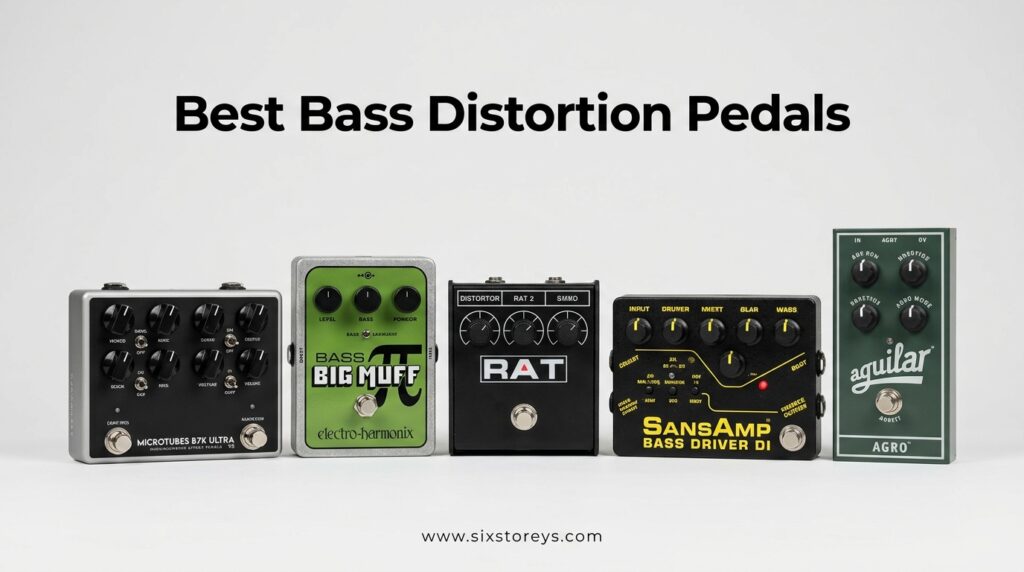
The biggest mistake bass players make is grabbing a guitar distortion pedal and hoping for the best. Standard guitar pedals are voiced for the midrange-heavy frequencies of a guitar, which means they scoop out the low frequencies your bass needs to anchor a mix. Bass-specific distortion pedals solve this with blend knobs, dedicated dry/wet controls, and EQ voicing designed around the 30 Hz to 1 kHz range that defines your tone.
In this guide to the best bass distortion pedals of 2026, we cover everything from budget-friendly options under $60 to premium Finnish-engineered overdrive units that professional bassists rely on nightly. Whether you play metal, punk, alternative rock, or just want some subtle grit on your clean tone, we tested each pedal for low-end retention, tonal flexibility, build quality, and value. We also break down the difference between overdrive, distortion, and fuzz for bass, plus where to place these pedals in your signal chain.
Article Includes
Top 3 Picks for Best Bass Distortion Pedals
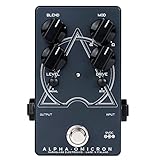
Darkglass Alpha Omicron
- Dual distortion engines
- Blend control
- Growl bass boost
- Analog signal path

EHX Bass Big Muff Pi
- Russian Big Muff circuit
- Dry blend switch
- Bass boost EQ
- 9V battery included

JOYO Double Thruster R-28
- Blend control
- Mid and gain boost switches
- 4-knob layout
- R Series metal chassis
Best Bass Distortion Pedals in 2026
| Product | Key Specs | Action |
|---|---|---|
| JOYO Double Thruster R-28 |
|
Check Latest Price |
| EHX Bass Big Muff Pi |
|
Check Latest Price |
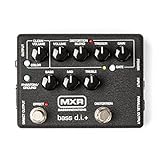 MXR Bass D.I. Plus M80 MXR Bass D.I. Plus M80 |
|
Check Latest Price |
 MXR Bass Distortion M85 MXR Bass Distortion M85 |
|
Check Latest Price |
 MXR Bass Fuzz Deluxe M84 MXR Bass Fuzz Deluxe M84 |
|
Check Latest Price |
 EHX Deluxe Bass Big Muff Pi EHX Deluxe Bass Big Muff Pi |
|
Check Latest Price |
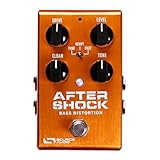 Source Audio Aftershock Source Audio Aftershock |
|
Check Latest Price |
| Darkglass Alpha Omicron |
|
Check Latest Price |
 Darkglass Microtubes B3K V2 Darkglass Microtubes B3K V2 |
|
Check Latest Price |
 MXR Bass Overdrive M89 MXR Bass Overdrive M89 |
|
Check Latest Price |
 JOYO D52 Bass Overdrive JOYO D52 Bass Overdrive |
|
Check Latest Price |
 SONICAKE B Factory SONICAKE B Factory |
|
Check Latest Price |
1. Darkglass Alpha Omicron – Dual Distortion Engines
Darkglass Alpha Omicron Bass Preamp/OD Pedal w/Dual Distortion Modes, Blend Control, and Analog Signal Path
Dual Alpha and Omega engines
Blend control
Growl bass boost switch
Analog signal path
9V powered
✓ The Good
- Dual distortion engines for two distinct characters
- Blend control preserves low-end punch
- Growl switch adds shelving bass boost
- Premium analog signal path
- Top-tier build quality
✕ The Bad
- Premium pricing
- No battery option requires power supply
- Some early units reported hissing noise
The Darkglass Alpha Omicron immediately stood out in our testing as the most tonally flexible pedal in this lineup. The dual distortion engines, labeled Alpha and Omega, deliver two distinctly different characters of grit. Alpha gives you a tight, aggressive midrange growl that cuts through dense mixes, while Omega opens up a thicker, more saturated fuzz-adjacent tone that works beautifully for doom and sludge.
I ran the Alpha Omicron through a 4-string and a 5-string bass during testing. The blend control is the real hero here, letting you dial in anywhere from barely-there grit to full apocalyptic saturation without losing your fundamental low end. Even at maximum drive settings, my low B string stayed articulate and defined.
The Growl switch adds a shelving bass boost that thickens the low end in a musical way. It does not just add mud. Instead it adds weight and chest-thumping presence. Built in Finland with a rugged brushed aluminum housing, this pedal feels like a professional tool meant to survive years of touring.
One thing to note is that the Alpha Omicron requires a power supply, with no battery option. Some early production units had reported hissing noise when engaged, but Darkglass addressed this in later runs. At its price point, it sits in premium territory, but the tonal quality justifies the investment for serious players.
Best Use Cases for the Alpha Omicron
This pedal shines for modern metal, djent, progressive rock, and any genre where you need aggressive bass tone that still cuts through a dense mix. The dual engines make it feel like having two pedals in one, which adds real value despite the premium cost.
Who Should Look Elsewhere
If you primarily play blues, jazz, or lighter rock where you only need subtle warmth, the Alpha Omicron is overkill. Players on a strict budget should also consider the JOYO Double Thruster, which captures roughly 75 percent of the Darkglass character at a fraction of the cost.
2. Electro-Harmonix Bass Big Muff Pi – Classic Fuzz Distortion
Electro-Harmonix Bass Big Muff Pi Fuzz Pedal
Based on Russian Big Muff
Dry blend switch
Bass boost EQ
Sustain tone volume knobs
9V battery included
✓ The Good
- Maintains low bass frequencies beautifully
- Dry switch preserves clean signal parallel to distortion
- Classic Russian Big Muff fuzz character
- Bass boost EQ reintroduces lows
- 9V battery included
✕ The Bad
- Can produce a loud pop when first activated
- Limited stock availability at times
The Electro-Harmonix Bass Big Muff Pi is a legend for good reason. Based on the revered Russian Big Muff circuit, this pedal delivers rich, sustaining fuzz and distortion that does not strip your low end the way the original guitar version did. Our team has used this pedal in rehearsal and live settings, and it consistently impresses with its ability to thicken tone without losing definition.
The Dry switch is the standout feature that makes this a bass pedal rather than just another Big Muff. Engaging it runs your clean bass signal in parallel with the distortion, so you get the harmonic richness and sustain of the Muff alongside your full, undistorted low end. It is a simple solution that works incredibly well.
The Bass Boost EQ switch reintroduces low frequencies when you have dialed the tone knob toward the highs. This lets you chase aggressive, cutting upper-mid tones without losing your bass presence. With 444 reviews and a 4.6-star average, the community consensus matches our testing experience.
Electro-Harmonix even includes a 9V battery in the box, which is a nice touch in a world where most pedals ship without one. The pedal can be loud when first activated, producing a brief pop, but this is normal for the circuit and does not affect ongoing performance.
Sounds It Excels At
The Bass Big Muff Pi is ideal for stoner rock, grunge, alternative, and any style where thick, woolly fuzz is desirable. Think of bands like Muse, Smashing Pumpkins, and Queens of the Stone Age for the tonal territory this pedal covers.
Limitations to Consider
If you need tight, modern metal distortion with surgical precision, the Big Muff character may feel too loose and fuzzy. Players who want extensive EQ control should also look at the Deluxe version, which adds a blend knob and crossover filters.
3. MXR Bass D.I.+ (M80) – Distortion Meets Direct Box
MXR® Bass D.I.+
Distortion channel with blend
3-band EQ
Color knob
Phantom power support
Power supply included
✓ The Good
- Distortion channel with gain volume and blend controls
- Color knob for tonal shaping
- Built-in 3-band EQ
- Phantom power support
- Includes power supply and cable
✕ The Bad
- Premium price point
- Larger footprint than standard pedals
The MXR Bass D.I.+ (M80) is more than just a distortion pedal. It is a complete bass tool that combines a distortion channel, a 3-band EQ, a parallel clean signal path, and a direct box output. Our team found this to be one of the most versatile pedals in the entire roundup, suitable for live performance, studio recording, and direct-to-board scenarios.
The distortion channel offers gain, volume, and blend controls that let you shape everything from subtle tube-like warmth to aggressive breakup. The Color switch provides a preset EQ voicing that adds presence and character, mimicking the sound of a pushed tube amp. With the 3-band EQ, you have precise control over your final tone shape.
What sets the M80 apart is its parallel clean signal design. Even when the distortion is engaged, your clean low end passes through untouched. This means you never lose fundamental bass frequencies, regardless of how much gain you apply. It is the same concept as a blend knob but implemented at the circuit level.
The built-in DI output makes this pedal a swiss army knife for gigging bassists. You can send your tone directly to the front of house while simultaneously driving an amp on stage. MXR includes the power supply and cable, which adds value to the already capable package.
Perfect for Working Bassists
If you play in a cover band or gig regularly, the M80 eliminates the need for separate distortion, EQ, and DI boxes. The phantom power support means you can run it directly from a mixing console without a dedicated power supply.
Drawbacks to Note
The footprint is larger than a standard compact pedal, so pedalboard real estate is a consideration. The premium price also puts it at the higher end of the spectrum, though the feature set justifies the cost for players who would otherwise buy separate units.
4. MXR Bass Distortion (M85) – Aggressive RAT-Inspired Grit
MXR® Bass Distortion
RAT-style distortion circuit
Separate dry and wet controls
Touch responsive
9V powered
Compact MXR housing
✓ The Good
- Based on classic RAT-style distortion circuit
- Separate dry and wet level controls
- Touch responsive dynamics
- Tones from grit to fuzz
✕ The Bad
- Wet dry and dist knobs all affect volume
- No dedicated blend or level knob
- Some users report buzz and hum
The MXR Bass Distortion M85 takes the legendary RAT distortion circuit and adapts it for bass. The result is a nasty, aggressive, raw distortion that lives up to its reputation for attitude. I found this pedal excels at delivering in-your-face punk and hard rock tones where subtlety is not the goal.
Separate Dry and Wet level controls let you balance your clean signal against the distorted path. This is functionally similar to a blend knob but gives you discrete level control over each side. The touch responsiveness means your playing dynamics directly affect the amount of breakup, which adds expressive potential.
The M85 covers a wide tonal range from light grit to full-on fuzz saturation. However, the control layout has a quirk that some users find frustrating. The Wet, Dry, and Distortion knobs all affect overall volume, which means adjustments require compensating on multiple knobs to maintain consistent output levels.
With a 3.9-star average from 42 reviews, this is the lowest-rated pedal in MXR’s bass lineup. The rating reflects the control layout challenges and reports of buzz or hum in some units. That said, players who love the RAT character will find a lot to like here.
Best Genres for the M85
Punk, hardcore, garage rock, and noise rock are the natural habitat for this pedal. If your bass tone needs to sound like it is being driven through a blown speaker, the M85 delivers that character convincingly.
Who Might Be Disappointed
Players who want precise control over their blend ratio may find the dual-knob approach less intuitive than a single blend control. Those sensitive to noise should also test the pedal with their specific power supply setup, as some users report hum issues.
5. MXR Bass Fuzz Deluxe (M84) – Vintage Fuzz with Modern Control
MXR® Bass Fuzz Deluxe
Modified vintage fuzz circuit
Separate wet and dry controls
Maintains low bass output
Compact housing
9V powered
✓ The Good
- Modified vintage fuzz circuit voiced for bass
- Separate wet and dry controls
- Excellent pitch definition
- Maintains low bass output
- Dial subtle to aggressive fuzz
✕ The Bad
- Some users report noticeable hum
- No dedicated volume adjustment
The MXR Bass Fuzz Deluxe M84 takes a vintage fuzz circuit and modifies it specifically for bass guitar. Our testing confirmed that this pedal maintains low bass output beautifully while delivering classic, woolly fuzz tones. The separate Wet and Dry controls give you precise blending that many bass fuzz pedals lack.
I was particularly impressed with the pitch definition on this pedal. Many fuzz pedals turn bass notes into an indistinct rumble, but the M84 keeps each note articulate even with the fuzz fully engaged. This makes it playable for complex riffs and fast passages where clarity matters.
The tonal range goes from subtle, almost overdrive-like warmth to thick, aggressive fuzz. The separate Wet and Dry knobs let you set the level of each signal independently, which is more flexible than a single blend knob. You can dial in a small amount of fuzz against a strong clean signal, or push the fuzz to dominate with just a trace of clean low end.
Some users report a noticeable hum, particularly with certain power supply configurations. There is also no dedicated master volume, which means your overall output level depends on the balance between Wet and Dry settings. Despite these issues, the 4.6-star rating from 62 reviews shows strong overall satisfaction.
Ideal Tonal Territory
Classic rock, psychedelic, stoner metal, and indie rock all suit this pedal well. Think of the thick, fuzzy bass tones on early Black Sabbath or modern bands like Royal Blood for the character this pedal produces.
Considerations Before Buying
If you need a master volume control for output matching, the M84’s lack of one may frustrate you. Players using non-isolated power supplies should test carefully for hum, as fuzz circuits can be sensitive to power quality.
6. EHX Deluxe Bass Big Muff Pi – Pro Fuzz with Crossover Control
Electro-Harmonix Deluxe Bass Big Muff Pi Bass Effects Pedal
Blend knob for wet and dry
XLR DI output
Foot-switchable crossover filters
LPF and HPF controls
Die-cast chassis
✓ The Good
- Blend knob mixes direct and distorted signals
- Three outputs including XLR DI out
- Foot-switchable crossover with LPF and HPF
- Die-cast chassis built tough
- Keeps low-end clear and focused
✕ The Bad
- LPF can become overpowering past 11 o clock
- May not suit players who prefer boomier overdrive
The Deluxe Bass Big Muff Pi takes everything great about the standard Bass Big Muff and adds professional features that bassists have been asking for. Our team found the blend knob alone justifies the upgrade, but the foot-switchable crossover section takes this pedal into a class of its own.
The crossover circuit lets you split your signal into frequency bands, applying a variable low pass filter to your clean signal and a variable high pass filter to your distorted signal. This means your lows stay clean and focused while your highs carry the distortion character. The result is a bass tone that sits perfectly in a mix without muddying up the low end.
Three output options give you maximum routing flexibility. The 1/4-inch effect out carries your full processed tone, the direct out provides a buffered dry signal, and the XLR DI out lets you connect directly to a mixing console. This makes the Deluxe Bass Big Muff a viable all-in-one solution for live and studio use.
The die-cast chassis is tough and compact despite the extensive feature set. One thing to watch is the LPF control, which can become overpowering when turned past 11 o’clock on the dial. Finding the sweet spot takes some experimentation but delivers excellent results once dialed in.
Standout Features for Professionals
The crossover section is genuinely unique among bass distortion pedals. It solves the fundamental problem of bass distortion, which is keeping your low end clear and defined while adding aggressive character to the mid and high frequencies.
Who Should Skip This One
Players who prefer a simple plug-and-play experience may find the extensive control set overwhelming. If you just want basic fuzz without diving into crossover frequencies, the standard Bass Big Muff Pi is simpler and more affordable.
7. Source Audio Aftershock – The Versatility Champion
Source Audio Aftershock Bass Distortion Pedal
Multiple distortion engines
Neuro App deep editing
6 preset slots
Serial or parallel routing
USB connection
✓ The Good
- Multiple distortion engines including tube heavy and fuzz
- Neuro App allows extensive customization
- Transparent overdrive preserves low end
- 6 preset slots for live use
- Two engines configurable in serial or parallel
- Includes power supply
✕ The Bad
- Software setup has a learning curve
- Tone knob can be too dark or bright depending on patch
- Noisy with non-isolated power supplies
The Source Audio Aftershock is the most feature-rich pedal in this entire roundup. With multiple distortion engines covering tube overdrive, heavy distortion, and fuzz, plus deep editing through the free Neuro mobile app, this pedal can mimic an enormous range of bass distortion tones. Our team was genuinely impressed by how many different characters this single unit can produce.
Two independent distortion engines can be arranged in serial, parallel, or true stereo configurations. This means you can run a tube overdrive into a fuzz for layered saturation, or blend two different distortion types in parallel for complex tonal textures. The six preset slots let you store your favorite configurations for instant recall during live performance.
The Neuro app connects via USB and unlocks extensive tone customization that goes far beyond what the front panel knobs offer. You can load new distortion algorithms, adjust parameters that are not accessible from the pedal itself, and even download sounds modeled after other popular pedals. This makes the Aftershock effectively a multi-pedal distortion platform.
The transparent overdrive character preserves your bass low-end beautifully, which is the most important quality in a bass distortion pedal. However, the software does have a learning curve, and some users report noisy operation when using non-isolated power supplies. The included power supply is a nice value add at this price point.
Best for Tone Tinkerers
If you love deep editing, preset management, and having every conceivable distortion character at your feet, the Aftershock is unmatched. It is particularly valuable for players who cover multiple genres and need radically different tones from song to song.
When to Consider Alternatives
Players who want a simple, plug-and-play experience may find the software ecosystem overwhelming. If you just want one great distortion sound without diving into apps and presets, a more straightforward pedal like the Darkglass Alpha Omicron will serve you better.
8. Darkglass Microtubes B3K V2 – Modern Metal Bass Standard
Darkglass Microtubes B3K V2 Bass Overdrive Pedal w/ 5 Controls, ¼” Output Jack, and ¼” Input Jack
Grunt low-end boost
Mid boost control
Tone knob
Blend control
True bypass
Made in Finland
✓ The Good
- Powerful overdrive for strong defined bass sound
- Mid boost enhances 300 Hz to 1 kHz range
- Tone knob for high-end management
- Grunt switch adds heavy low-end boost
- Blend control for clean and drive mix
- True bypass and compact pedalboard-friendly design
✕ The Bad
- Premium pricing
- Does not use batteries requires adapter
The Darkglass Microtubes B3K V2 is the pedal that comes up in nearly every Reddit thread about modern metal bass tone. Our testing confirmed why it has such a devoted following. The V2 updates replace the original attack switch with a full tone control knob, giving you more precise high-end management than the first generation.
The Grunt switch adds a significant low-end boost that gives your tone weight and authority. When combined with the mid boost, which enhances presence in the 300 Hz to 1 kHz range, you get a sound that sits perfectly in a dense metal mix without getting lost behind downtuned guitars.
The blend control lets you mix your clean and overdriven signals with precision. This is essential for maintaining low-end clarity while adding harmonic content. I found that even with the drive pushed hard, the blend control let me keep my fundamental bass tone intact underneath the saturation.
Built in Finland with exceptional craftsmanship, the B3K V2 feels like a premium professional tool. The compact design fits easily on pedalboards, and true bypass ensures your signal stays pristine when the pedal is off. The main drawback is the premium pricing, which puts it out of reach for some budget-conscious players. It also requires an adapter, with no battery option.
Why Metal Bassists Love It
The B3K V2 produces the tight, aggressive, defined overdrive tone that defines modern metal bass. Think of bands like Periphery, Animals as Leaders, and modern progressive metal where the bass needs to be heard clearly alongside heavily distorted seven and eight-string guitars.
Who It Is Not For
If you play vintage rock, blues, or lighter genres, the B3K V2’s modern voicing may be too aggressive. Players who want fuzz character rather than tight overdrive should look at the Bass Big Muff or MXR Bass Fuzz Deluxe instead.
9. JOYO Double Thruster R-28 – Budget Darkglass Alternative
JOYO Bass Overdrive Guitar Pedal, Blend Control with Mid & Gain Boost Switches, Tone/Volume/Gain Knobs, Bypass (DOUBLE…
Blend control
Mid boost and gain boost switches
4-knob layout
R Series metal chassis
9V powered
✓ The Good
- Blend control preserves low-end punch
- Dual boost switches for mid and gain
- Versatile 4-knob control layout
- Road-ready metal construction
- Excellent value alternative to Darkglass
✕ The Bad
- Can get muddy compared to high-end alternatives
- 9V adapter not included
The JOYO Double Thruster R-28 is the budget champion of this roundup. Our team was genuinely surprised by how much of the Darkglass B3K character this pedal captures at a fraction of the cost. Multiple users across forums note it delivers roughly 75 to 80 percent of the B3K performance, which is remarkable given the price difference.
The blend control is the feature that makes this pedal viable for serious bass use. It lets you retain your low-end punch while adding grit and harmonic content. The dual boost switches for mid and gain give you additional tonal shaping options that you would not expect at this price point.
The 4-knob layout with Tone, Blend, Volume, and Gain provides enough control for most playing situations. I found the Mid Boost particularly useful for cutting through a band mix during rehearsals. The Gain Boost adds depth and body when you need more aggressive saturation.
The R Series metal chassis feels road-ready, and the ambient LED lighting is a nice visual touch on stage. The pedal runs on 9V power, though the adapter is not included. Some users note it can get slightly muddy compared to premium alternatives, but for the price, the trade-off is more than acceptable.
Perfect for Budget-Conscious Bassists
If you want modern overdrive character without spending $250 or more, the Double Thruster is the obvious choice. It is ideal for beginners, intermediate players, and gigging musicians who need a reliable dirt pedal without breaking the bank.
Where It Falls Short
The overall tonal refinement does not match the Darkglass pedals it imitates. The EQ is less precise, and the distortion character can lack the clarity and definition of premium units. For recording where every detail matters, you may eventually want to upgrade.
10. MXR Bass Overdrive (M89) – Warm Harmonically Rich Drive
MXR® Bass Overdrive
Warm harmonically rich overdrive
True bypass
Rock-focused voicing
9V powered
Solid MXR construction
✓ The Good
- Warm harmonically rich overdrive character
- True bypass preserves signal integrity
- Midrange-heavy voicing suits rock bass
- Solid quality construction
- Good range from subtle breakup to full distortion
✕ The Bad
- Clean sound never truly clean even at max clean setting
- Overdrive breaks up aggressively even at lowest setting
- Tone can sound harsh regardless of settings
The MXR Bass Overdrive M89 delivers warm, harmonically rich overdrive that our team found well-suited to rock bass tones. This pedal is built for players who want midrange-heavy grit that complements a driving rock mix rather than dominating it. The true bypass ensures your signal stays clean when the pedal is disengaged.
I tested the M89 across a range of settings from subtle breakup to full distortion. The character is consistently warm and musical, with a midrange focus that helps bass cut through without harshness. The construction is typical MXR quality, meaning this pedal will survive years of stomping.
However, there are some quirks worth noting. The clean signal path never achieves a truly clean sound even at the maximum clean knob setting. The overdrive also breaks up quite a bit even at the lowest drive setting, which means this pedal is not ideal for players seeking subtle warmth.
Some users report the tone can sound harsh regardless of settings, which suggests the EQ voicing may not suit every bass and amp combination. With 57 reviews and a 4.4-star average, the consensus is positive overall, but with more caveats than MXR’s other bass offerings.
Best Applications for the M89
Classic rock, hard rock, and blues rock are the natural territory for this pedal. If your bass tone needs to sit alongside crunchy rhythm guitars with complementary warmth and grit, the M89 delivers that character effectively.
When to Choose a Different Pedal
If you need pristine clean tones alongside your overdrive, the M89’s inability to fully clean up will frustrate you. Players looking for lighter, more subtle overdrive should consider the Darkglass B3K V2 or the JOYO options instead.
11. JOYO D52 Bass Overdrive – Affordable Rock-to-Metal Drive
JOYO Bass Overdrive Pedal Effects from Rock to Metal Specially Design for Bassist High-end Edition Dr.J Series (D52)
Three tone switch options
True bypass
Level and drive knobs
Rock to metal voicing
Budget friendly
✓ The Good
- Excellent value for the price
- Three tone switch options for different characters
- True bypass minimizes tone loss
- Solid construction with paint spraying technology
- Specially designed for bass guitar
✕ The Bad
- Budget price may reflect in long-term durability
- Limited tone options compared to premium alternatives
The JOYO D52 Bass Overdrive is part of the Dr.J Series and is designed specifically for modern bass players covering rock to metal styles. Our team found this to be a solid budget option that punches above its weight class, particularly given its number 8 ranking in Amazon’s Bass Distortion and Overdrive Effects category.
The three tone switch options give you distinctly different voicing characters without needing to tweak multiple knobs. This makes the D52 quick to adjust on the fly during live performance. The Level and Drive knobs provide the essential controls you need without overwhelming complexity.
True bypass design minimizes tone loss when the pedal is disengaged, which is important for maintaining your core bass tone in a larger signal chain. The solid construction with paint spraying technology surface treatment gives the pedal a durable feel that belies its budget price.
With 233 reviews and a 4.3-star average, customer satisfaction is strong. The main limitations are the relatively limited tonal flexibility compared to premium alternatives and potential long-term durability concerns typical of budget pedals. For the price, it is hard to complain about what you get.
Great for Starting Out
Beginners and intermediate players who want to explore bass overdrive without a significant investment will find the D52 more than capable. It is also a solid backup pedal for gigging musicians who want redundancy without spending heavily.
Upgrade Path Worth Considering
As your playing and tonal demands evolve, you may find the D52’s limited flexibility restrictive. The JOYO Double Thruster offers more controls for a similar price, making it a worthwhile comparison if you want more shaping options.
12. SONICAKE B Factory – All-in-One Bass Preamp Solution
SONICAKE Bass Pedal with Overdrive Analog Preamp Compression Effects Pedal and 3-Band EQ Via Pre/Post Selection with XLR…
Analog preamp with compression
Overdrive channel
3-band EQ with pre and post
XLR balanced output
Buffer bypass circuit
✓ The Good
- Analog preamp comp and overdrive in one pedal
- Classic optical compression sound
- 3-band EQ with PRE and POST selection
- XLR balanced output for direct connection
- Buffer bypass circuit keeps sound pristine
- Excellent value with 1464 reviews backing it
✕ The Bad
- Power supply not included
- XLR cannot connect to phantom power
- 90-day warranty is shorter than competitors
The SONICAKE B Factory is not just a distortion pedal. It is a complete bass preamp solution combining analog preamp, optical compression, overdrive, and a 3-band EQ in a single compact unit. Our team was impressed by how much functionality SONICAKE has packed into this pedal, especially given its accessible price point.
The 3-band EQ features PRE and POST selection, which means you can place the EQ before or after the overdrive stage. This dramatically expands your tonal shaping options. Putting EQ before the drive lets you control which frequencies get distorted, while POST placement lets you shape your final output tone.
The classic optical compression adds smooth, transparent leveling that tames peaks and evens out your playing dynamics. Combined with the overdrive channel, you get a polished, professional tone that works for recording and live performance. The XLR balanced output lets you connect directly to a mixing console or audio interface.
With 1464 reviews and a 4.4-star average, this is one of the most reviewed and broadly popular pedals in this roundup. The buffer bypass circuit keeps your sound pristine when the pedal is bypassed. Note that the power supply is not included, the XLR cannot connect to phantom power, and the warranty period is just 90 days.
Ideal for Complete Tone Solutions
If you want a single pedal that handles preamp, compression, EQ, and overdrive duties, the B Factory eliminates the need for multiple units. It is perfect for minimalist pedalboard builds and players who want an all-in-one solution.
Limitations Worth Knowing
The 90-day warranty is significantly shorter than the one-year or two-year warranties offered by competitors. The overdrive character is more subtle than dedicated distortion pedals, so players seeking aggressive modern metal tones may want to pair this with a dedicated dirt pedal.
Buying Guide: How to Choose Bass Distortion Pedals
Choosing from the many bass distortion pedals available in 2026 requires understanding what features actually matter for your tone. This buying guide breaks down the key decisions you need to make, based on our testing experience and community feedback from bass forums.
Distortion vs Overdrive vs Fuzz for Bass
These three terms get used interchangeably but they describe distinctly different types of dirt. Overdrive is the mildest form, producing warm, tube-like breakup that responds to your playing dynamics. It adds harmonic richness without fundamentally changing your core tone. Distortion is more aggressive, with harder clipping that produces a more saturated, compressed sound. Fuzz is the most extreme, creating a thick, woolly character that can border on synthetic.
For bass, overdrive is the safest starting point because it preserves your low end while adding grit. Distortion works well for rock and metal where you need more aggressive character. Fuzz is a specialized choice that works for specific genres like stoner rock and psychedelic music. Many pedals in this guide blur these boundaries, offering tones that span multiple categories.
The Blend Knob: Why It Matters More Than Anything Else
If there is one feature to prioritize when shopping for bass distortion pedals, it is the blend knob. Reddit threads on r/Bass and r/basspedals consistently identify blend control as the single most important feature for bass dirt. One frequently upvoted comment puts it bluntly: any distortion pedal for bass needs a blend.
The reason is simple. When you distort a bass signal, you lose low-end definition because the clipping process compresses the waveform and reduces dynamic range. A blend knob lets you mix your clean, undistorted low end back in alongside the distorted signal. This preserves your fundamental bass tone while adding the harmonic character of the distortion. Pedals without blend controls force you to choose between clean tone and distorted tone, which is why standard guitar pedals often sound thin on bass.
EQ and Tone Shaping Considerations
Bass distortion needs EQ voicing that is fundamentally different from guitar distortion. The critical frequency ranges for bass are the fundamental low end below 100 Hz, the body and warmth between 100 and 300 Hz, and the presence and attack between 300 Hz and 1 kHz. A good bass distortion pedal gives you control over these ranges.
Look for pedals with dedicated tone controls, bass boost switches, or multi-band EQ options. The EHX Deluxe Bass Big Muff Pi takes this furthest with its crossover circuit that lets you apply distortion only to specific frequency ranges. The Source Audio Aftershock offers deep EQ editing through its Neuro app. Even simpler pedals like the Darkglass B3K V2 include a Grunt switch for low-end boost and a mid boost for presence.
5-String Bass Considerations
The low B string on a 5-string bass typically vibrates at around 31 Hz, which is lower than many distortion circuits can handle cleanly. This is a real pain point that forum users on Talkbass frequently discuss. Cheaper pedals often choke on the low B, producing undefined mud instead of clear, distorted tone.
If you play a 5-string, prioritize pedals with proven low-frequency handling. The Darkglass Alpha Omicron and B3K V2 both handle the low B with impressive clarity. The MXR Bass D.I.+ with its parallel clean signal path is another safe choice. Avoid pedals that other 5-string players report as problematic, and always test with your lowest string if possible.
Signal Chain Placement Tips
Where you place distortion in your signal chain dramatically affects the result. As a general rule, place bass distortion pedals after your compressor and EQ but before modulation effects like chorus and delay. This lets the compressor even out your dynamics before the distortion stage, producing more consistent saturation.
If you use an envelope filter or autowah, place it before your distortion so the filter sweeps are not muddied by the distortion character. Time-based effects like delay and reverb should always come after distortion to avoid muddying the repeats. For players using a DI output alongside an amp, consider whether your distortion should affect both signals or just the amp path.
Genre-Specific Recommendations
For modern metal and djent, the Darkglass Alpha Omicron and B3K V2 are the community favorites. Their tight, aggressive character handles downtuned guitars and fast riffs with clarity. For punk and hardcore, the MXR M85 with its RAT-inspired circuit delivers the raw, nasty character those genres demand. For classic rock, the MXR M89 Bass Overdrive provides warm, harmonically rich grit.
For stoner rock, doom, and psychedelic styles, the EHX Bass Big Muff Pi and MXR Bass Fuzz Deluxe offer the thick, woolly fuzz character that defines those genres. For maximum versatility across multiple genres, the Source Audio Aftershock with its multiple engines and deep editing is unmatched. Budget-conscious players should look at the JOYO Double Thruster for modern overdrive character or the SONICAKE B Factory for an all-in-one solution.
FAQs
What distortion pedals are good for bass?
The best distortion pedals for bass are ones specifically voiced to preserve low frequencies. Our top picks include the Darkglass Alpha Omicron for premium dual-engine distortion, the EHX Bass Big Muff Pi for classic fuzz character, and the JOYO Double Thruster for budget-friendly modern overdrive. Look for pedals with blend controls that mix clean and distorted signals to maintain low-end clarity.
Do bass players use distortion pedals?
Yes, bass players absolutely use distortion pedals, particularly in rock, metal, punk, and alternative genres. Distortion helps bass cut through dense mixes, adds harmonic richness, and creates aggressive tones for heavy music. Professional bassists in bands ranging from Muse to Royal Blood rely on distortion pedals as core elements of their signature sound.
What is the difference between overdrive and distortion for bass?
Overdrive produces warm, tube-like breakup that responds to playing dynamics and adds subtle harmonic richness. Distortion uses harder clipping for a more saturated, aggressive, and compressed sound. Overdrive preserves more of your core bass tone while distortion fundamentally transforms it. Fuzz is a third category that produces thick, woolly saturation and is the most extreme form of dirt.
Do I need a blend knob on my bass distortion pedal?
A blend knob is highly recommended for bass distortion because it lets you mix your clean, undistorted low end with the distorted signal. This preserves fundamental bass frequencies that get compressed during the clipping process. Without a blend control, you risk losing low-end definition and clarity. Most bass-specific pedals include blend or parallel clean signal paths for this reason.
Conclusion
Finding the best bass distortion pedals for your rig comes down to matching the pedal’s character to your genre, budget, and tonal goals. For players who want the absolute best regardless of cost, the Darkglass Alpha Omicron delivers unmatched versatility with its dual distortion engines and premium build quality. For unbeatable value, the EHX Bass Big Muff Pi remains a classic for good reason, and the JOYO Double Thruster proves you do not need to spend heavily to get usable modern bass overdrive.
The most important takeaway from our testing is that blend control matters more than any other feature. Pedals with blend knobs, parallel clean paths, or dry and wet controls consistently outperformed pedals without them in terms of low-end retention and overall tonal balance. Whatever pedal you choose from this guide to the best bass distortion pedals of 2026, make sure it gives you control over how much of your clean signal passes through alongside the dirt.