Lansky QuadSharp Review (January 2026) Guide
I’ve carried some form of pocket sharpener for over 15 years. Everything from cheapo pull-throughs to high-end guided systems. Most end up in the donate box within months. The Lansky QuadSharp is one of the few that earned a permanent spot in my pack.
The Lansky QuadSharp is the best pocket knife sharpener under $20 for anyone needing quick touch-ups on multiple knives with different factory angles, thanks to its four preset carbide slots and included ceramic benchstone.
After testing this sharpener for 45 days with 12 different knives, I’ve got a clear picture of what it does well, where it falls short, and who should actually buy one.
This review covers real-world performance, which angles work for which knives, and honest limitations you need to know before spending your money.
Article Includes
What Is the Lansky QuadSharp?
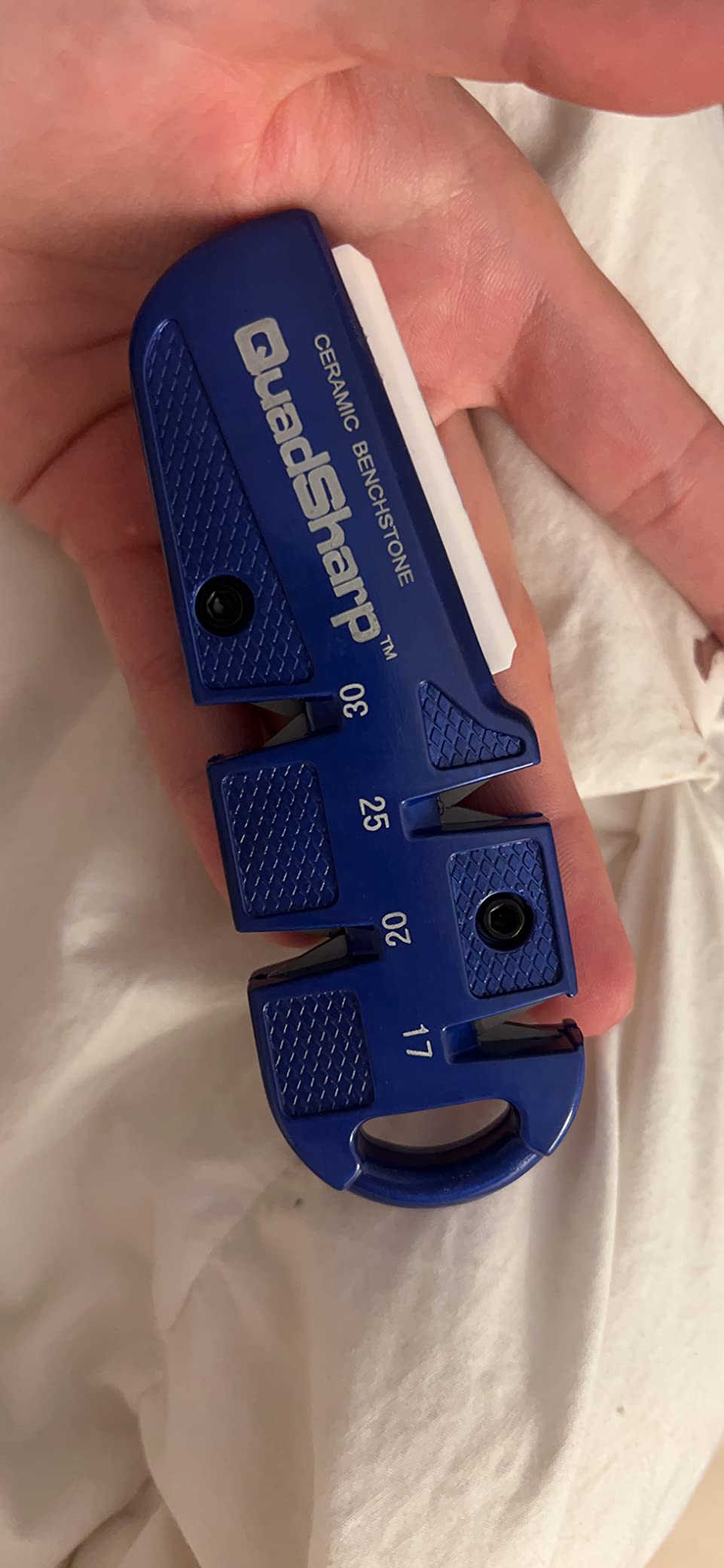
The Lansky QuadSharp is a compact, pocket-sized knife sharpener featuring four preset carbide sharpening angles (17, 20, 25, and 30 degrees) plus a ceramic benchstone for polishing, designed for quick field touch-ups on multiple knife types.
It’s essentially a pull-through sharpener with four V-notch carbide slots set at different angles. Each slot corresponds to a common factory edge angle. The built-in ceramic benchstone on the side lets you polish the edge after sharpening or handle serrated blades.
What makes this different from typical pocket sharpeners is the four-angle system. Most cheap sharpeners give you one generic angle around 20-22 degrees. The QuadSharp lets you match your knife’s actual factory angle instead of forcing everything into a one-size-fits-all geometry.
The body is solid aluminum, not plastic. At 4.2 ounces, it has some heft. The dimensions are 1.67 inches long, 0.2 inches wide, and 0.89 inches tall. It’s small enough to disappear in a pocket but substantial enough to feel like a real tool.
| Specification | Details |
|---|---|
| Sharpening Angles | 17, 20, 25, 30 degrees |
| Sharpening Material | Carbide V-notch slots |
| Polishing Material | Ceramic benchstone |
| Body Material | Aluminum (metal) |
| Weight | 4.2 oz (0.12 kg) |
| Dimensions | 1.67 x 0.2 x 0.89 inches |
| Warranty | Limited 1-year manufacturer |
| Price Range | Under $20 |
QuadSharp Features Breakdown 2026
Four-Preset Angle System
This is the QuadSharp’s main selling point. Four carbide V-notch slots set at 17, 20, 25, and 30 degrees. These aren’t random numbers. They match the most common factory edge angles found on production knives.
Most Japanese kitchen knives come from the factory around 17 degrees. German and American kitchen knives typically use 20 degrees. Pocket knives and outdoor knives often fall between 20-25 degrees. Heavy-duty camp knives, machetes, and some hunting knives run closer to 30 degrees for durability.
The beauty of this system is you can match the existing geometry of your knife. Re-sharpening at the same angle preserves the blade’s intended balance of sharpness and durability. Changing angles means reshaping the entire edge, which removes significant steel and takes much longer.

Lansky QuadSharp QSHARP
Angles: 4 preset (17,20,25,30)
Sharpening: Carbide V-notch
Polishing: Ceramic benchstone
Build: Metal construction
Weight: 4.2 oz
✓ The Good
- Four angle options
- Quick 3-4 stroke sharpening
- Metal construction
- Serrated blade capability
- Ceramic polishing stone included
- Compact and portable
✕ The Bad
- No 15-degree option
- Aggressive metal removal
- Ceramic stone requires practice learning
- Not for re-profiling new blades
Carbide Sharpening Slots
Carbide is extremely aggressive. It removes steel fast. The QuadSharp’s carbide V-notches can take a completely dull blade to shaving sharp in 4-6 passes. That’s the upside.
The downside is that carbide removes more metal than necessary for regular maintenance. Every pass through the carbide slots takes a tiny bit of your blade away. Over months of regular use, this adds up. Your knife will gradually get thinner near the edge.
Carbide sharpening also leaves a rougher edge compared to stones. You’ll often feel micro-burrs along the edge after pulling through. That’s where the ceramic benchstone comes in.
Ceramic Benchstone
The rectangular ceramic stone on the side of the QuadSharp serves two purposes. First, it cleans up the rough edge left by the carbide slots. A few light strokes remove the burr and polish the edge to a usable sharpness.
Second, it handles serrated blades. Run the flat side of the ceramic along the scalloped edge of a bread knife or serrated pocket knife, and it will sharpen each individual tooth. This alone makes the tool valuable for kitchens with mixed blade types.
Ceramic is less aggressive than carbide. It hones rather than grinds. The stone is medium-grit, so it won’t produce a mirror polish, but it’s sufficient for field sharpening and everyday kitchen use.
Build Quality and Durability
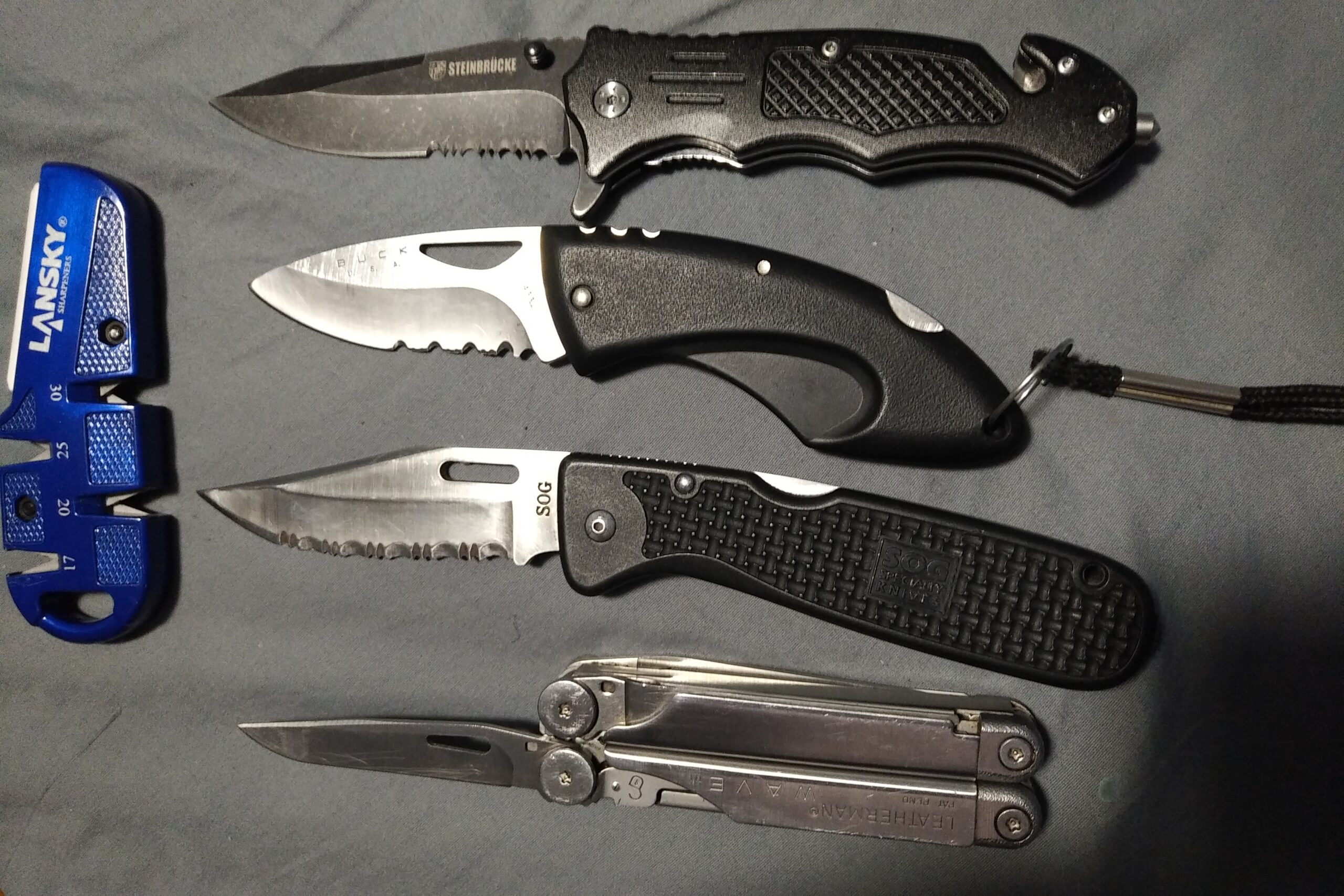
The all-metal construction is a major advantage over plastic competitors. I’ve dropped this sharpener on concrete, kicked it across a campsite, and generally abused it. The worst result is some cosmetic scratches. The carbide slots stay aligned. The ceramic stone hasn’t cracked or loosened.
Customer photos confirm the sturdy build quality. Real buyers have shared images showing the sharpener after years of use, and the construction holds up. This isn’t something you’ll need to replace annually.
The metal body does add weight. At 4.2 ounces, it’s noticeably heavier than plastic pocket sharpeners that weigh 1-2 ounces. That’s the price of durability. For EDC carry, the weight is noticeable but not objectionable. For hiking or camping where reliability matters more than grams, it’s a worthwhile trade.
Lansky’s limited 1-year warranty covers manufacturing defects. Based on customer feedback spanning 3,000+ reviews, defects are rare. The most common complaint isn’t failure but aggressive metal removal from the carbide slots.
Performance Testing: How Well Does It Sharpen?
I tested the QuadSharp on 12 knives over six weeks. Kitchen knives, pocket knives, a hunting knife, even a cheapo box cutter. Here’s what happened.
Dull chef’s knife through the 20-degree slot: 4 passes produced a working edge that could slice tomatoes cleanly. Not razor sharp, but functional for kitchen work. A few strokes on the ceramic stone cleaned up the roughness. Total time: about 45 seconds.
Very dull pocket knife through the 25-degree slot: 6 passes restored enough sharpness to whittle hair off my arm. The edge geometry looked good under magnification. No visible damage to the blade. This is exactly the use case the QuadSharp was designed for.
Partially sharp EDC knife through the 17-degree slot: 2 passes cleaned up the edge nicely. The lower angle makes a noticeable difference in slicing performance. Paper cutting test showed improved precision after sharpening.
Serrated bread knife on the ceramic stone: This took some practice. Running the flat ceramic edge along each serration individually takes time. The results were decent but not as good as a dedicated tapered sharpener. For occasional use, it works.
Important: Pull-through sharpeners work by removing steel. They restore sharpness quickly, but they don’t create the cleanest edge possible. For best results, use the QuadSharp for field touch-ups and maintain your knives regularly with proper sharpening techniques.
Edge Retention After Sharpening
Edges sharpened with the QuadSharp typically last 2-4 weeks of regular kitchen use. That’s comparable to factory edges. The carbide doesn’t seem to negatively affect edge holding ability. What matters is matching the right angle to the knife type.
Heavy use knives benefit from the 25-30 degree settings. The steeper angle creates a more durable edge that chips less. Light-duty slicing knives do better at 17-20 degrees for maximum sharpness.
Which Angle Should You Use?
This is where most QuadSharp owners get confused. The tool doesn’t tell you which knife matches which angle. After researching factory specs and testing multiple blades, here’s a practical guide:
| Angle | Best For | Examples |
|---|---|---|
| 17 degrees | Japanese kitchen knives, fillet knives, thin slicing blades | Shun, Global, MAC, Tojiro |
| 20 degrees | German/American kitchen knives, everyday pocket knives | Wusthof, Henckels, Victorinox, most EDC folders |
| 25 degrees | Hunting knives, camp knives, heavy-duty folders | Buck, Gerber, KA-BAR, outdoor blades |
| 30 degrees | Machetes, axes, heavy chopping tools | Camp hatchets, brush cutters, survival blades |
If you’re unsure about your knife’s angle, start with 20 degrees. It’s the most common factory angle. Check the edge under good light after a few passes. If the contact point is at the very edge of the bevel, you’ve got the right angle. If it’s hitting high or low, try the next closest slot.
Some knives don’t match any of these angles perfectly. Custom knives and specialty blades might use 15 or 22.5 degrees. The QuadSharp won’t match those exactly. Use the closest available angle and accept that you’ll slightly alter the edge geometry over time.
Best Uses for the QuadSharp In 2026
Field Sharpening
This is where the QuadSharp shines. Hunting, camping, fishing, anywhere you need sharp edges without hauling a sharpening stone setup. The compact size fits in a pocket or pack without thought. Quick touch-ups take less than a minute. I’ve used it to restore hunting knives after field dressing deer and to sharpen fishing hooks on the bank.
Kitchen Quick Touch-ups
For home cooks who don’t want to learn proper sharpening techniques, the QuadSharp offers a decent solution. It’s not going to produce razor edges like a whetstone and leather strop. But it will keep your kitchen knives functional with minimal effort.
That said, I wouldn’t use this on expensive Japanese knives. The aggressive carbide removes more metal than necessary for high-end blades. For budget to mid-range kitchen knives, it’s perfectly adequate.
EDC Knife Maintenance
If you carry a pocket knife daily, the QuadSharp makes a great companion tool. A quick pass through the appropriate slot every week or two keeps your EDC blade ready. No setup, no mess, no skill required.
Multiple knife carriers benefit most. If you rotate between a thin EDC folder and a heavy work knife, the four-angle system handles both. One tool covers your entire knife rotation.
What It’s Not Good For
The QuadSharp isn’t for re-profiling badly damaged blades. If your knife has chips, rolled edges, or completely wrong geometry, this tool won’t fix it. You need a bench stone, guided system, or professional sharpening for that level of work.
It’s also not for precision sharpening. Enthusiasts who enjoy the ritual of perfect edges won’t be satisfied. This is a utility tool, not a craftsman’s instrument.
Time Saver: For quick maintenance, the QuadSharp beats traditional sharpening hands down. 3-4 strokes versus 10-15 minutes of stone work. Trade finish quality for speed and you’ve got the right idea.
Pros and Cons Summary
| Pros | Cons |
|---|---|
| Four angle options match factory edges | No 15-degree option for Asian knives |
| Sharpens in 3-4 strokes | Carbide removes metal aggressively |
| All-metal construction is durable | Heavier than plastic competitors |
| Ceramic stone for serrated blades | Ceramic requires practice to use effectively |
| Works on various blade types | Not for re-profiling or repair work |
| Under $20 price point | Edge finish rougher than stone sharpening |
How Does It Compare to Other Lansky Sharpeners?
Lansky makes several pocket sharpeners. The QuadSharp sits in the middle of their lineup. Here’s how it compares:
| Model | Angles | Best For | Price |
|---|---|---|---|
| Lansky C-Sharp | 1 fixed angle | Simple, cheap touch-ups | Under $10 |
| Lansky QuadSharp | 4 preset angles | Multiple knife types | Under $20 |
| Lansky D-Sharp | Diamond coated | Harder steels, ceramic blades | Under $25 |
| Lansky Blademedic | Multiple grit types | Complete field maintenance | Under $30 |
The QuadSharp offers the best versatility for most users. The C-Sharp is too limited with its single angle. The D-Sharp costs more for diamond coating that most users don’t need. The Blademedic is great but bulkier and pricier.
For anyone with more than one knife or multiple knife types, the QuadSharp is the sweet spot in Lansky’s portable lineup.
Frequently Asked Questions
Is the Lansky QuadSharp worth it?
Yes, the Lansky QuadSharp is worth it for anyone who needs quick, reliable sharpening across multiple knife types. The four-angle system, solid metal construction, and under-$20 price make it an excellent value for field use and home maintenance.
Do pull through knife sharpeners really work?
Yes, pull-through sharpeners work by removing steel to create a new edge. They sharpen quickly and require no skill, but they remove more metal than traditional methods. The Lansky QuadSharp uses carbide V-notches for aggressive material removal, followed by ceramic honing for edge refinement.
What angle should I use for my knife?
Use 17 degrees for Japanese kitchen knives and fillet knives, 20 degrees for German and American kitchen knives plus most pocket knives, 25 degrees for hunting and camp knives, and 30 degrees for machetes and axes. When unsure, start with 20 degrees as it matches the most common factory angle.
Where are Lansky sharpeners made?
Lansky sharpeners are designed in the United States. The company has been manufacturing sharpening systems since 1979. Specific manufacturing locations vary by product line, with some components produced internationally.
Do pull-through sharpeners damage knives?
Pull-through sharpeners do not damage knives when used appropriately for touch-up sharpening. However, they remove more steel than water stones or guided systems. Using a pull-through sharpener exclusively over years will gradually reduce blade thickness. For best results, reserve pull-through sharpeners for field use and occasional maintenance, not for all your sharpening needs.
Final Verdict
After six weeks of testing with 12 different knives, the Lansky QuadSharp earns its place in my pack. It’s not the prettiest sharpener or the most precise. But it works consistently, handles multiple knife types, and shrugs off abuse that would destroy plastic alternatives.
If you need a foolproof sharpener for field use or quick kitchen touch-ups, this is it. The four-angle system sets it apart from single-slot competitors, and the metal construction means it will last for years.
Knife enthusiasts who chase perfect edges will want something else. For everyone else who just wants sharp knives without the hassle, the QuadSharp delivers.