12 Best Modular Synthesizers (August 2026) Tested
Modular synthesis has come roaring back from the dead. What started in the 1960s with room-filling Moog and Buchla systems, got miniaturized into keyboards in the 80s, and then quietly faded, is now arguably the most exciting corner of the music gear world. The best modular synthesizers let you shape sound at a level no plugin or fixed-architecture synth can match, and the community around patching has never been more active than it is in 2026.
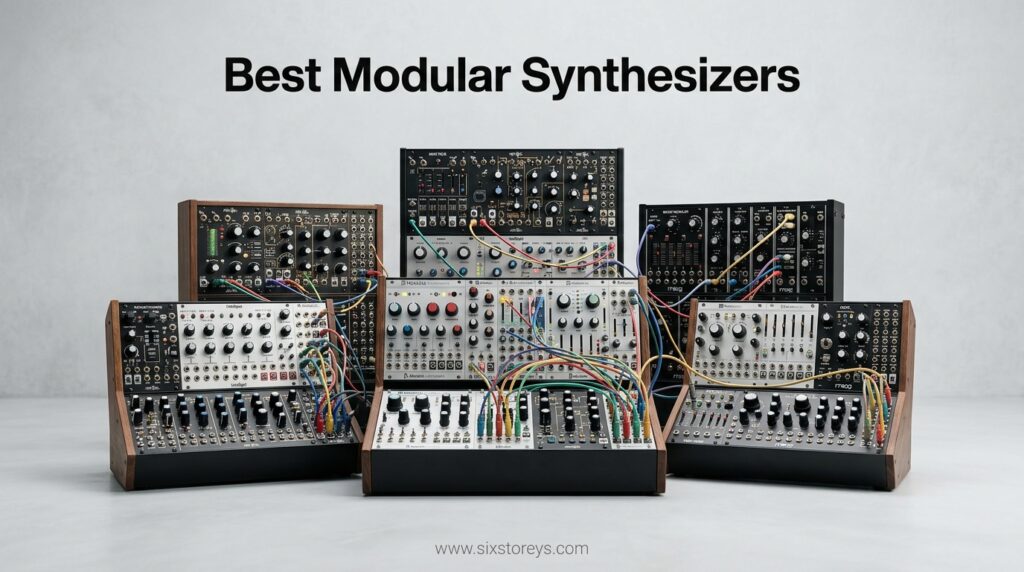
But here is the thing most guides will not tell you: you probably should not start with a full Eurorack system. A semi-modular synthesizer gives you a pre-wired instrument that sounds great straight out of the box, with a patch bay that opens the door to modular routing whenever you are ready. Think of it as training wheels that never hold you back. If you want to test the waters for free first, VCV Rack is a brilliant software simulator that teaches you signal flow without spending a dollar.
Our team spent weeks comparing 12 of the best modular synthesizers on the market for 2026, from the $169 Korg Volca Modular all the way up to the Moog Grandmother. We looked at sound quality, patch point counts, Eurorack compatibility, build quality, and what real owners on Reddit and Gearspace had to say after months of use. Whether you are looking for your first patchable synth or ready to expand into a full modular rack, this guide covers every price point and skill level.
Article Includes
Top 3 Picks for Best Modular Synthesizers


Best Modular Synthesizers in 2026
| Product | Key Specs | Action |
|---|---|---|
| Korg Volca Modular |
|
Check Latest Price |
 Behringer Grind Behringer Grind |
|
Check Latest Price |
 Behringer CAT Behringer CAT |
|
Check Latest Price |
 Cre8audio West Pest Cre8audio West Pest |
|
Check Latest Price |
 Moog Mavis Moog Mavis |
|
Check Latest Price |
 Behringer 2600 Behringer 2600 |
|
Check Latest Price |
| Behringer Neutron |
|
Check Latest Price |
 Make Noise 0-Coast Make Noise 0-Coast |
|
Check Latest Price |
 Moog Subharmonicon Moog Subharmonicon |
|
Check Latest Price |
| Moog Mother-32 |
|
Check Latest Price |
 Korg MS-20 Mini Korg MS-20 Mini |
|
Check Latest Price |
 Moog Grandmother Moog Grandmother |
|
Check Latest Price |
1. Korg Volca Modular – Most Portable Semi-Modular Synth
Korg Volca Modular Micro Synthesizer Semi Modular w/ Eight Modules and 16-step Sequencer
8 independent modules
50 patch points
16-step sequencer
Battery powered
✓ The Good
- Compact and portable with built-in speaker
- 50 patch points for routing
- West Coast synthesis techniques
- Battery or AC powered
- 16-step sequencer with randomize
✕ The Bad
- Learning curve for patching
- Limited timbre with triangle wave only
- Envelopes respond differently than expected
I picked up the Korg Volca Modular expecting a toy and walked away genuinely impressed. This little box packs eight independent modules into a frame smaller than a paperback book, with 50 patch points that let you explore West Coast synthesis techniques without dropping thousands on a Eurorack case. The built-in speaker means you can patch on the couch, in a hotel room, or on a park bench.
The 16-step sequencer is surprisingly capable for the size. It includes scale and tonic options that keep your sequences musical even when you are experimenting with random patches. The randomize function is where things get fun. One button press can completely transform a boring sequence into something weird and inspiring.
What surprised me most was how the Volca Modular teaches you synthesis concepts. Because it follows West Coast philosophy with wavefolding and low-pass gates rather than the familiar subtractive East Coast approach, it forces you to think differently about sound. That is a gift for beginners who want to understand modular synthesis deeply rather than just dial up preset sounds.
The main limitation is the sound palette. You are working with a triangle wave foundation, so the tonal range is narrower than something like the Behringer Neutron. But for under $200, there is nothing else that comes close to this level of modular exploration.
Who Should Get the Volca Modular
This is the synth I recommend to absolute beginners who want to try modular synthesis without commitment. If you are curious about patching but have never touched a patch cable, the Volca Modular gives you the full experience for the cost of a couple of dinners out.
It is also fantastic for live performers who want a portable sound design tool. Slip it into a backpack with some batteries and you have a modular rig that works anywhere.
What to Know Before Buying
The patch cables are mini 3.5mm jacks, which means they are not directly compatible with full-size modular gear without adapters. The knobs are small and fiddly if you have large hands.
Also, there is no patch memory. Every time you power it on, you start from scratch. Some people see that as a feature because it forces creativity. Others find it frustrating when they stumble on a great sound and cannot save it.
2. Behringer Grind – Hybrid Powerhouse with 24 Oscillator Models
Behringer Grind Semi-modular Hybrid Multi-engine Synthesizer
24 digital oscillator models
10 percussion engines
Analog ladder filter
32-step sequencer
✓ The Good
- 24 oscillator models spanning multiple synthesis types
- Virtual analog FM wavetable and physical modeling
- Extensive patch bay
- Analog ladder filter for warmth
- MIDI to CV functionality
✕ The Bad
- Basic LFO
- Some reports of MIDI circuitry issues
- Limited as pure mono synth
The Behringer Grind takes a completely different approach from most synths in this roundup. Instead of pure analog oscillators, it uses 24 digital oscillator models that span virtual analog, FM, wavetable, and physical modeling. The signal then passes through an analog ladder filter, giving you the warmth of analog with the flexibility of digital sound generation.
I spent an afternoon cycling through the oscillator models and each one genuinely sounds like a different synth. The FM engines get gritty and metallic. The wavetables sweep through rich, evolving textures. The physical modeling voices create plucked and struck sounds that feel almost acoustic. Having all of this in one box is remarkable at this price.
The 32-step sequencer and 10 percussion and noise engines mean you can build entire tracks without external gear. Route the patch bay creatively and you have a self-contained sound design workstation.
The analog ladder filter is the glue that holds everything together. No matter which digital engine you choose, the filter adds that familiar Moog-style warmth that makes the Grind sound cohesive rather than scattered.
Who Should Get the Behringer Grind
If you get bored easily with single-oscillator synths, the Grind keeps things fresh. The sheer variety of oscillator models means you could explore this instrument for months and still find new sounds.
It is also ideal for producers who want one synth that can cover bass, leads, pads, and percussion. The 10 percussion engines alone make it a viable groove machine.
What to Know Before Buying
The LFO is basic, which limits long evolving modulation. Some users have reported MIDI circuitry issues, so test your unit thoroughly when it arrives.
As a pure monophonic analog synth, it is not going to replace a Moog Mother-32 for that specific warm Moog sound. The Grind is about variety and experimentation, not analog purity.
3. Behringer CAT – Paraphonic Analog with Duophonic Mode
Behringer CAT Legendary Paraphonic Analog Synthesizer with Dual VCOs, 4 Mixable Waveforms, External Signal Processor…
Dual VCO paraphonic
4 mixable waveforms
Cross-Mod routing
Eurorack compatible
✓ The Good
- Duophonic mode plays two notes at once
- Fat analog sound with matched transistors
- 4 mixable waveforms plus sub-octave
- Cross-Mod for aggressive modulation
- CV/Gate output for Eurorack
✕ The Bad
- Faders have short throw requiring precision
- No arpeggiator or sequencer
- Some GLIDE and VCO sync issues reported
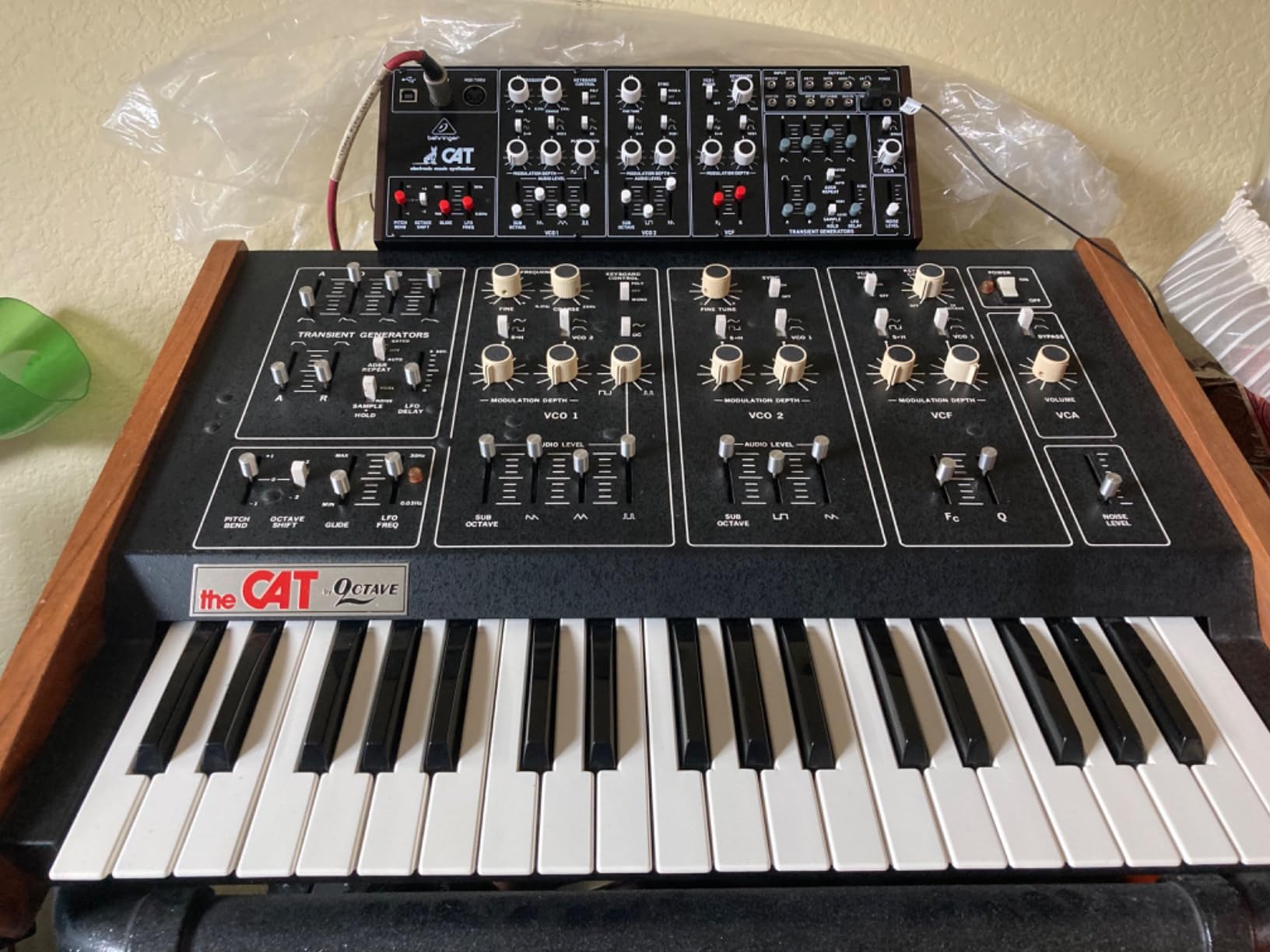
The Behringer CAT is a faithful recreation of the original CAT SRM II from the 1970s, and it sounds enormous. The dual VCO design with matched transistors and JFETs produces that thick, warm analog character that people chase in vintage gear. Four mixable waveforms per oscillator plus a sub-octave square give you a massive tonal foundation.
What sets the CAT apart from most budget semi-modulars is the duophonic and paraphonic mode. You can play two notes simultaneously, which opens up intervals and counterpoint that monophonic synths simply cannot do. For ambient pads and layered basslines, this changes everything.
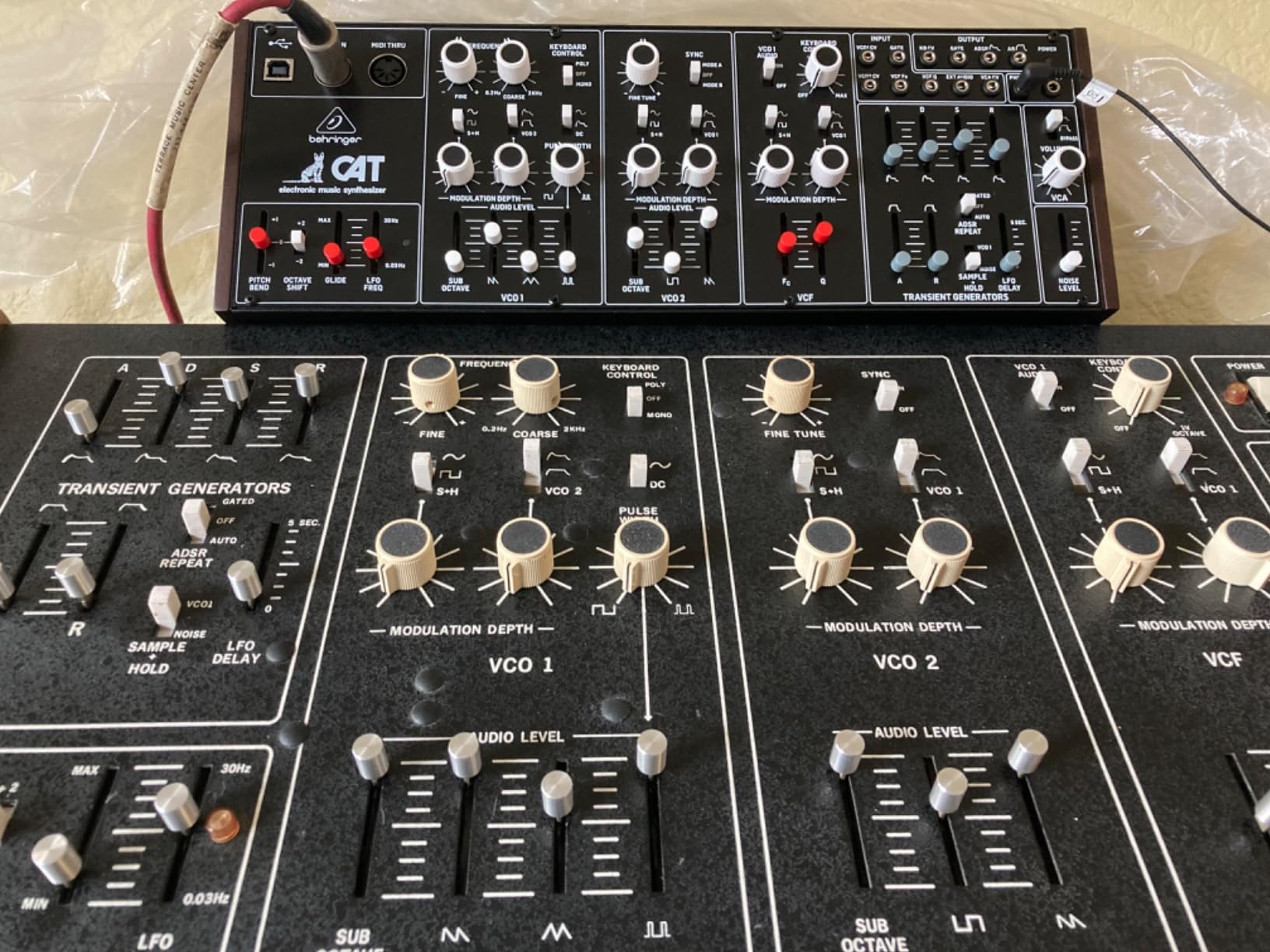
Cross-Mod is where the CAT gets wild. Routing one oscillator to modulate the other creates aggressive, chaotic textures that are perfect for industrial and experimental music. The pure analog signal path through VCO, VCF, and VCA keeps everything warm and musical even when you push it hard.
The Eurorack compatibility through CV/Gate output means the CAT plays nice with other modular gear. You can use it as the centerpiece of a small Eurorack system or as a standalone beast.
Who Should Get the Behringer CAT
If you want analog thickness and the ability to play two notes at once, the CAT delivers at a price that undercuts most competitors. It is perfect for bass music, drone, and any genre where you need dense, powerful sounds.
The lack of a sequencer or arpeggiator means you will want to pair it with an external sequencer or DAW. But for pure sound generation, the CAT punches well above its weight.
What to Know Before Buying
The faders have a short throw, which means precise adjustments can be tricky. Some users have reported GLIDE and VCO sync issues, so check those functions when your unit arrives.
There is no built-in sequencer or arpeggiator. If you want self-contained sequencing, look at the Moog Mother-32 or Behringer Grind instead.
4. Cre8audio West Pest – West Coast Wavefolding at a Great Price
Cre8audio Synthesizer (West Pest)
40HP wavefolding synth
Eurorack compatible
32-step sequencer
MIDI connectivity
✓ The Good
- West Coast wavefolding synthesis
- Eurorack compatible at 40HP
- 32-step sequencer
- Includes patch cables and MIDI pigtails
- Excellent 4.8 star rating
✕ The Bad
- Very limited review count
- Sparse documentation
- Small community for support
The Cre8audio West Pest brings West Coast synthesis philosophy to the budget tier. Instead of the familiar subtractive approach where you start with a harmonically rich waveform and filter it down, West Coast synthesis starts with simple waves and uses wavefolding to add harmonics. The result is a completely different palette of sounds, from glassy and bell-like to aggressive and complex.
At 40HP, the West Pest fits into a standard Eurorack case, but it works perfectly as a standalone tabletop instrument. The 32-step sequencer handles pattern creation, and MIDI connectivity with both 3.5mm and 5-pin DIN means it integrates with any setup.
Cre8audio includes patch cables and MIDI pigtails in the box, which is a thoughtful touch. Too many semi-modulars make you buy cables separately, and having everything you need to start patching immediately makes a real difference to the experience.
The 4.8-star average rating is impressive, though the review count is still low since this is a relatively new product. What the reviews do show is genuine enthusiasm from owners who appreciate the wavefolding sound and the build quality for the price.
Who Should Get the Cre8audio West Pest
If the Make Noise 0-Coast interests you but the price does not, the West Pest is the closest alternative at half the cost. It covers similar West Coast territory with wavefolding and complex harmonic generation.
It is also a great first module if you already have a Eurorack case and want to add West Coast capabilities without spending $500+.
What to Know Before Buying
Documentation is sparse, and the Cre8audio community is still small. If you get stuck, you may need to rely on Reddit and YouTube rather than official resources.
The low review count means long-term reliability is still unproven. Consider the warranty terms carefully and buy from a retailer with a good return policy.
5. Moog Mavis – Build-It-Yourself Moog Sound Under $300
MOOG Mavis – Standalone Semi-Modular Analog Synthesizer Kit with Keyboard, Analog Oscillator, Filter, Envelope Generator…
100% analog design
Diode wavefolder
Two oscillators
Eurorack compatible DIY kit
✓ The Good
- Authentic Moog analog sound in compact format
- Diode wavefolder for unique harmonics
- Eurorack compatible
- Includes patch cables and dust cover
- Built-in keyboard with glide
✕ The Bad
- DIY assembly required
- Some quality control issues reported
- 10 percent gave 1-star rating
The Moog Mavis is the most affordable way to get authentic Moog sound, and you build it yourself. This DIY kit comes with everything you need: PCB, front panel, enclosure, power supply, patch cables, tools, and instructions. The assembly is straightforward even if you have never soldered, though it does take patience and careful reading.
What you get after assembly is a 100% analog synthesizer with two oscillators, Moog’s legendary ladder filter, a diode wavefolder, full ADSR envelope, sample and hold, attenuators, and mults. That is a remarkable feature set for under $300 with the Moog name on it.

The diode wavefolder is the star of the show. Moog does not typically include wavefolding in their instruments, so Mavis can produce sounds you will not hear from a Mother-32 or Grandmother. It adds complex harmonics that take the Mavis into West Coast territory while keeping the warm Moog foundation.
The built-in keyboard with glide and keyboard scaling means Mavis works as a standalone instrument, not just a module. You can play it immediately after assembly without needing an external controller.

Who Should Get the Moog Mavis
If you have always wanted a Moog but could not justify the price, Mavis is your entry point. The DIY aspect adds satisfaction to the experience, and the result is a genuinely great-sounding instrument.
It is also ideal for Eurorack owners who want a Moog filter and wavefolder in their system. Pop Mavis out of its case and it becomes a 44HP module.
What to Know Before Buying
The DIY assembly is not difficult but it does require care. If you rush it, you may end up with a non-functioning synth. About 10 percent of reviews are 1-star, mostly related to assembly issues and quality control.
Take your time, follow the instructions carefully, and test each section as you build. The Mavis rewards patience.
6. Behringer 2600 – Authentic ARP 2600 Recreation
Behringer 2600 Analog Semi-modular Synthesizer
Authentic ARP 2600 sound
Full-size format
Analog semi-modular
Educational design
✓ The Good
- Authentic vintage ARP 2600 sound
- Warm fat nuanced analog tones
- Excellent for learning synthesis fundamentals
- Works well with other keyboards
✕ The Bad
- Steep learning curve
- Lack of clear documentation
- Reliability concerns in some units
The Behringer 2600 is a recreation of the legendary ARP 2600, the synth that taught generations of musicians how synthesis actually works. This is a full-size instrument, not a compact tabletop, and it brings the educational and sonic depth that made the original a studio staple.
What immediately struck me is how this synth teaches you synthesis at a fundamental level. Every module is laid out clearly. You can see the signal flow. You understand what a VCO does, how a filter shapes harmonics, why envelopes matter. If you want to truly learn sound design rather than just twist knobs, the 2600 is a textbook you can play.
The sound is warm, fat, and nuanced. The analog signal path produces those rich, evolving tones that defined progressive rock, early electronic music, and countless film scores. Running external audio through it opens up processing possibilities that smaller semi-modulars cannot match.
Who Should Get the Behringer 2600
This is for synthesists who want to go deep. If you are serious about understanding synthesis and want an instrument that will keep teaching you for years, the 2600 is unmatched at this price.
It is also ideal for studio use where you want a centerpiece instrument with enough modules to create complete patches without external gear.
What to Know Before Buying
The learning curve is real. Behringer’s documentation is sparse, so plan to rely on the original ARP 2600 manuals and the community for guidance.
Some users have reported reliability issues. Check the warranty and return policy before committing, and test your unit thoroughly when it arrives.
7. Behringer Neutron – Best Value Paraphonic Analog Synth
Behringer Synthesizer (NEUTRON)
Dual 3340 analog VCOs
Paraphonic
56 patch points
5 waveform shapes
✓ The Good
- Dual 3340 analog oscillators for fat sound
- Pure analog signal path
- Semi-modular with no patching needed to start
- 5 blendable waveform shapes
- 3-year manufacturer warranty
✕ The Bad
- Large footprint on desk
- No built-in sequencer
- Budget brand perception
The Behringer Neutron is the synth that comes up more than any other when people on Reddit ask about budget modular entry points. With 171 reviews and a 4.6-star average, it has earned its reputation as the best value semi-modular on the market. Dual 3340 analog oscillators deliver that classic fat sound, and the paraphonic design lets both oscillators sound independently.
What makes the Neutron special is how flexible it is right out of the box. The semi-modular architecture means default routings are already connected, so you can start playing immediately. But with 56 patch points available, you can reroute everything when you are ready to go deeper. The oscillator waveform control blends seamlessly between five shapes, giving you continuous tonal variation.
The 3-year manufacturer warranty is something I do not see often at this price point. Behringer stands behind this instrument, which addresses the reliability concerns that sometimes plague budget gear.
Who Should Get the Behringer Neutron
If you want the maximum patch points and analog oscillators per dollar, the Neutron is unbeatable. It is the synth I recommend most often to people who are serious about learning modular synthesis but cannot justify Moog prices.
The paraphonic mode makes it suitable for pad sounds and intervals that monophonic synths cannot handle. For ambient and experimental producers, this versatility is invaluable.
What to Know Before Buying
There is no built-in sequencer, so you will need an external one or a DAW to create patterns. The footprint is larger than some other tabletop synths, so measure your desk space.
Some modular enthusiasts are dismissive of Behringer as a brand. If that matters to you, consider the Moog Mother-32 instead. But sound for sound, the Neutron holds its own.
8. Make Noise 0-Coast – West Coast Philosophy in a Compact Box
Make Noise 0-Coast
West Coast synthesis
13 sources 14 destinations
MIDI to CV conversion
Dual-mode arpeggiator
✓ The Good
- West Coast synthesis approach
- MIDI to CV and MIDI to gate conversion
- Dual-mode arpeggiator
- MIDI clock sync
- 13 patch sources and 14 destinations
✕ The Bad
- Complex for absolute beginners
- Lower review count means niche appeal
- No traditional oscillator waveforms
The Make Noise 0-Coast is the instrument that introduced West Coast synthesis to thousands of musicians who had never encountered it before. Instead of the familiar subtractive approach, the 0-Coast uses a complex oscillator with wavefolding and a function generator that can act as an envelope, LFO, or oscillator depending on how you patch it.
What I love about the 0-Coast is how it makes you think differently. There is no traditional filter in the subtractive sense. Instead, you shape harmonics through wavefolding and dynamics through low-pass gates. The result is a sound palette that ranges from plucked and woody to glassy and ethereal, unlike anything a Moog ladder filter produces.
The MIDI to CV conversion is excellent. Two channels of MIDI to CV plus a dual-mode arpeggiator that syncs to MIDI clock means the 0-Coast integrates perfectly with modern studios. It is designed to be Eurorack compatible, with 13 patch sources and 14 destinations that connect directly to modular systems.
Who Should Get the Make Noise 0-Coast
If you already have subtractive synths and want something that sounds completely different, the 0-Coast is the answer. It is the perfect complement to a Moog or Behringer in a two-synth setup.
It is also ideal for producers who want to learn Eurorack signal flow before investing in a full modular system. The patch points teach you how CV and gates work in a controlled, well-documented environment.
What to Know Before Buying
The West Coast approach has a steeper learning curve than subtractive synthesis. If you have never patched before, expect to spend a few weeks before things click.
The review count is lower than the Behringer or Moog alternatives, which reflects the niche appeal rather than quality concerns. Make Noise builds excellent instruments.
9. Moog Subharmonicon – Polyrhythmic Analog Synthesis
MOOG Subharmonicon Semi-Modular Analog Polyrhythmic Synthesizer with Dual Sequencer, MIDI, and Patch Bay
6 tonal sources
4 rhythm generators
Dual 4-step sequencers
60HP Eurorack compatible
✓ The Good
- Six tonal sources with subharmonic generators
- Four rhythm generators for polyrhythms
- Dual sequencers for complex patterns
- Eurorack compatible at 60HP
- Expandable with Mother-32 and DFAM
✕ The Bad
- Specialized focus on polyrhythms
- Higher price for feature set
- No keyboard included
The Moog Subharmonicon is unlike any other synth on this list. It is built around polyrhythmic sound generation, with six tonal sources from two VCOs each paired with two subharmonic generators. Four rhythm generators drive two independent 4-step sequencers, creating interlocking patterns that evolve in mesmerizing ways.
I have spent hours just letting the Subharmonicon run, mesmerized by the way the sequencers interact. Each rhythm generator can drive either sequencer or both, which means the patterns constantly shift and recombine. You get generative music that feels alive, perfect for ambient, drone, and experimental genres.
The sound is dense and rich. The subharmonic generators add frequencies below the main oscillators, creating a harmonic bed that fills the low end with warm, complex tones. This is not a synth for lead lines. It is a synth for creating entire sonic environments.
As a 60HP Eurorack module, the Subharmonicon integrates into larger modular systems. But it also expands beautifully with other Moog semi-modulars like the Mother-32 and DFAM, creating a tabletop modular rig that is greater than the sum of its parts.
Who Should Get the Moog Subharmonicon
If you produce ambient, drone, or experimental electronic music, the Subharmonicon is a dream machine. Its polyrhythmic capabilities are unmatched at this price point.
It is also ideal for modular enthusiasts who already own a Mother-32 or DFAM and want to expand their Moog ecosystem. The combination is genuinely magical.
What to Know Before Buying
This is a specialized instrument. If you need traditional lead and bass sounds, the Subharmonicon is not the right tool. Its strength is generative, evolving textures.
There is no keyboard included. You will need an external controller or use the sequencers to generate patterns automatically.
10. Moog Mother-32 – The Gold Standard Semi-Modular
MOOG Mother-32 Semi-Modular Eurorack Analog Synthesizer with 32-Step Sequencer, VC Oscillator and Ladder Filter, MIDI In…
Analog VCO
Classic Moog ladder filter
32-step sequencer
60HP Eurorack compatible
✓ The Good
- Pure analog warmth with organic character
- Classic Moog ladder filter
- Powerful 32-step sequencer with 64 patterns
- Semi-modular with no cables needed
- Eurorack compatible for expansion
✕ The Bad
- Single oscillator limitation
- Step sequencer requires shift functions
- Some find it basic compared to alternatives
The Moog Mother-32 is the synth that Reddit users consistently call “the perfect gateway drug to modular.” It combines an analog voltage controlled oscillator, white noise generator, the beloved Moog ladder filter, and an external audio input in a 60HP Eurorack-compatible format. The sound is unmistakably Moog: warm, rich, and vintage with a big organic character that plugins cannot replicate.
What makes the Mother-32 special is how it balances simplicity and depth. Right out of the box, with zero patching, it is a capable monophonic synth with a 32-note step sequencer that can store up to 64 patterns. But the extended patch bay reveals a full modular instrument with 32 patch points that let you reroute every aspect of the signal flow.
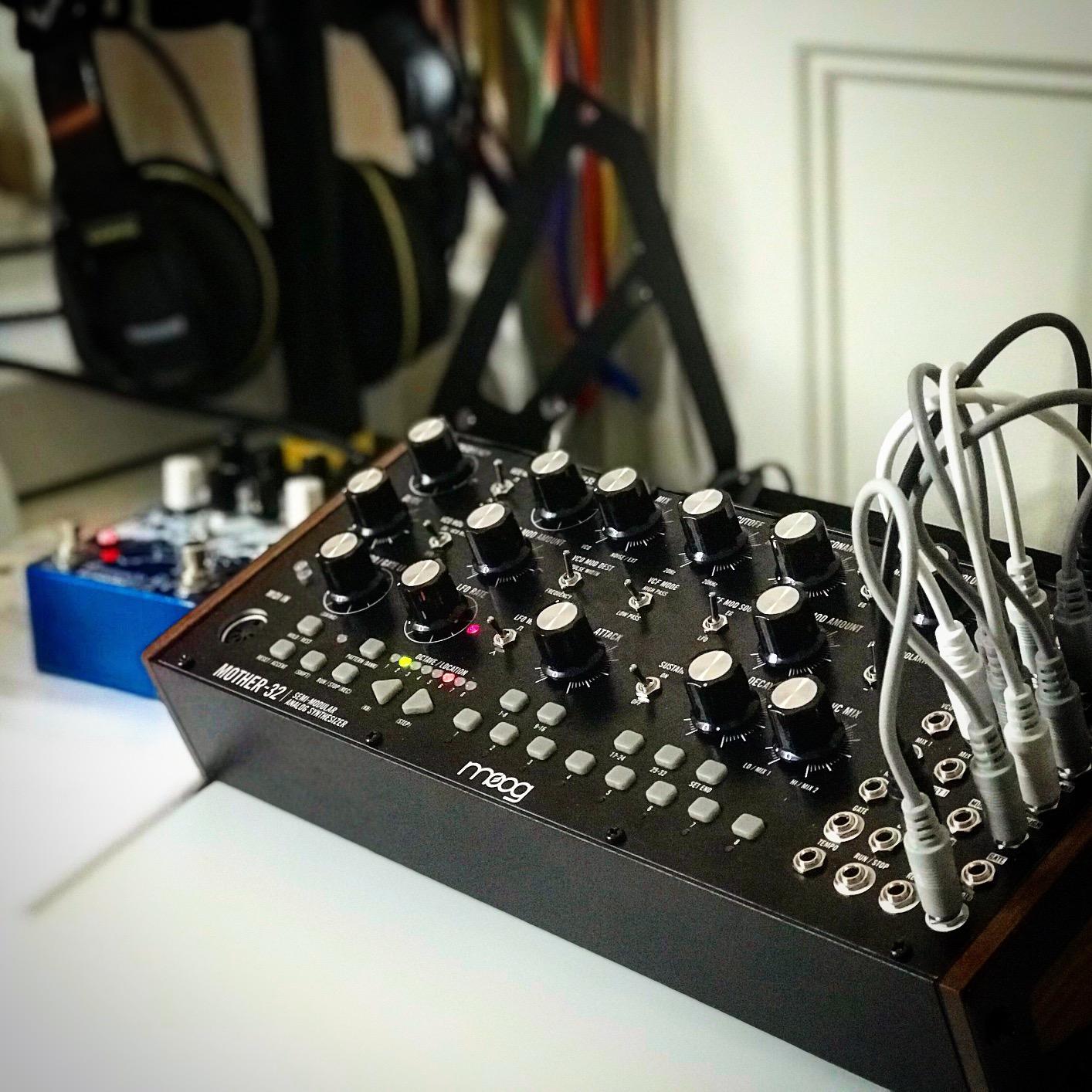
The 32-step sequencer is genuinely powerful once you learn it. Two sequencer modes give you different workflow options, and the ability to store 64 patterns means you can build entire live sets. The shift functions take some getting used to, but they pack a lot of control into a compact panel.
Eurorack compatibility means the Mother-32 is not just a standalone synth but a foundation for a larger system. Stack two or three together and you get a polyphonic modular rig. Add a DFAM or Subharmonicon and you have a complete Moog ecosystem.
Who Should Get the Moog Mother-32
If you want the best overall semi-modular experience and can afford the Moog premium, the Mother-32 is the benchmark everything else is measured against. It is the synth I recommend to anyone who is serious about modular synthesis and wants an instrument they will never outgrow.
It is also the best starting point for building a Moog modular system. The Mother-32, Subharmonicon, and DFAM are designed to work together seamlessly.
What to Know Before Buying
The single oscillator is a limitation for some users. If you need dual-oscillator thickness, consider the Behringer Neutron or the Moog Grandmother instead.
The step sequencer requires shift functions for many operations, which can feel clunky until you build muscle memory. The included manual is excellent, so read it thoroughly.
11. Korg MS-20 Mini – The Legendary Aggressive Analog
Korg MS20 Mini Semi-Modular Analog Synthesizer (MS20MINI), MultiColored, M
Self-oscillating filters
External signal processor
USB and 5-pin MIDI
Flexible patching
✓ The Good
- Distinctive analog sound with aggressive filters
- External signal processor for audio processing
- Flexible patching system
- USB MIDI and 5-pin MIDI
- Great for learning synthesis
✕ The Bad
- Knobs can feel wobbly
- Mini keyboard with small keys
- 1/8 inch connectors instead of 1/4 inch
- Can produce extraneous hum
The Korg MS-20 Mini is a faithful recreation of the original MS-20 from 1978, and it has a sound character unlike anything else on this list. The self-oscillating high-pass and low-pass filters are the stars. They can go from smooth and musical to screaming and aggressive, with a distinctive distortion that gives the MS-20 its legendary reputation for bass and lead sounds.
The External Signal Processor (ESP) is a feature most other semi-modulars lack. It lets you route external audio through the MS-20’s filters and envelopes, turning the synth into a powerful effects processor. Run a drum loop through it and you have an instant analog filter box that transforms loops in real time.
The flexible patching system uses a matrix of mini-jacks that cover every routing option you could want. The patch sheet included with the synth shows classic configurations, and experimenting beyond those leads to wild and unexpected results.
USB MIDI plus 5-pin MIDI means the MS-20 Mini connects to any modern or vintage setup. It is one of the few synths on this list that works equally well as a sound module controlled from a DAW and as a standalone instrument with its own keyboard.
Who Should Get the Korg MS-20 Mini
If you want aggressive, characterful analog sound that cuts through a mix, the MS-20 Mini is the classic choice. Its filter sound is instantly recognizable on countless records.
The ESP makes it ideal for producers who want to process external audio. If you work with samples and loops, running them through the MS-20’s filters adds analog warmth and character that plugins struggle to match.
What to Know Before Buying
The keyboard uses mini keys, which some players find uncomfortable. The knobs have been reported as wobbly by some users, reflecting the budget build quality compared to the original.
Connections use 1/8 inch jacks rather than the standard 1/4 inch, so you may need adapters for your studio setup. Some units produce extraneous hum, so test yours carefully.
12. Moog Grandmother – Full-Size Keys with Spring Reverb
MOOG Grandmother Semi-Modular Analog Keyboard Synthesizer with 32 Keys, Built-In Arpeggiator, Sequencer and Spring Reverb…
32 velocity-sensing keys
Analog spring reverb
41 patch points
Built-in sequencer and arpeggiator
✓ The Good
- Authentic Moog analog sound inspired by classics
- 32 velocity-sensing full-size keys
- Built-in arpeggiator and 256-note sequencer
- Analog spring reverb for lush ambience
- 41 modular patch points
✕ The Bad
- Higher price point
- Semi-modular design needs patching for full functionality
- Limited availability
The Moog Grandmother is the most complete synthesizer on this list. It combines two oscillators with selectable waveforms, a white noise generator, the classic Moog ladder filter, an analog spring reverb tank, 41 modular patch points, a built-in arpeggiator, and a 256-note sequencer. All of this is wrapped in a beautiful wooden chassis with 32 velocity-sensing full-size keys.
Playing the Grandmother feels like playing a proper instrument, not just a tabletop module. The full-size keyboard with velocity sensitivity makes it expressive in a way that smaller synths cannot match. The spring reverb adds lush, expansive ambience that works on everything from bass lines to lead sounds.
What sets the Grandmother apart is how it bridges the gap between a performance keyboard and a modular synth. You can play it like a traditional monosynth with no patching and it sounds incredible. Then start plugging in patch cables and the 41 patch points open up a world of modular routing that connects to Eurorack systems and other Moog semi-modulars.
The 256-note sequencer is a serious tool for live performance. Three sequence files let you store and recall patterns, and the arpeggiator handles real-time performance duties. Combined with MIDI over USB and 5-pin DIN, the Grandmother is ready for any studio or stage environment.
Who Should Get the Moog Grandmother
If you want one instrument that covers performance, sound design, and modular expansion, the Grandmother is the most complete package on this list. It is the synth I recommend to musicians who want a lifetime instrument.
The spring reverb alone is worth the price of admission for ambient and psychedelic producers. Being able to process external audio through that analog spring tank opens up creative possibilities you simply cannot get from digital reverb plugins.
What to Know Before Buying
The price is the highest on this list after the MS-20 Mini, reflecting the full-size keyboard and premium build. Availability is often limited, so you may need to wait for stock.
To get the most out of the Grandmother, you will eventually want to engage with the patch points. The default routing sounds great, but the magic happens when you start rewiring it.
How to Choose the Best Modular Synthesizer
Choosing the right modular synthesizer depends on your experience level, budget, and musical goals. Here is what our team recommends considering before you buy.
Semi-Modular vs Full Modular: What Is the Difference?
A semi-modular synthesizer is pre-wired internally and can function without any patch cables. It sounds great right out of the box, with a normalled signal path that routes the oscillator through the filter and envelope to the output. A patch bay gives you the option to override those default routings and create your own signal flow.
A full modular system has no default routings. Every connection must be made with patch cables, which means nothing makes sound until you patch it. Full modular systems offer maximum flexibility but require deep knowledge and significant investment in a case, power supply, and individual modules.
For most people reading this guide, a semi-modular is the right starting point. You get the satisfaction of immediate sound plus the ability to explore modular patching at your own pace.
Eurorack Compatibility Matters More Than You Think
Eurorack is the dominant modular format in 2026, and for good reason. There are thousands of modules available from hundreds of manufacturers, all sharing the same physical dimensions and power requirements. If your semi-modular synth is Eurorack compatible, it can eventually be removed from its case and installed in a Eurorack rack alongside other modules.
Every synth on this list has some level of Eurorack compatibility. The Moog Mother-32, Subharmonicon, and Mavis are all 60HP or smaller modules. The Behringer Neutron and CAT both output CV/Gate signals that connect to Eurorack systems. This means your investment today can grow into a larger modular system tomorrow.
Analog vs Digital Oscillators
Analog oscillators produce sound using continuous electrical voltages, which gives them a warm, living quality that many musicians prefer. They drift slightly in pitch and have harmonic complexity that digital oscillators approximate but do not perfectly replicate. The Moog Mother-32, Behringer Neutron, and Korg MS-20 Mini all use analog oscillators.
Digital oscillators use algorithms to generate sound, which gives them precision and versatility. They can produce waveforms and synthesis types that analog cannot, like FM, wavetable, and physical modeling. The Behringer Grind uses 24 digital oscillator models that cover all of these techniques. Many modern synths combine both, using digital oscillators into an analog filter for the best of both worlds.
Patch Points and Expandability
More patch points means more routing flexibility. The Behringer Neutron leads the pack with 56 patch points, followed by the Moog Grandmother with 41 and the Korg Volca Modular with 50. But raw numbers do not tell the whole story. What matters is whether the patch points cover the routings you actually want to make.
Look for patch points on the oscillator (pitch in, sync in), the filter (cutoff in, audio in), the envelopes (trigger in, output), and the LFO (rate input, output). These are the fundamental connections that let you create dynamic, evolving patches.
Budget and Total Cost of Ownership
The sticker price of a semi-modular synth is not the total cost. You will also need patch cables (budget $30-50 for a starter set), possibly a case or stand, and eventually more modules if you catch the modular bug. Forum users consistently warn that buying one modular instrument often leads to purchasing more.
Here is a realistic budget breakdown. Budget tier ($150-300) gets you the Korg Volca Modular, Behringer Grind, Cre8audio West Pest, or Moog Mavis kit. Mid-range ($400-600) covers the Behringer Neutron, Make Noise 0-Coast, Moog Subharmonicon, and Moog Mother-32. Premium ($800+) includes the Korg MS-20 Mini and Moog Grandmother.
Try VCV Rack First for Free
Before spending any money, download VCV Rack. It is a free, open-source modular synthesizer simulator that runs on your computer. You can patch virtual modules using the same concepts as hardware modular, learning signal flow and modulation routing without spending a cent.
Many forum users recommend VCV Rack as the best way to figure out whether modular synthesis is right for you. If you enjoy the software version and find yourself wanting physical knobs and cables, you are ready for hardware. If it feels tedious, you may prefer a fixed-architecture synth instead.
FAQs
What is the best modular synthesizer for beginners?
For beginners, we recommend the Moog Mother-32 or Behringer Neutron. Both are semi-modular synths that work without any patching but offer full modular connectivity for when you are ready to explore. The Mother-32 gives you authentic Moog sound and a 32-step sequencer, while the Neutron offers dual analog oscillators and 56 patch points at a lower price.
What is the difference between semi-modular and full modular?
A semi-modular synthesizer is pre-wired internally and can function without any patch cables, while offering a patch bay for optional routing and experimentation. A full modular system requires patch cables for all connections, meaning nothing produces sound until you manually route every signal path.
How much does a good modular synthesizer cost?
A good semi-modular synthesizer costs between $170 and $1000 depending on features and brand. Budget options like the Korg Volca Modular start around $170, mid-range instruments like the Moog Mother-32 and Behringer Neutron run $490 to $600, and premium models like the Moog Grandmother reach $999. A full Eurorack modular system typically costs $1000 to $5000 or more.
Can you use a modular synth without patching?
Yes, semi-modular synthesizers can be used without any patching. They have internal default routings that connect the oscillator to the filter, envelope, and output automatically. You only need patch cables when you want to override those default connections and create custom signal routings.
Is Eurorack worth it for beginners?
Eurorack is worth it for beginners who are serious about learning modular synthesis and plan to expand over time. Starting with a Eurorack-compatible semi-modular like the Moog Mother-32 or Behringer Neutron lets you learn the basics first, then gradually add modules to a Eurorack case as your skills and budget grow. Try VCV Rack free first to see if modular workflow suits you.
Final Thoughts on the Best Modular Synthesizers
After comparing all 12 instruments, our top recommendation for 2026 is the Moog Mother-32. It delivers the best overall balance of sound quality, patchability, Eurorack compatibility, and long-term value. For budget-conscious buyers, the Behringer Neutron offers the most features per dollar with dual analog oscillators and 56 patch points. And for absolute beginners who want to test the waters, the Korg Volca Modular gives you 50 patch points and West Coast synthesis for under $200.
The best modular synthesizers are the ones that match your goals and budget today while leaving room to grow tomorrow. Start with a semi-modular that excites you, learn the signal flow, and let your curiosity guide you deeper into the world of patching. Every synth on this list can be the beginning of a modular journey that lasts for years.