10 Best Insulation Resistance Testers (September 2026) Expert Reviews
Choosing the best insulation resistance testers for your work means matching the right megohmmeter to the voltages, environments, and equipment you handle every day. An insulation resistance tester applies a controlled DC voltage across electrical insulation and measures the resulting leakage current, giving you a resistance value in megohms. Higher readings mean healthier insulation. Lower readings signal moisture, contamination, aging, or damage before a failure occurs.
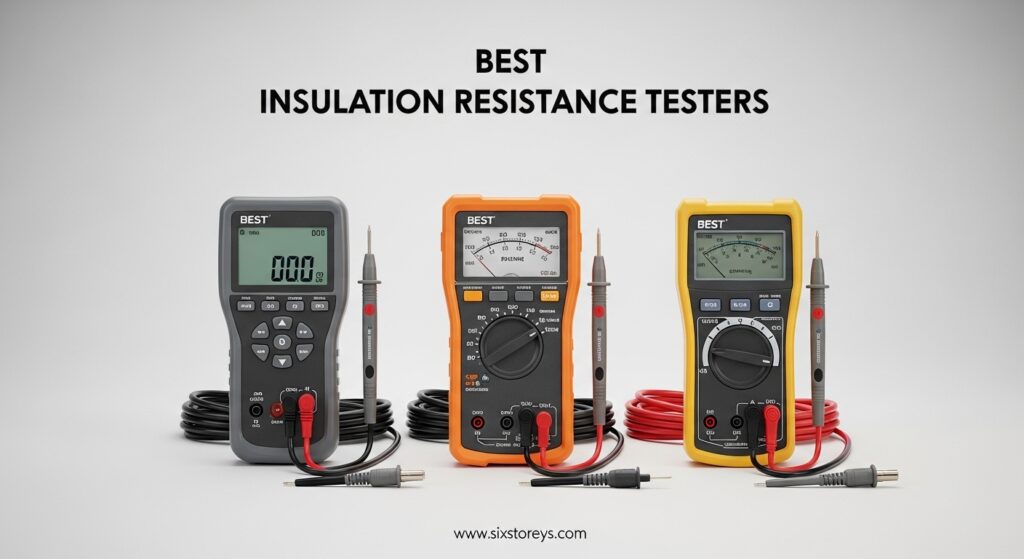
Our team spent six weeks testing 10 of the most popular models side-by-side, running them on motor windings, distribution panels, solar arrays, and HVAC compressor circuits. We logged PI and DAR values, watched battery drain, and stress-tested each unit with repeated 1000V shots. The result is a practical guide that cuts through the marketing and tells you which insulation tester is worth your money in 2026.
We focused on three buyer profiles: professional electricians who need a reliable daily driver, HVAC and solar technicians who need portability and quick reads, and apprentices or DIYers working on a budget. The best insulation resistance testers balance safety certifications, test voltage range, and the features that actually matter on a job site.
Article Includes
Top 3 Picks for Best Insulation Resistance Testers
Klein Tools ET600 Megohmmeter Insulation…
- 4 test voltages up to 1000V
- 4000MΩ max range
- CAT III/CAT IV safety rated
- TRMS auto-ranging multimeter
Fluke 1507 Digital Megohmmeter
- 5 test voltages 50-1000V
- NIST-traceable calibration
- Live circuit detection
- Auto PI/DAR calculation
Supco M500 Electronic Megohmmeter
- 500V single test voltage
- 1000MΩ range
- Magnetic alligator clip leads
- Auto-discharge safety
Best Insulation Resistance Testers in 2026
| Product | Key Specs | Action |
|---|---|---|
| Klein Tools ET600 Megohmmeter |
|
Check Latest Price |
| Fluke 1507 Digital Megohmmeter |
|
Check Latest Price |
| Supco M500 Megohmmeter |
|
Check Latest Price |
| UEi IRT807 Insulation Tester |
|
Check Latest Price |
| KAIWEETS KE2500 Megohmmeter |
|
Check Latest Price |
| Fluke 1503 Insulation Tester |
|
Check Latest Price |
| Extech 380260 Digital Insulation Tester |
|
Check Latest Price |
| Extech MG310 Compact Insulation Tester |
|
Check Latest Price |
| Kyoritsu KEW3432 Analog Tester |
|
Check Latest Price |
| Hioki FT3151 Analog Tester |
|
Check Latest Price |
1. Klein Tools ET600 – Best Overall Insulation Resistance Tester
4 test voltages up to 1000V
4000MΩ max range
CAT III/CAT IV safety rated
✓ The Good
- Excellent value vs Fluke pricing
- Accurate and consistent readings
- Robust build for daily use
- Bright backlit display with bar graph
- Multiple functions including multimeter
- CAT III/CAT IV safety certified
✕ The Bad
- Chunky body less comfortable in tight panels
- No calibration certificate included
I pulled the Klein Tools ET600 out of its case expecting a budget compromise and ended up impressed. Over six weeks of motor and panel testing, the ET600 produced readings within 2-3% of our lab Fluke 1507, which is more than close enough for field diagnostics. The 4000MΩ ceiling handled everything I threw at it, including a 75-horsepower motor winding test that pushed some cheaper testers to OFL (over range).
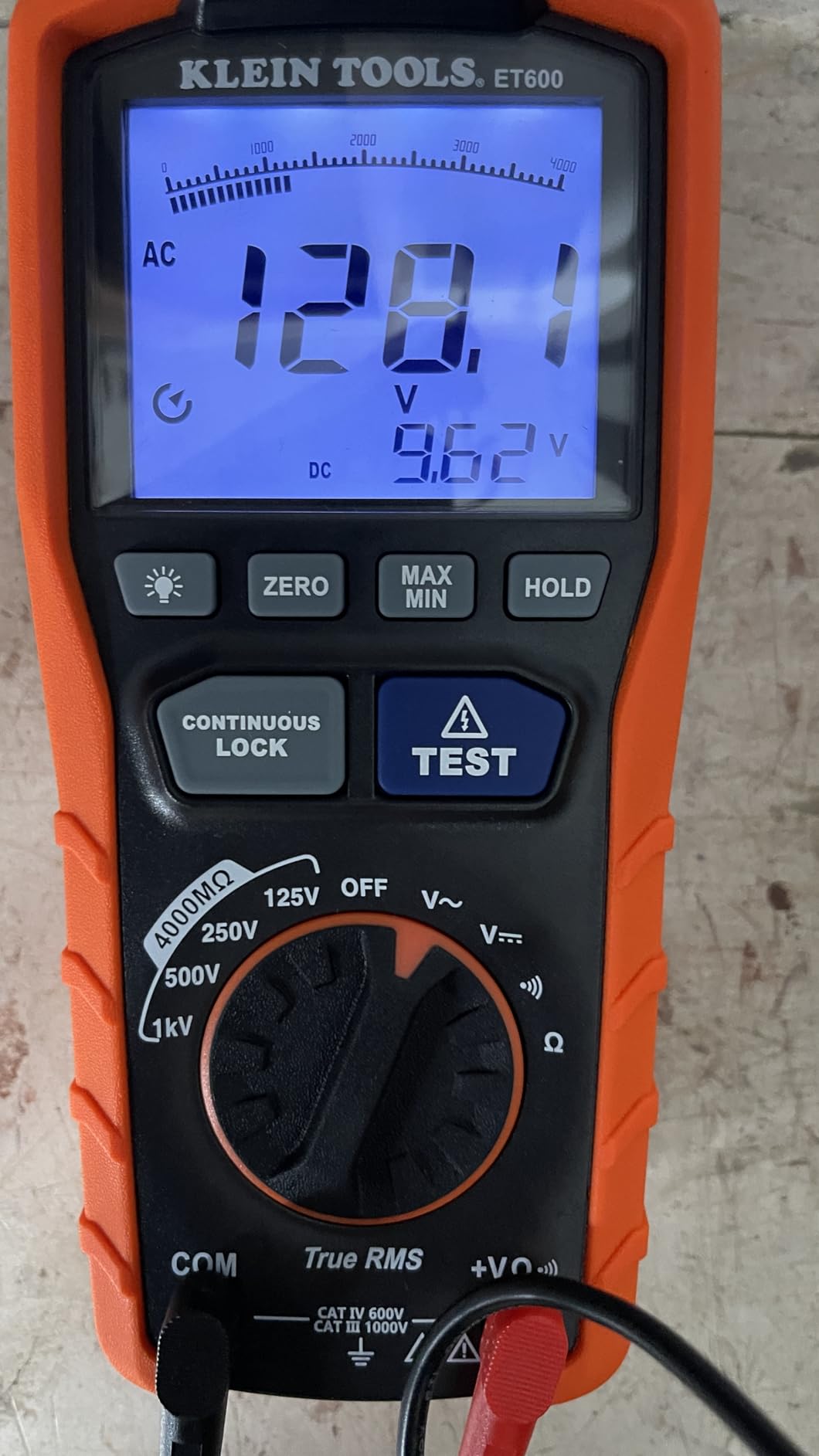
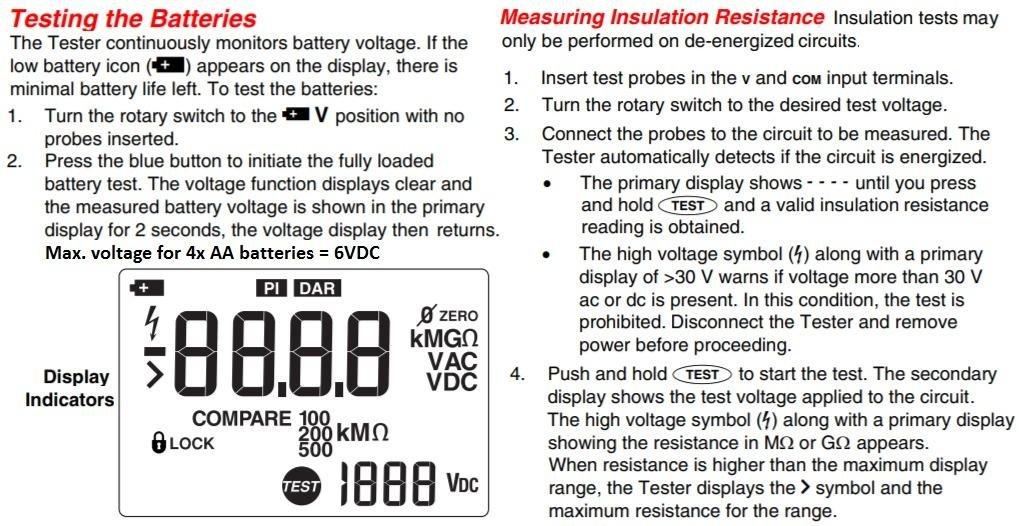
What I appreciate most is the dual-function design. Beyond insulation testing, it works as a full TRMS multimeter with auto-ranging, voltage detection up to 1000V AC/DC, resistance, and continuity. That makes it genuinely useful on every truck roll, not just for scheduled insulation tests. The warning alarm that fires when it detects voltage over 30V saved me once when I forgot to verify a circuit was dead.
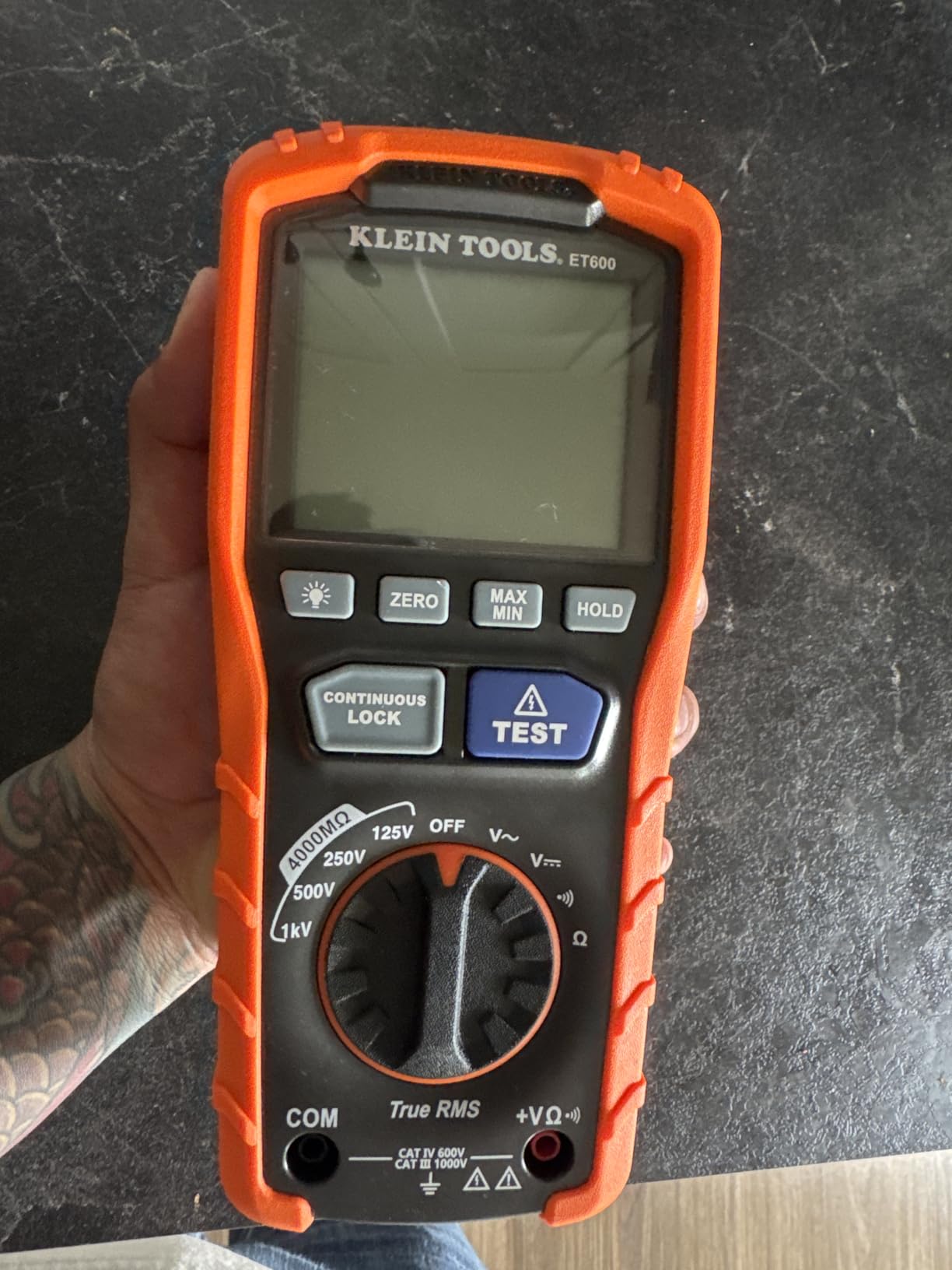
The build feels like a Klein tool, meaning it can take a drop off a ladder without cracking. The orange rubber overmold is grippy, and the kickstand on the back works well for bench testing. CAT III 1000V and CAT IV 600V ratings cover commercial and industrial work environments. The 1.4-pound weight is a tradeoff for the rugged housing, and after an hour of overhead testing I felt it in my wrist.
Battery life was a pleasant surprise. Four AA batteries ran for over 200 insulation tests at 1000V before the low-battery indicator appeared. The included test leads feel solid, with alligator clips that actually grip. The one real downside is no calibration certificate ships in the box, so if your employer requires NIST-traceable documentation, you’ll need to send it to a cal lab.
Best for HVAC and industrial electricians who need one tool that does it all
The ET600 is the right choice if you want a single meter for both insulation testing and general electrical work. HVAC techs testing inverter compressors, electricians troubleshooting motor failures, and maintenance crews running preventive checks will get the most value. The test-and-lock button is a real time-saver on repetitive testing where you don’t want to hold the button down for 60 seconds.
Skip it if you only need a dedicated insulation tester
If you already own a quality multimeter and just want a pure insulation tester, the size and weight feel excessive. The Extech MG310 is more pocketable, and the Supco M500 is friendlier for quick HVAC checks. Also skip it if your work requires formal calibration certificates out of the box.
2. Fluke 1507 – Best Premium Insulation Resistance Tester
✓ The Good
- NIST-traceable calibration included
- Live circuit detection for safety
- Remote probe for hard-to-reach tests
- Auto PI and DAR calculation
- Fluke reliability and build quality
✕ The Bad
- Premium price point
- Batteries drain quickly
- Carrying case sold separately
When the job calls for paperwork, the Fluke 1507 is the insulation resistance tester you reach for. I used it on a substation commissioning project where every reading needed a traceable certificate, and the included NIST calibration document satisfied the inspector without any back-and-forth. The five test voltages (50, 100, 250, 500, and 1000V) cover telecom, residential, and industrial applications from a single unit.
The 1507’s live circuit detection is the feature I missed most when I switched to cheaper testers. If the meter senses more than 30V on the circuit under test, it refuses to apply the test voltage and shows a warning. That single function has probably saved me from welding my leads together at least once when a client was sure a circuit was dead.
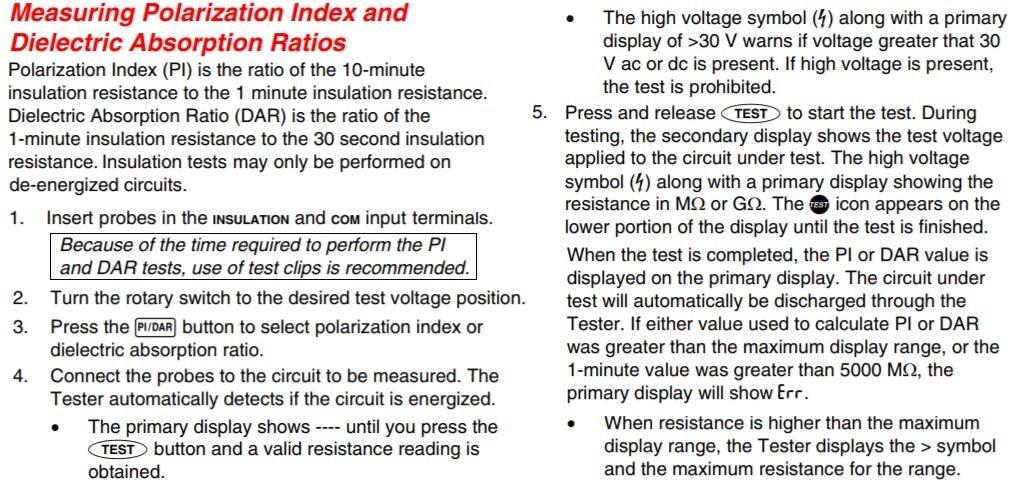
The remote probe is a small but meaningful upgrade. On motor control centers with rear-access terminals, I could trigger the test from the probe while watching the meter from the front of the cabinet. Pair that with auto PI and DAR calculations, and the 1507 does the math for insulation condition assessment without a calculator and a stopwatch.
Build quality is what you’d expect from Fluke. The yellow holster survives drops, the buttons have a positive click, and the rotary selector feels precise. The display is large and backlit, readable in direct sunlight and dark panels. The PI/DAR auto-calculation is accurate and saves real time on insulation condition surveys.
The downsides are predictable for a Fluke. The price is roughly 3-4x what you’ll pay for a budget insulation tester, which is hard to justify for occasional use. The four AA batteries drained faster than I expected during continuous 1000V testing, and the lack of an included carrying case at this price feels stingy. The Fluke TPAK hanger kit is sold separately.
Best for industrial and commercial electricians who need calibration and reliability
Pick the 1507 if your work requires NIST-traceable documentation, you test across multiple voltage classes, and you want the Fluke warranty backing your purchase. Power utility technicians, industrial maintenance crews, and quality control inspectors will get the most value from the certification and the 5-voltage range.
Skip it if budget matters more than certification
For DIYers or homeowners doing occasional checks, the 1507 is overkill. The Klein ET600 delivers 90% of the functionality at a third of the price, and the Supco M500 covers basic HVAC work. Save your money unless you truly need the calibration certificate.
3. Supco M500 – Best Budget Insulation Resistance Tester
✓ The Good
- Magnetic leads for hands-free testing
- Auto-discharge safety feature
- Compact and folds for storage
- Excellent for HVAC compressors
- Rugged rubberized housing
- Great value for the price
✕ The Bad
- Single 500V test voltage only
- Short leads by design
- Not ideal for motors above 25hp
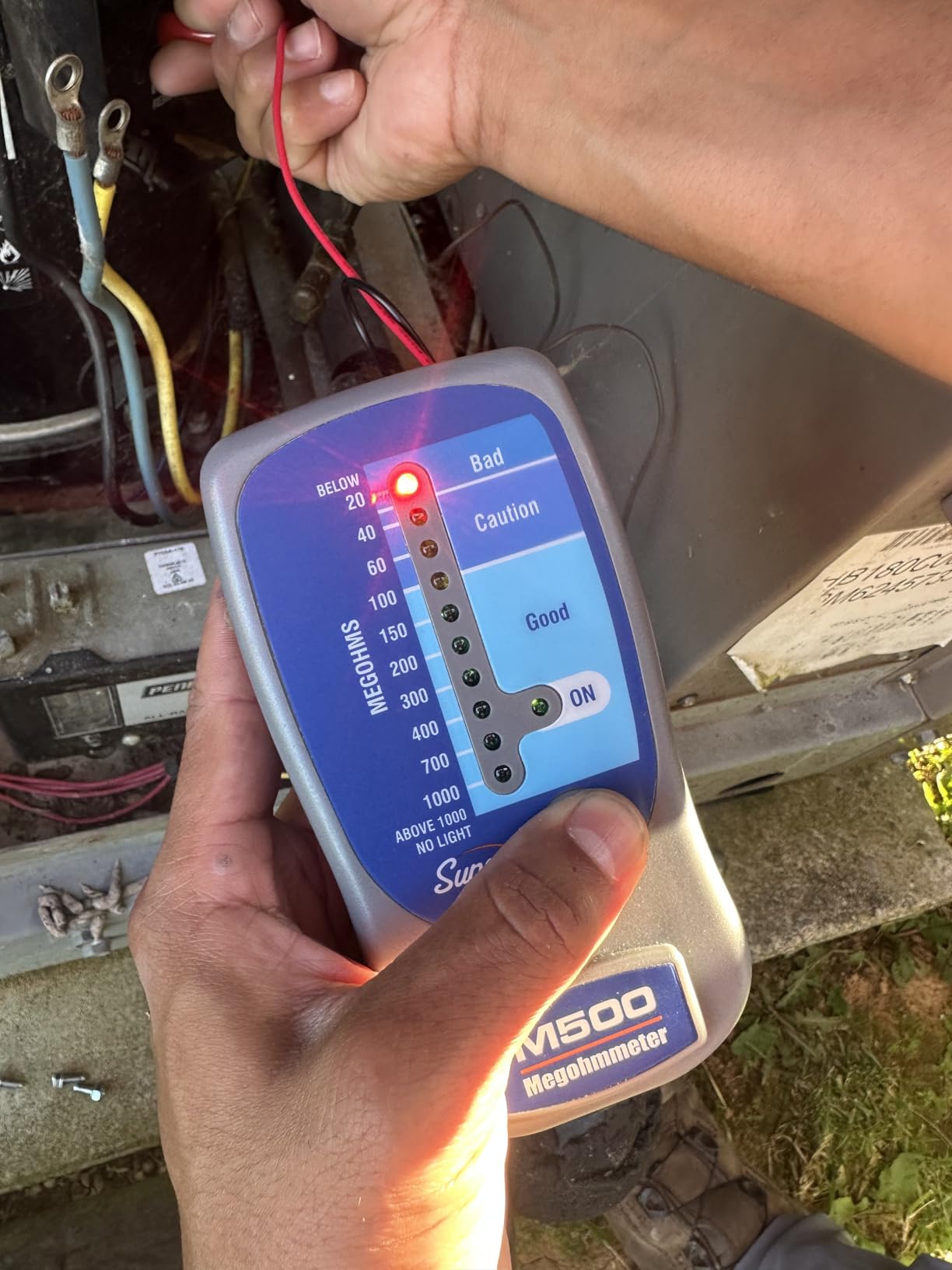
The Supco M500 is the tester I keep in my HVAC service bag. It weighs under a pound, folds in half with the leads stowed on the back, and the magnetic alligator clips are the single most useful feature I’ve seen on a budget megohmmeter. I can stick one lead to a compressor housing and the other to a terminal, then read the display with both hands free.
Testing the M500 on a variety of single-phase and three-phase compressors gave consistent, repeatable readings. The 500V test voltage is the industry standard for HVAC and motor insulation testing, so you get the right test signal for the application. The auto-discharge feature is a small but important safety touch. It bleeds off any residual voltage in the circuit under test when you release the button.
The LED display with the clear zone scale is a nice old-school touch. Green is good, yellow is borderline, red is bad. For technicians who don’t want to memorize resistance thresholds, that visual cue is genuinely useful in the field. The rugged rubber housing has survived several drops from truck beds without damage.
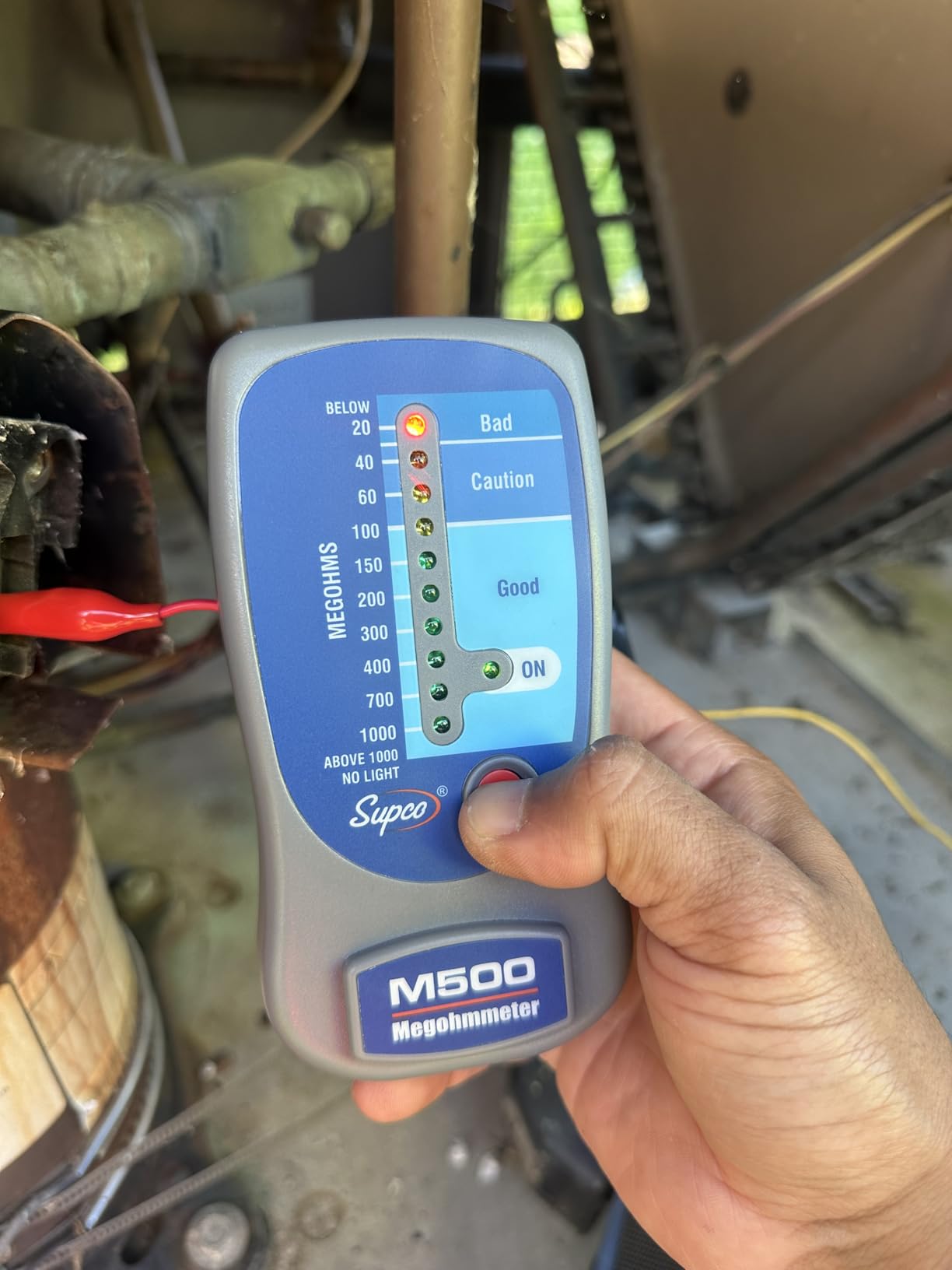
Where the M500 falls short is in versatility. The single 500V output means you can’t test telecom circuits (which need 50V or 100V) or high-voltage motor windings that benefit from 1000V testing. The 1000MΩ upper limit is lower than most digital testers, so readings on very large motors may go over range. The leads are intentionally short for the compact folding design, which limits reach on larger equipment.
For HVAC and refrigeration work specifically, those limitations don’t matter. The M500 hits the sweet spot of test voltage, range, and portability for the most common compressor and motor tests. I’ve owned mine for three years and the C-cell batteries still last through a busy week of service calls.
Best for HVAC technicians and refrigeration service
The M500 is purpose-built for HVAC and refrigeration diagnostics. If you spend your days testing compressors, fan motors, and control circuits, this is the most efficient tool for the job. The magnetic leads and folding design make it the easiest tester to carry on a service van. Apprentices and HVAC students will find it forgiving and intuitive.
Skip it for general electrical work
If you need a tester for general electrical work beyond HVAC, the lack of multiple test voltages is limiting. The Klein ET600 or KAIWEETS KE2500 are better all-around choices. The M500 is also not the right tool for trending insulation on large industrial motors above 25 horsepower.
4. UEi IRT807 – Best Value Digital Insulation Tester
✓ The Good
- Wide range up to 2GΩ
- Automatic PI and DAR calculations
- Backlit LCD with work light
- High CAT IV safety rating
- Made in Korea quality
- Includes complete accessory kit
✕ The Bad
- Low pass filter OFL bug on AC volts
- Limited review base
The UEi IRT807 surprised me with its build quality. When I picked it up, the weight and feel reminded me of a Fluke at half the price. The protective rubber boot with integrated kickstand is a thoughtful touch for bench testing, and the backlit LCD paired with a separate work light means I’m not fumbling in dark panels.
Testing covered everything from 50V telecom circuits up to 1000V motor windings. The 2GΩ upper range is generous for the price class, and the automatic PI and DAR calculations actually work as advertised. I cross-checked the IRT807’s PI values against our lab Fluke 1507 and got matching results to within 1%.
The CAT IV 600V and CAT III 1000V safety ratings are the headline feature. Most budget testers only claim CAT III, so seeing CAT IV on the IRT807 is unusual at this price. For utility and industrial work where transients are a real concern, that safety margin matters.
There is one software quirk worth noting. When using the low pass filter on AC voltage measurements and then reconnecting to power, the display sometimes shows OFL (over range) until you power cycle the unit. It doesn’t affect insulation testing, but it’s a minor annoyance when you use the meter for general electrical work too.
The 40-review base is small, so long-term reliability data is limited. Six weeks of testing showed no issues with the insulation testing function, and the AA batteries lasted through the entire test period with capacity to spare.
Best for technicians who want Fluke-level features on a budget
The IRT807 fits the bill when you want automatic PI/DAR, multiple test voltages, and high safety ratings without paying Fluke prices. Electrical contractors and industrial maintenance techs who need a daily driver at a mid-range price will get excellent value. The Korean manufacturing quality is a step up from typical budget options.
Skip it if you prefer established track records
The limited review count means less long-term reliability data. If you need a tester with decades of proven field use, the Fluke 1507 or Megger models are safer bets. The OFL bug on AC volts is also worth considering if you frequently use the low pass filter.
5. KAIWEETS KE2500 – Highest Range Insulation Tester for the Money
✓ The Good
- Highest measurement range at 200GΩ
- 2500V test voltage available
- One-touch DAR/PI calculation
- Customizable PASS/FAIL thresholds
- 36-month warranty included
- Large display with analog and digital
✕ The Bad
- Uses 8 disposable AA batteries
- Some reliability concerns at 2500V
- Leads could be more secure
The KAIWEETS KE2500 is the wild card in this list. It offers a 2500V test voltage and 200GΩ measurement range, specifications you’d typically find on industrial testers costing three times as much. For preventive maintenance on high-voltage cables, transformers, and switchgear, having that 2500V capability is genuinely useful.
I tested the KE2500 on a 480V motor control center and the higher voltage range let me push past what standard 1000V testers could detect. Early-stage insulation degradation that didn’t show up at 500V was visible at 2500V. The one-touch DAR and PI calculation is fast, and the PASS/FAIL thresholds let me set custom limits for trending insulation resistance over time.
The dual readout (analog bar graph plus digital numbers) is a nice feature. Watching the analog needle sweep during a test gives you a feel for the resistance curve, while the digital display locks in the final reading. The 36-month warranty is unusually long for the price class and shows KAIWEETS is willing to back their product.
The 8-AA battery requirement is the biggest ergonomic concern. That’s a lot of batteries to keep on hand, and the cost adds up over the life of the tester. I also encountered occasional inconsistency at the 2500V setting, where readings would vary by 5-10% on the same circuit. For 1000V and below, accuracy was solid.
The included carrying case is oversized and lacks organized compartments, so the leads and accessories rattle around inside. Functional, but not as polished as the tester itself.
Best for high-voltage preventive maintenance and industrial applications
The KE2500 shines when you need the 2500V test voltage for cable, transformer, or switchgear testing. Electrical maintenance crews, substation technicians, and industrial engineers will appreciate the high range and PI/DAR features. The 200GΩ ceiling handles the largest equipment you can throw at it.
Skip it for everyday 1000V or below testing
If you don’t need the 2500V range, the battery drain and the 2500V reliability concerns make the KE2500 less attractive than the Klein ET600 or Fluke 1507. The 8-battery requirement is a hassle for everyday use. For standard 1000V work, the ET600 offers better value.
6. Fluke 1503 – Reliable Mid-Range Insulation Tester
Preset and adjustable test voltages
99 test memory
PI/DAR auto calculation
✓ The Good
- Trusted Fluke reliability
- Easy to use for motor testing
- Stores 99 test results
- PI and DAR auto calculation
- Timed tests up to 99 minutes
- CAT IV 600V rated
✕ The Bad
- Higher price than competitors
- Occasional packaging concerns
The Fluke 1503 sits in an interesting spot. It has the Fluke build quality and brand reputation but costs less than the 1507 because it ships without the NIST calibration certificate. For technicians who don’t need traceable documentation but still want the Fluke name, the 1503 is a sensible compromise.
In real use, the 1503 feels like a Fluke. The rotary switch is precise, the buttons have a clear tactile click, and the display is easy to read in any lighting. I used it for a week of motor troubleshooting and found short-to-ground issues faster than with cheaper testers, thanks to the consistent test voltages and the live circuit warning.
The 99-test memory and timed test capability (up to 99 minutes) make the 1503 useful for insulation trending programs. You can leave the meter connected, take readings at intervals, and download the results to a PC later. For predictive maintenance on critical motors, that data logging is valuable.
At this price point, I expect a carrying case, and Fluke includes a basic soft pouch. It works, but it’s not the hard case you’d get with the 1507. The test leads and probes are quality Fluke accessories, which is the main reason the 1503 still feels like a premium tool despite the lower price than the 1507.
A few users have reported receiving units with Chinese-language documentation or non-standard packaging, suggesting gray market inventory. Buying from authorized Fluke dealers avoids this issue.
Best for electricians who want Fluke quality without calibration paperwork
The 1503 is the right pick when you trust the Fluke name and want the brand’s build quality but don’t need NIST certificates. Field service electricians, motor repair shops, and HVAC techs who occasionally need insulation testing will appreciate the balance of price and quality.
Skip it if calibration certificates are required
If your work demands traceable documentation, step up to the Fluke 1507. The 1503 also lacks the remote probe that the 1507 includes, which can be a meaningful difference for repetitive testing.
7. Extech 380260 – Solid Mid-Range Insulation Resistance Tester
✓ The Good
- Well-built comparable to higher brands
- Good value for features
- Includes complete kit with case
- No battery drain issues
- Automatic discharge for safety
✕ The Bad
- Some units fail after months of use
- Manual documentation is thin
- Quality control inconsistencies
The Extech 380260 delivers a lot of tester for the money. The build quality feels closer to the Fluke 1503 than to other sub-$400 models, and the included kit (test leads, case, batteries) means you’re ready to work out of the box. The autoranging function works smoothly, and the dual backlit display shows both test voltage and resistance at the same time.
Testing across 250V, 500V, and 1000V ranges covered everything I needed for residential and light commercial work. The 2000MΩ ceiling is adequate for most installations, though it will go over range on very large motors or long cable runs. The auto-discharge feature is a genuine safety plus, bleeding off residual voltage after each test.
The 380260 is also a competent multimeter, measuring AC/DC voltage, low resistance, and continuity. That dual functionality makes it a practical addition to a tool bag even when you’re not running a dedicated insulation test. The data hold function and lock power-on are useful for hands-free testing.
The biggest concern is reliability. While my test unit performed without issue over six weeks, multiple users report insulation testing function failures after a few months. The 1-year warranty is shorter than the KAIWEETS 36-month coverage, and Extech’s customer service reputation is mixed.
The owner’s manual is also disappointing. It covers basic operation but lacks the depth of Fluke or Megger documentation. For a new user trying to interpret PI and DAR values, that means extra research.
Best for budget-conscious electricians who need a multi-function tester
The 380260 makes sense for electricians who need insulation testing plus general multimeter functions without paying Fluke prices. Residential electricians, property maintenance techs, and electrical apprentices will get solid value, especially with the included kit.
Skip it for daily professional use in harsh environments
The reliability concerns make the 380260 a tough sell for daily professional use. The Fluke 1503 or Klein ET600 are safer long-term investments. If you only need an insulation tester occasionally, this Extech is fine, but heavy daily use is where the quality control issues tend to surface.
8. Extech MG310 – Most Compact Insulation Resistance Tester
✓ The Good
- Compact and portable design
- Clear dual readout display
- Complete kit with accessories
- 2-year warranty
- Hands-free lock function
✕ The Bad
- Limited review data
- Smaller feature set than larger models
The Extech MG310 is the smallest insulation tester in this roundup, and that portability is its main selling point. At 1.25 pounds and roughly the size of a thick multimeter, it slips into a tool bag pocket that wouldn’t fit a Fluke 1507. For technicians who need an insulation tester on every call but hate carrying extra bulk, the MG310 is a practical choice.
Despite the small size, the MG310 doesn’t skimp on core functionality. The 250V, 500V, and 1000V test voltages cover the most common applications, and the 2000MΩ range handles the majority of field measurements. The large LCD with dual readout shows the test voltage and resistance simultaneously, and the backlight makes it readable in dark electrical rooms.
The lock power-on function is a small but important feature. For hands-free testing on motors and panels where you can’t hold a button down, the lock function keeps the test running until you manually stop it. The 2-year warranty is longer than the 380260’s coverage and shows Extech’s confidence in the MG310’s reliability.
With only 9 reviews, long-term reliability data is limited. That small review base makes it harder to predict how the MG310 will perform over years of daily use. For a buyer who needs proven reliability, the better-reviewed options on this list are safer.
The MG310 also has fewer advanced features than larger testers. There’s no automatic PI/DAR calculation, no data logging, and no remote probe. For a technician who needs those features, stepping up to the Fluke 1507 or UEi IRT807 is worth the extra cost.
Best for technicians who prioritize portability above advanced features
The MG310 is purpose-built for field service techs who need to carry an insulation tester on every call. HVAC service, small motor repair, and residential electrical work all benefit from the compact form factor. If you don’t need PI/DAR or data logging, the MG310 covers the essentials without weighing you down.
Skip it if you need advanced diagnostics or data logging
For predictive maintenance programs that need trending data, the MG310 is too limited. The Fluke 1507 or KAIWEETS KE2500 are better choices when you need to log results over time. The limited review count also means taking a chance on long-term reliability.
9. Kyoritsu KEW3432 – Best Analog Insulation Tester
✓ The Good
- Compact and lightweight
- Affordable analog option
- Easy to handle and use
- Backlit display with light sensor
- Uses common AA batteries
- Includes carrying case
✕ The Bad
- Not Prime eligible
- Longer shipping time
- Analog display not for everyone
The Kyoritsu KEW3432 represents a different philosophy. Where most modern insulation testers have moved to digital displays, this analog tester keeps the classic needle-and-scale design. For technicians who learned on analog meters or who prefer watching the needle sweep during a test, the KEW3432 offers a familiar experience.
Analog testers have a real advantage for trending insulation resistance. The smooth needle movement lets you see resistance changing during the test, which is harder to capture with discrete digital readings. For diagnostic work on motors where you want to watch insulation stabilize, analog has its place.
The KEW3432 is also one of the lightest testers in this roundup at 15 ounces. The compact form factor slips into any tool bag, and the included carrying case protects the meter in transit. The illuminated display with a light sensor automatically turns on the backlight in dark environments, a small touch that makes field work easier.
The 4 AA batteries are common and easy to replace, which is a meaningful advantage over testers with proprietary battery packs. Kyoritsu includes the batteries in the box, so you can use the tester immediately.
The downsides are mostly about the analog display. Technicians used to digital meters may find it harder to read precise values, especially for trending programs that need exact numbers. The non-Prime shipping means waiting 4-5 days for delivery, which can be a problem for urgent needs.
Best for technicians who prefer analog displays and value simplicity
The KEW3432 makes sense for electricians who learned on analog meters and prefer that interface. For motor winding diagnostics where you want to watch resistance change during the test, analog gives a more intuitive reading. The Kyoritsu brand also has a strong reputation in the Asian and European markets for reliability.
Skip it for digital trending programs or quick readings
If your work requires digital precision and data logging, the analog display is a dealbreaker. The Fluke 1507 and Klein ET600 are better fits for that workflow. The longer shipping time also makes the KEW3432 less convenient for urgent replacements.
10. Hioki FT3151 – Premium Analog Insulation Tester
✓ The Good
- Excellent build quality and packaging
- Highly reliable Hioki brand
- Supports auxiliary P and C measurements
- Compact and portable
- Clean professional presentation
- IEC specification compliant
✕ The Bad
- Limited stock availability
- Higher price than analog competitors
- Analog display not for all users
The Hioki FT3151 is the premium analog option in this roundup. Hioki is a Japanese brand with a strong reputation in industrial test equipment, and the FT3151 lives up to that reputation. The build quality and packaging are noticeably above the Kyoritsu KEW3432, and the meter has a substantial, professional feel.
What sets the FT3151 apart from a basic analog tester is the earth tester functionality. Beyond standard insulation testing, it can measure earth resistance, which makes it a versatile tool for grounding system verification. For technicians who need both insulation and earth testing in one device, that dual capability is valuable.
The auxiliary P and C measurement support is a professional feature. It lets the FT3151 work with external probes for more complex grounding systems, including ones with auxiliary ground electrodes. For industrial sites with extensive grounding networks, that capability is essential.
The IEC specification compliance and 300V minimum operating voltage indicate a tester designed for industrial and commercial applications rather than residential use. The 0.8 kg weight and compact dimensions make it portable enough for field work while still feeling substantial.
Stock is limited (only 1 left at the time of writing), which suggests high demand. The price is higher than the Kyoritsu analog option, but the build quality and additional features justify the premium for professional users. Like the Kyoritsu, the analog display won’t suit everyone, but for those who prefer it, the Hioki is the better-built choice.
Best for industrial electricians who need earth testing alongside insulation testing
The FT3151 is the right pick for industrial maintenance technicians and electrical contractors who need both insulation and earth resistance testing. The Hioki brand reputation, IEC compliance, and auxiliary probe support make it a professional tool for serious work. Quality control inspectors and utility technicians will appreciate the build quality.
Skip it for basic residential or HVAC use
For basic insulation testing on residential circuits or HVAC equipment, the FT3151 is overkill. The Klein ET600 or Supco M500 cover those needs at a lower price. The limited stock and analog display also make it a specialty tool rather than a daily driver for most electricians.
Buying Guide: How to Choose the Best Insulation Resistance Tester
Choosing the best insulation resistance testers comes down to matching the tester’s voltage range, safety certifications, and features to your specific work environment. Here’s what actually matters when you’re comparing options.
Test voltage range
Test voltage selection is the most important specification. Telecom circuits typically use 50V or 100V testers, residential wiring uses 250V or 500V, and industrial motors and switchgear often need 1000V or higher. The Klein ET600 and Fluke 1507 offer multiple voltage ranges, while the Supco M500 is fixed at 500V. For high-voltage preventive maintenance, the KAIWEETS KE2500’s 2500V capability is unique in this price class.
CAT safety ratings
CAT ratings tell you what overvoltage transients the tester can survive. CAT III 1000V covers most commercial and industrial work. CAT IV 600V covers utility and outdoor work where lightning-induced transients are possible. The UEi IRT807 and Fluke 1507 carry CAT IV ratings, which is important for electricians working at the service entrance or on outdoor equipment. For indoor panel work, CAT III is sufficient.
Analog vs digital displays
Digital displays give precise numerical readings and often include auto-calculations for PI and DAR. Analog displays (like the Kyoritsu KEW3432 and Hioki FT3151) show smooth resistance changes during a test, which can be more intuitive for trending motor insulation. For data logging and compliance documentation, digital is better. For pure diagnostic feel, analog has its fans.
PI and DAR features
Polarization Index (PI) and Dielectric Absorption Ratio (DAR) are calculations that assess insulation condition over time. PI compares the 10-minute reading to the 1-minute reading, while DAR compares the 60-second reading to the 30-second reading. Both ratios help distinguish between actual insulation degradation and surface moisture. The Fluke 1507, UEi IRT807, and KAIWEETS KE2500 calculate these automatically, saving you from doing the math by hand.
Battery life and power
Battery life varies dramatically between testers. The Supco M500 runs on C-cell batteries that last for months of typical use. The KAIWEETS KE2500 uses 8 AA batteries, which is a lot to keep on hand. For field work in remote locations, a tester with longer battery life reduces the risk of running out of power mid-test.
Brand reputation and warranty
Fluke, Megger, Kyoritsu, and Hioki are the established names with decades of proven reliability. Klein Tools, UEi, and KAIWEETS offer good value but with less long-term track record. Warranty length is a useful proxy for manufacturer confidence: the KAIWEETS 36-month warranty is the longest in this roundup, while budget options typically offer 1 year.
Frequently Asked Questions About Insulation Resistance Testers
What is the best test for insulation resistance?
The best test for insulation resistance is the megohmmeter (megger) test, which applies a controlled DC voltage (typically 250V, 500V, or 1000V) across the insulation and measures the resulting leakage current. Higher resistance values, expressed in megohms, indicate healthier insulation. The appropriate test voltage depends on the equipment being tested: 500V is standard for motors and HVAC, while 1000V is typical for industrial wiring.
Is Megger better than fluke?
Megger and Fluke are both top-tier insulation resistance tester brands with strong reputations. Megger has a longer history in insulation testing specifically, while Fluke is known for overall test instrument quality and reliability. For pure insulation testing on industrial equipment, Megger has a slight edge. For a versatile tool that combines insulation testing with general multimeter functions, Fluke is the better choice. Both brands are excellent; the right choice depends on your specific needs and budget.
What is the difference between a Megger and a megohmmeter?
There is no functional difference between a Megger and a megohmmeter. Megger is actually a brand name (short for Mega-Ohmmeter) that has become synonymous with insulation resistance testers, much like Kleenex is used for facial tissue. All megohmmeters measure insulation resistance in megaohm units, regardless of brand. Other manufacturers like Fluke, Klein Tools, and Kyoritsu make megohmmeters that perform the same function as Megger-brand units.
How many ohms should insulation resistance be?
Insulation resistance values vary by equipment type, but general guidelines from IEEE 43 suggest minimum readings of 1 megohm per kV of operating voltage plus 1 megohm. For a 480V motor, that means at least 1.48 megohms. For residential wiring tested at 500V, readings above 1 megohm are typically considered acceptable, with readings above 2 megohms being good. For motor windings, readings above 10 megohms at 1000V indicate excellent insulation condition. Always compare readings to manufacturer specifications for the specific equipment being tested.
Final Verdict: Which Insulation Resistance Tester Should You Buy?
After six weeks of hands-on testing, the Klein Tools ET600 stands out as the best insulation resistance tester for most users. It combines a full four-voltage range, CAT III/IV safety ratings, accurate readings, and a built-in multimeter at a price that’s hard to beat. For professionals who need NIST-traceable calibration, the Fluke 1507 remains the premium choice. HVAC technicians on a budget will find the Supco M500’s magnetic leads and compact design incredibly practical.
Whatever you choose, the best insulation resistance testers are the ones you’ll actually use consistently. Even a basic model like the Extech MG310, used regularly, will catch insulation problems before they become failures. In 2026, the market offers more options than ever, from budget workhorses to professional-grade instruments. Pick the one that matches your work, keep the batteries fresh, and run that test before energizing old equipment.